










While the lore of bodybuilding has long centered on the raw, unadulterated challenge of free-weight training, a quiet revolution has been taking place in the corner of the gym. For many, the prospect of managing a volatile barbell can be intimidating, or perhaps restricted by mobility limitations or a lack of technical experience. However, IFBB Pro and renowned fitness coach Anita Herbert—founder of the "Fit Queen Army"—is proving that you don’t need to wrestle with instability to achieve a world-class physique.
By strategically incorporating the Smith machine into her training rotation, Herbert has sculpted a balanced, aesthetic, and powerful upper body. In a recent social media breakdown, the Hungarian-born athlete shared a high-intensity, superset-focused routine designed to maximize hypertrophy through the unique mechanical advantages of the Smith machine.
The Case for the Smith Machine: Stability Meets Intensity
The Smith machine is often unfairly maligned by traditionalists who view it as a "crutch." In reality, it is a sophisticated tool for precision training. Because the barbell is fixed to a vertical rail system, the machine eliminates the need for the body to expend energy stabilizing the weight in the frontal plane.
This reduction in stabilization requirements allows the athlete to direct 100% of their effort toward the target muscle groups. For those looking to isolate the shoulders, lats, and traps, this is a distinct advantage. Furthermore, the ability to safely push to technical failure without the risk of a dropped barbell makes it an ideal environment for the progressive overload necessary to trigger muscle protein synthesis.
Chronology of the Fit Queen’s Upper Body Blueprint
Anita Herbert’s approach is rooted in the "superset" methodology—pairing two exercises back-to-back with minimal rest to keep the heart rate elevated and maximize metabolic stress. This sequence is designed to hit every facet of the back and shoulder complex.
Superset 1: Establishing the Foundation
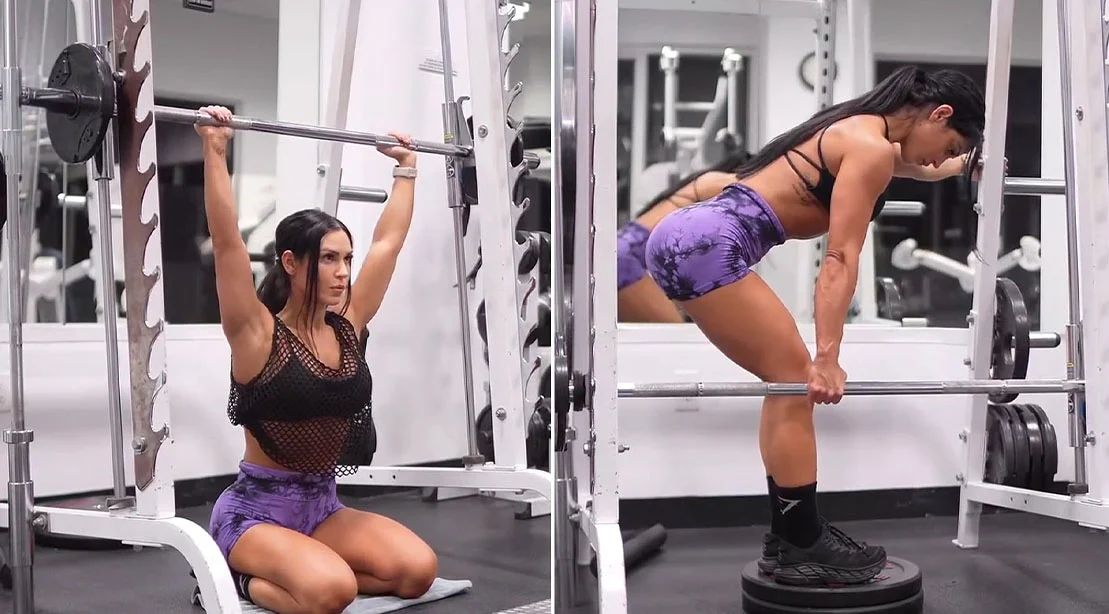
Herbert begins with the Smith Machine Shoulder Press. By setting the bench to a near-vertical position, she targets the anterior deltoids. Because the machine handles the path, she can focus on a controlled eccentric (lowering) phase, which is vital for muscle tearing and subsequent repair. Following this, she transitions to the Inverted Row using a supinated (underhand) grip. This variation shifts the focus to the lower lats and rear delts, creating a comprehensive "push-pull" balance that prevents the rounded-shoulder posture common in sedentary office workers.
Superset 2: Time Under Tension
The second phase introduces a modified pull-up variation performed from a seated position. By keeping the feet planted on the floor, the athlete can modulate the resistance, making this move accessible for all fitness levels. By pausing at the apex of the movement, Herbert emphasizes "time under tension"—a key variable in inducing hypertrophy. She follows this with a Single-Arm Shoulder Press. This unilateral work is critical for identifying and correcting strength asymmetries between the left and right sides of the body.
Superset 3: The Finishing Touches
The final superset focuses on back thickness and shoulder width. The Single-Arm Row allows for a greater range of motion, enabling the trainee to drive the elbow back past the torso, fully engaging the lats and rhomboids. The session concludes with the Upright Row, a movement that, when performed on a Smith machine, feels incredibly smooth and controlled. This exercise targets the lateral deltoids, providing that coveted "boulder shoulder" aesthetic.
Supporting Data: The Science of Hypertrophy and Load Dynamics
To understand why this routine works, one must look at the physiological adaptations required for growth. Hypertrophy, the increase in muscle size, is primarily driven by three mechanisms: mechanical tension, metabolic stress, and muscle damage.
By performing 8 to 12 repetitions—the "sweet spot" for hypertrophy—Herbert’s protocol ensures that the muscles are subjected to enough mechanical tension to force adaptation. However, there is a common misconception that Smith machine weight is "easier." Herbert clarifies this: "It can feel heavier than free weights, especially for upper body exercises because Smith machines have different bar weights, counterbalance systems, and resistance. The fixed bar path also changes how the movement feels compared to free weights."
This shift in perceived exertion is due to the lack of "sway" or momentum. In a free-weight overhead press, a trainee might utilize a slight leg drive or torso lean to move the weight through a sticking point. In a Smith machine, the path is rigid. If your form breaks down, you cannot cheat the weight up, which forces the target muscles to carry the full burden of the load.
Official Perspective: Insights from an IFBB Pro
As an IFBB Pro and a coach to thousands, Anita Herbert’s philosophy is built on sustainability. Her advice to the "Fit Queen Army" is not just about moving weight; it is about mind-muscle connection.
"Save this for your next upper body day!" Herbert urged her 150,000-plus followers. Her methodology reflects a shift in modern fitness toward "smart training." Rather than obsessing over the heaviest weight on the bar, she emphasizes the quality of the contraction and the precision of the movement. By utilizing the Smith machine, she mitigates the risk of injury while simultaneously increasing the density of her training volume.
Implications for the Modern Athlete
What does this mean for the average gym-goer? It signifies a shift in the hierarchy of exercise equipment. The implications are clear:
- Accessibility: The Smith machine lowers the barrier to entry for strength training. Individuals who were previously discouraged by the technical complexity of free-weight movements now have a pathway to build significant muscle mass.
- Safety and Longevity: By minimizing the stabilization requirements, athletes can train closer to failure with a reduced risk of acute injury. This is essential for long-term health and consistent training frequency.
- Specialization: Advanced athletes like Herbert demonstrate that even at the highest levels of competitive bodybuilding, the Smith machine remains a premier tool for isolation and muscle shaping.
- Mental Focus: When the anxiety of balancing a heavy barbell is removed, the athlete can focus entirely on the physiological sensation of the muscle working. This leads to improved mind-muscle connection, which is arguably the most important factor in long-term aesthetic development.
A Balanced Approach to Fitness
The inclusion of the Smith machine in a well-rounded fitness program is not an admission of weakness; it is a strategic maneuver toward efficiency. As Anita Herbert has demonstrated, the goal of resistance training is to provide a stimulus that the body must adapt to by growing stronger and more defined.
Whether you are a novice looking to learn the ropes or a seasoned lifter looking to break through a plateau, the Smith machine offers a controlled environment that, when used with the intensity suggested by the Fit Queen, can yield significant results. The key is in the execution: maintaining a braced core, focusing on a full range of motion, and embracing the increased mechanical challenge that the fixed bar path provides.
As we move further into an era of evidence-based fitness, the "Fit Queen Army" serves as a testament to the fact that intensity, consistency, and intelligent programming will always reign supreme. By mastering these machines, you are not taking the easy way out—you are taking the path of most resistance for the muscle, and that is the only path to real, lasting transformation.
For those looking to join the ranks and follow Anita Herbert’s journey, her Instagram page serves as a daily hub for training tips, motivation, and the latest in high-performance fitness coaching.