






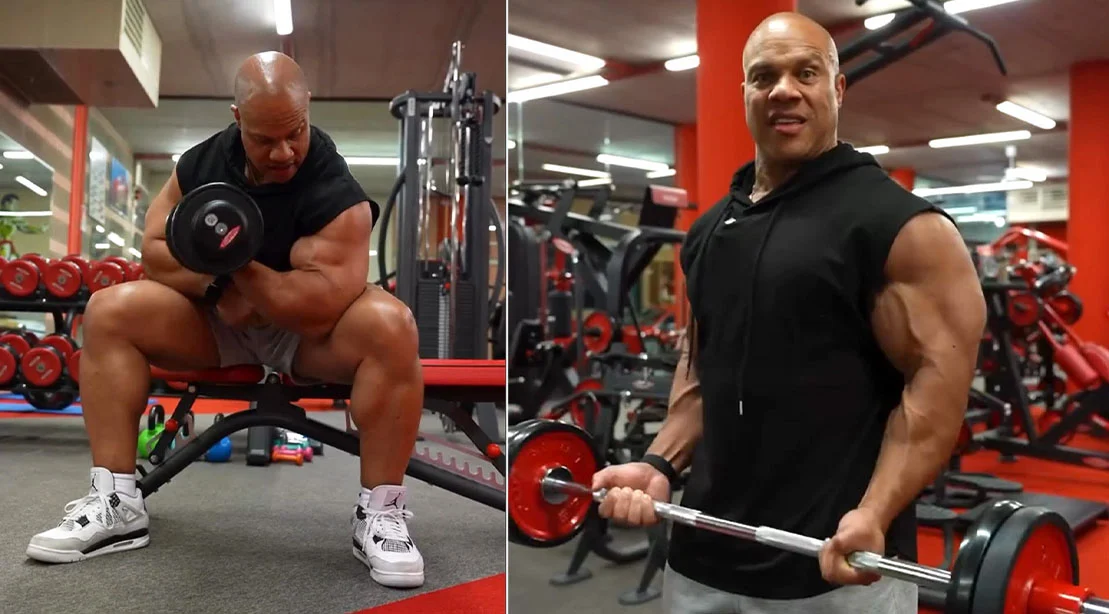
Even at 46 years of age, seven-time Mr. Olympia Phil Heath remains a titan of the iron game. While many retired bodybuilders scale back their intensity as the years roll on, Heath continues to prove that his legendary physique wasn’t built on luck, but on a relentless commitment to biomechanical precision. Known as "The Gift," Heath dominated the Olympia stage from 2011 to 2017, setting a standard for 3D muscle development that few have ever replicated.
Today, Heath is sharing the specific, high-intensity methodology that allowed him to cultivate 22-inch arms at his competitive peak. While he emphasizes that there are "no shortcuts" to achieving elite-level hypertrophy, he has distilled his complex training philosophy into a straightforward, three-move routine designed to stimulate maximum growth. This article explores the mechanics, the methodology, and the mindset behind what might be the most effective arm-building protocol in modern bodybuilding.
The Core Philosophy: Intensity Meets Precision
To understand the efficacy of Heath’s workout, one must first understand the man himself. At his zenith, Phil Heath’s arms were not just large; they were structural masterpieces. His training was never about simply moving weight from point A to point B; it was about the deliberate, calculated destruction of muscle fibers through time under tension (TUT).
Heath’s approach to arm training is centered on the principle that the biceps brachii, the brachialis, and the brachioradialis require specific angles of attack to achieve true, professional-grade fullness. He advocates for a "hard and smart" philosophy, suggesting that while the volume should be punishing, the execution must be flawless to avoid injury and ensure that the target muscle—not the surrounding stabilizers—is doing the heavy lifting.
The Three-Move Blueprint: A Chronological Breakdown
The following sequence is designed to be performed in a specific order, moving from foundational mass-builders to isolation refinement and, finally, a high-volume metabolic finisher.
1. Alternating Dumbbell Curls
The session begins with the primary mass-builder: the seated alternating dumbbell curl. By choosing a seated position, Heath effectively eliminates the possibility of using the lower back or hips to generate momentum. This forces the biceps to work in complete isolation.
- The Execution: Start with a weight that allows for 8 to 12 reps with perfect form. As you curl, focus on a controlled supination of the wrist, which maximizes the recruitment of the biceps brachii.
- The Target: This move hits the biceps, the deep-seated brachialis (which pushes the bicep up, creating that coveted peak), and the brachioradialis in the forearm.
- Rest: 90 seconds between sets to allow for sufficient ATP (adenosine triphosphate) recovery.
2. Concentration Curls
Once the biceps are pre-exhausted from the heavy dumbbell work, Heath transitions to concentration curls. If the first exercise was about raw load, this move is about refined isolation.
- The Execution: Lean forward, resting your elbow against the inner thigh. The goal is to eliminate any secondary muscle recruitment. Because the bicep is acting in near-total isolation, you will likely need to decrease the weight compared to your previous set.
- The Target: This is the "sculpting" phase. Concentration curls are widely considered the gold standard for refining the peak of the bicep, allowing the lifter to control the eccentric (lowering) portion of the lift with extreme precision.
- Rest: 90 seconds between sets.
3. The Finisher: Barbell Curl 21s
The culmination of the workout is a grueling seven-set ordeal involving the infamous "21s." This is where Heath’s background as a professional athlete truly shines, as he pushes his muscles into a state of metabolic stress that is difficult to achieve with standard rep ranges.
- The Mechanism: Each set is divided into three segments:
- Seven reps in the bottom half: From full extension to the midpoint.
- Seven reps in the top half: From the midpoint to full contraction.
- Seven reps through the full range of motion.
- The Logic: By performing 21 total reps per set, you are significantly increasing the time under tension. This forces a massive influx of blood into the muscle (the "pump") and recruits deep muscle fibers that might be missed during lower-rep training.
- Rest: Take a full two-minute break between each of the seven sets to ensure that you can maintain the intensity required to complete the final segment.
Supporting Data: Why "Time Under Tension" Works
The science of hypertrophy has long supported the methods Heath utilized throughout his seven-year reign. When training arms, the goal is to create micro-trauma within the muscle fibers. According to sports science literature, increasing the duration that a muscle is held under load—specifically through techniques like 21s—enhances metabolic stress, which is one of the three primary mechanisms of muscle growth (the others being mechanical tension and muscle damage).
Furthermore, by limiting momentum, Heath ensures that the nervous system is firing directly into the biceps. Modern EMG (electromyography) studies indicate that when lifters use "cheating" form (swinging the weight), the biceps’ activity drops by as much as 30-40% because the deltoids and back muscles take over the workload. Heath’s insistence on a seated position for his initial curls is not merely preference; it is a scientifically sound way to ensure maximum recruitment of the targeted muscle group.
Official Responses and Professional Guidance
Phil Heath has been vocal about the "Olympia mindset" when it comes to training. In recent interviews, he has emphasized that the most common mistake he sees in the gym is the sacrifice of form for ego.
"Make sure you’re doing the following," Heath concluded in his most recent training breakdown. "Training hard, training smart, and having fun, because arms day should put a smile on your face."
For those who are not yet at an elite level, Heath offers a pragmatic approach: modification. If seven sets of 21s is too daunting, he suggests starting with three or four sets and gradually increasing the volume as your work capacity improves. The critical factor is not the number on the dumbbell, but the ability to reach momentary muscular failure within the 8–12 rep range for the first two exercises.
Implications for the Modern Lifter
The implication of Heath’s routine is clear: the path to "freakish" arms is not found in complex, gimmicky equipment, but in the mastery of basic movements. By focusing on the fundamentals—the curl, the isolation, and the extended tension—any lifter can potentially see growth, provided they are willing to put in the work.
For the aging athlete, this routine also highlights the importance of longevity. By using controlled, deliberate movements, Heath is able to maintain his impressive physique at 46 without the joint degradation often associated with "ego lifting."
Key Takeaways for Your Next Arm Day:
- Prioritize Stability: Use a seated position or a preacher bench to isolate the bicep.
- Manage the Tempo: Do not rush the eccentric portion of the lift. The "lowering" phase is just as important for growth as the "lifting" phase.
- Use 21s as a Tool, Not a Crutch: The goal of 21s is to exhaust the muscle through extended tension. If your form breaks down, lighten the load on the bar.
- Consistency is King: Heath’s success wasn’t built on one workout, but on years of consistent, smart application of these principles.
As Phil Heath continues to share his knowledge, it serves as a reminder that the "Olympia level" of fitness is accessible to anyone who approaches the gym with discipline, a clear plan, and the willingness to endure the burn. Whether you are a beginner looking to add your first half-inch or an advanced trainee seeking to break through a plateau, this three-move protocol provides the architecture for growth.
To stay updated on Phil Heath’s training tips and to witness his ongoing fitness journey, you can follow him on Instagram. Remember: the goal isn’t just to work out—it’s to grow. And as The Gift has proven for nearly two decades, the right tools, combined with the right attitude, can turn even the most stubborn arms into a true display of bodybuilding excellence.