It has been nearly five years since the Taliban’s return to power in Afghanistan, a period characterized by a systematic and relentless dismantling of women’s rights. At the center of this humanitarian crisis is the regime’s prohibition on education for girls older than 12. What began as a temporary policy has hardened into a permanent state of exclusion, effectively erasing an entire generation of women from the academic and professional life of the country. Yet, in the face of this suffocating erasure, a clandestine movement has emerged. From subterranean classrooms in Kabul to digital networks spanning the nation, Afghan women are risking their lives to ensure the light of learning is not extinguished.
The Chronology of Erasure: From Classroom to Captivity
The decline of women’s rights in Afghanistan was not a singular event but a rapid, deliberate progression of legislative violence.
- August 2021: Following the withdrawal of U.S. and coalition forces, the Taliban seized control of Kabul. While initial rhetoric suggested a more moderate approach than their 1990s predecessor, the reality proved vastly different.
- September 2021: The Taliban issued a formal decree banning girls from secondary education. Initially framed as a "temporary" measure pending the creation of an "Islamic environment," the ban remained in place, eventually expanding to cover universities and public workspaces.
- 2022–2023: The Ministry of the Propagation of Virtue and Prevention of Vice (MPVPV) intensified its reach. The regime expanded restrictions on movement, dress codes, and public assembly, turning the streets into spaces of surveillance.
- 2024: The crackdown reached the formerly diverse and liberal province of Herat, where authorities began using the city as a "test case" for the most draconian enforcement of gender segregation and body-covering requirements.
The Underground Classroom: A Desperate Defiance
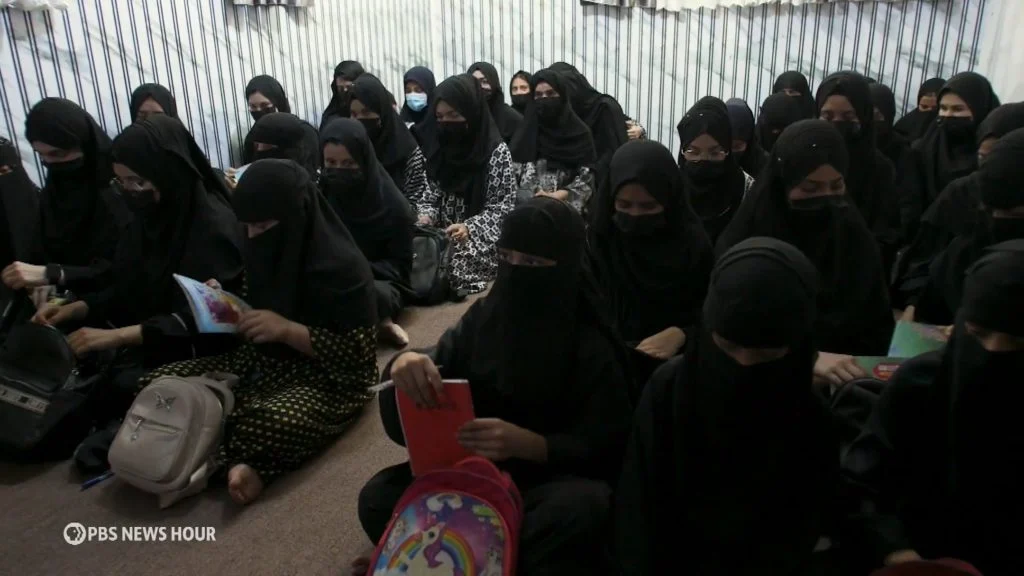
In a nondescript neighborhood in Kabul, dozens of teenage girls navigate a quiet side street before dawn. They disappear behind an unmarked door, descending a staircase into a basement shielded by heavy curtains. This is the reality of education in Taliban-controlled Afghanistan.
"From the very beginning, we unexpectedly had hundreds of students," says Farimah, the founder of one such secret school. For Farimah, the ban on girls’ education felt like a death sentence for her own professional purpose. "I suddenly felt very lost, so I decided to make this class to bring the girls together and teach them whatever I know."
The school operates entirely on word-of-mouth. There is no signage, no public enrollment, and no digital footprint that could alert the Taliban’s morality police. For students like 13-year-old Niloufar, these classes are more than an academic pursuit; they are a lifeline. "Now that we are studying here and are supported, I feel very happy and hopeful," Niloufar says. "When I finish my studies, I want to teach other girls."
For others, the isolation of the past five years has been a catalyst for severe mental health crises. Noosha, an 18-year-old student, describes the years before she found the secret school as "a very small prison." The psychological toll of being denied a future has led to a surge in depression and hopelessness among Afghan youth. "I cried every night," Noosha recalls. "But when I came to the school, I made a decision: I must study, I must succeed."
The Human Cost: Forced Marriage and Systemic Decay
The banning of education has had a catastrophic secondary effect: the resurgence of child marriage. With few prospects for a career or independent life, many families are being pressured into marrying off their daughters to significantly older men.
Maya, a teenager whose story represents the silent suffering of thousands, was in her penultimate year of high school when the regime returned. Her dreams were replaced by a forced marriage to a man she had never met. The consequences were tragic: "When you realize that you can’t reach your dreams and are forced to stay at home and have to focus on your husband, it feels like you have no control over your choices."
After suffering a miscarriage due to the physical and emotional strain of early pregnancy, Maya remains in a state of profound despair. Activists report that child marriage rates have surged even in urban centers like Kabul, where girls as young as 14 are increasingly traded as property to ensure their "protection" or financial survival.
Resistance in the Streets: The Herat Crackdown
If Kabul represents the quiet, secret resistance, Herat represents the loud, public defiance. Historically the most liberal province in Afghanistan, Herat became a target for the Taliban’s most aggressive enforcement tactics.
The "morality police" became a fixture on every corner, enforcing strict dress codes that demand women cover their hands, feet, and faces. Ms. Mubariz, an activist and founder of a secret online school that reaches 12,000 girls, explains the atmosphere: "Every day, we are seeing a new rule. About 90 percent of the rules are against women. They are just restricting us every day."
In June, when the Taliban introduced even harsher clothing mandates, the women of Herat could no longer stay silent. Protesters gathered in the streets chanting, "Education, work, freedom." The regime’s response was immediate and violent. Security forces, armed with armored vehicles, opened fire on the demonstrators.
Dima, one of the protesters, recalls the terror of that day: "When we reached the university entrance, the Taliban forces attacked us with their guns. It was a terrifying experience. In that moment, we felt we might lose our lives." The crackdown did not end on the streets; security forces conducted house-to-house raids, even infiltrating hospitals to arrest wounded protesters. Those who returned from detention were often left traumatized and physically broken, unwilling to speak of the horrors they endured behind bars.
Implications for the Future
The Taliban’s policy of systemic exclusion has created a profound "brain drain" and a generation of girls living in constant fear. Yet, the resilience of women like Farimah and Ms. Mubariz suggests that the regime’s control is not as absolute as it appears.
Global and Domestic Impacts
- The Digital Underground: Online education networks, though difficult to access due to limited internet and electricity, have become the primary method for disseminating knowledge. These networks serve as the connective tissue for a fractured, isolated generation.
- Moral Courage vs. State Power: The willingness of these women to risk imprisonment—or death—for the sake of education challenges the Taliban’s narrative of a unified, compliant Afghanistan.
- Humanitarian Neglect: As the international community focuses on geopolitical instability, the gender-based apartheid in Afghanistan risks being normalized. Activists argue that the silence of the global community only emboldens the regime.
A Stance for Survival
For those involved in the resistance, the motivation is simple: they refuse to be erased. "We want to take a stand because Afghanistan needs women who should stand up, who should resist," Farimah asserts. "We want to show the world that this is not the end for us."
Dima, despite the constant threat of arrest, echoes this sentiment with a chilling clarity. "I know that I might die or they shoot me. But if my actions could help a generation live freely, have education and work rights, I would attend a protest again. It’s either death or victory. I believe one generation has to make sacrifices so the other can live."
As the sun sets over Kabul, the secret school empties. The girls return to their homes, once again donning the heavy, shapeless clothing mandated by the state, hiding their books, and masking their intellect. They live in a country that officially refuses to acknowledge their existence, yet they continue to study, to learn, and to dream. In the darkness of a basement, they are building a future that the Taliban cannot yet see, but which they are increasingly desperate to destroy.
The struggle in Afghanistan is no longer just about the right to attend a classroom; it is a fight for the fundamental right to exist as an independent, thinking human being. For these women, every word learned and every secret lesson held is an act of rebellion. It is a slow, dangerous, and quiet war—one that they are determined to win, one page at a time.