









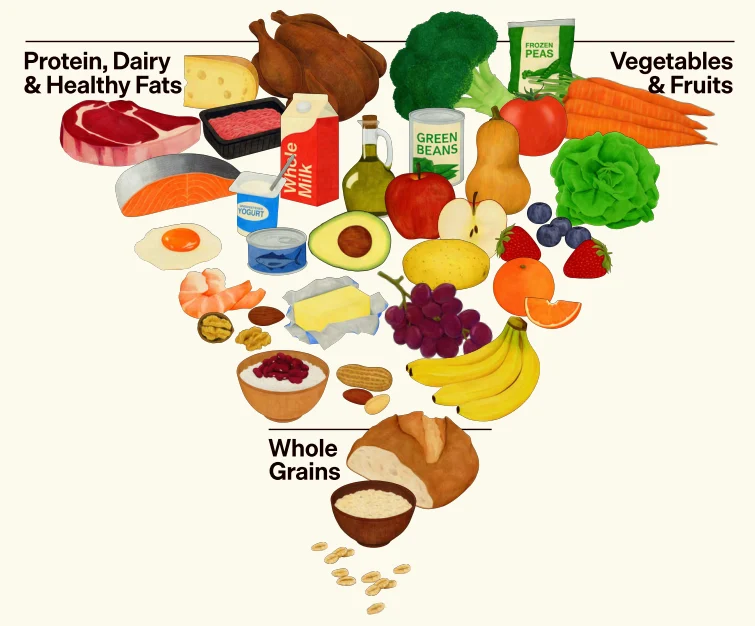
The release of the 2025–2030 Dietary Guidelines for Americans (DGAs) was met with significant anticipation, as public health advocates and nutrition scientists waited to see how federal agencies would address the dual crises of metabolic disease and ultra-processed food consumption in the United States. While the new guidelines feature a commendable, modernized focus on “eating real food” and a stringent crackdown on added sugars, the document is already sparking intense debate. Central to this controversy is a newly introduced, inverted pyramid graphic that prioritizes animal-based foods, creating a glaring disconnect between the government’s written policy and its visual representation of a healthy diet.
Main Facts: The New Federal Standard
The 2025–2030 Dietary Guidelines for Americans represent the gold standard for federal nutrition policy, informing school lunch programs, military rations, and the clinical advice provided by registered dietitians across the country. This edition distinguishes itself by being the first to explicitly warn against the broad category of “highly processed foods.” The guidance urges consumers to pivot toward whole, fiber-rich options while minimizing intake of sugar-sweetened beverages and refined carbohydrates like white bread.
However, the most striking feature of this cycle is the "New Food Pyramid." Unlike previous iterations that emphasized grains and plant-based staples, this inverted visual places steak, full-fat dairy, and butter in positions of prominence. Despite this visual shift, the written text of the guidelines remains tethered to long-standing scientific consensus, maintaining the upper limit of saturated fat intake at 10% of total daily calories. This creates a cognitive dissonance for the average consumer: how does one follow a "heart-healthy" diet when the government’s primary visual aid highlights the very foods that, if consumed in excess, jeopardize cardiovascular health?
Chronology of a Contentious Process
The path to the 2025–2030 guidelines was anything but standard. Typically, the DGAs are shaped by the Dietary Guidelines Advisory Committee (DGAC)—an independent body of preeminent nutrition scientists who synthesize the latest evidence. Their report is meant to serve as the unbiased foundation for the final policy.
However, this cycle deviated sharply from that norm. The administration elected to reject the primary findings of the appointed DGAC, opting instead to conduct a "supplemental scientific analysis" via a private federal contracting process. This departure from the established, transparent methodology has drawn sharp criticism from within the scientific community. Deirdre Tobias, an assistant professor at the Harvard T.H. Chan School of Public Health and a member of the original 2025–2030 DGAC, has been vocal about the lack of transparency in this process. She noted that the supplemental reviews lacked the replicable, rigorous methodology typically required to ensure that federal guidance remains free from non-scientific or industry-driven influence. By bypassing the traditional advisory committee’s final synthesis, the government has inadvertently cast a shadow of doubt over the legitimacy of the final product.
Supporting Data: The Saturated Fat Math
To understand the friction between the visual pyramid and the written guidelines, one must look at the "saturated fat math." The guidelines recommend a 2,000-calorie diet capped at roughly 22 grams of saturated fat.
If a consumer follows the DGAs’ recommendation of three daily servings of dairy—opting for the "full-fat" versions featured in the pyramid—the results are immediate. One cup of whole milk (5g), three-quarters of a cup of full-fat Greek yogurt (6g), and an ounce of cheddar cheese (6g) bring the total to 17 grams of saturated fat. If that same individual then uses a single tablespoon of butter (7g) or beef tallow (6g) for cooking, they have already exceeded their daily limit by lunch.
When you add protein-dense animal meats—which often contain their own saturated fat loads—it becomes mathematically impossible to reconcile the pyramid’s "recommended" food choices with the government’s own 10% ceiling. Dr. Frank Hu, Chair of the Department of Nutrition at the Harvard T.H. Chan School of Public Health, argues that this mixed messaging is more than just a clerical error. It is a potential public health hazard. "The mixed messages surrounding saturated-fat-rich foods such as red meat, butter, and beef tallow may lead to confusion and potentially higher intake of saturated fat and increased LDL cholesterol," Hu explains.
Official Responses and Conflicts of Interest
The controversy is further compounded by concerns regarding the financial affiliations of the individuals who conducted the supplemental analysis. Investigative reporting has flagged that several reviewers involved in the final document have documented financial ties to the beef and dairy industries. While these ties were disclosed within the appendix of the supplemental analysis, their existence in the context of the pyramid’s heavy promotion of animal fats has sparked accusations of industry capture.
Critics argue that by prioritizing animal products, the guidelines ignore the "protein package"—the reality that when we eat protein, we are also consuming the accompanying fats, sodium, and lack of fiber that define the healthfulness of that food. By failing to distinguish between plant-based proteins (like legumes and nuts) and red meats, the guidelines miss a critical opportunity to steer the American public toward heart-healthier, more sustainable choices.
Implications for Public Health
The implications of these guidelines are far-reaching. Historically, research from the CDC indicates that Americans already struggle to follow dietary guidelines. When the official guidance is internally inconsistent—blending sound advice on reducing added sugar with contradictory advice on fat intake—the likelihood of public adherence plummets.
Furthermore, the 2025–2030 DGAs conspicuously omit any consideration of environmental sustainability or the socioeconomic factors that limit access to fresh, whole foods. As climate change continues to impact food systems, the exclusion of sustainability metrics represents a missed opportunity to align personal health with planetary health.
For the average consumer, the "New Food Pyramid" may be easy to remember, but its message is fundamentally flawed. If the goal of the DGAs is to provide a roadmap for a healthier nation, the current iteration serves more as a cautionary tale of what happens when policy-making is decoupled from transparent, rigorous science.
Navigating the Confusion: What Should You Eat?
Given the ambiguity of the new federal standards, nutrition experts suggest that consumers look past the government’s simplified graphics. The Healthy Eating Plate and the Healthy Eating Pyramid, developed by independent institutions like Harvard, remain the most reliable tools for balanced nutrition. These frameworks prioritize:
- Whole Grains: Unlike the current DGA pyramid, which minimizes grains, healthy diets should rely on fiber-rich, whole-grain sources.
- Unsaturated Fats: Replacing butter and animal fats with olive oil, nuts, and seeds is one of the most effective ways to lower LDL cholesterol and reduce cardiovascular risk.
- Plant-Forward Proteins: Choosing beans, lentils, fish, and poultry over red and processed meats provides high-quality protein without the baggage of excessive saturated fat.
- A "Real Food" Approach: Regardless of federal shifts, the core principle remains: prioritize minimally processed, nutrient-dense foods over those that come in a package with a long list of additives.
Ultimately, the 2025–2030 Dietary Guidelines for Americans are a reminder that even official government documents must be scrutinized. While they make strides in the war against sugar and ultra-processed foods, the conflicting signals regarding animal fats suggest that the path to a healthier America requires individual discernment, reliance on independent science, and, when in doubt, consultation with a registered dietitian rather than a government-issued graphic. As the country navigates the fallout of these guidelines, the message from the scientific community is clear: true health is found in evidence-based habits, not in the shifting priorities of federal committees.