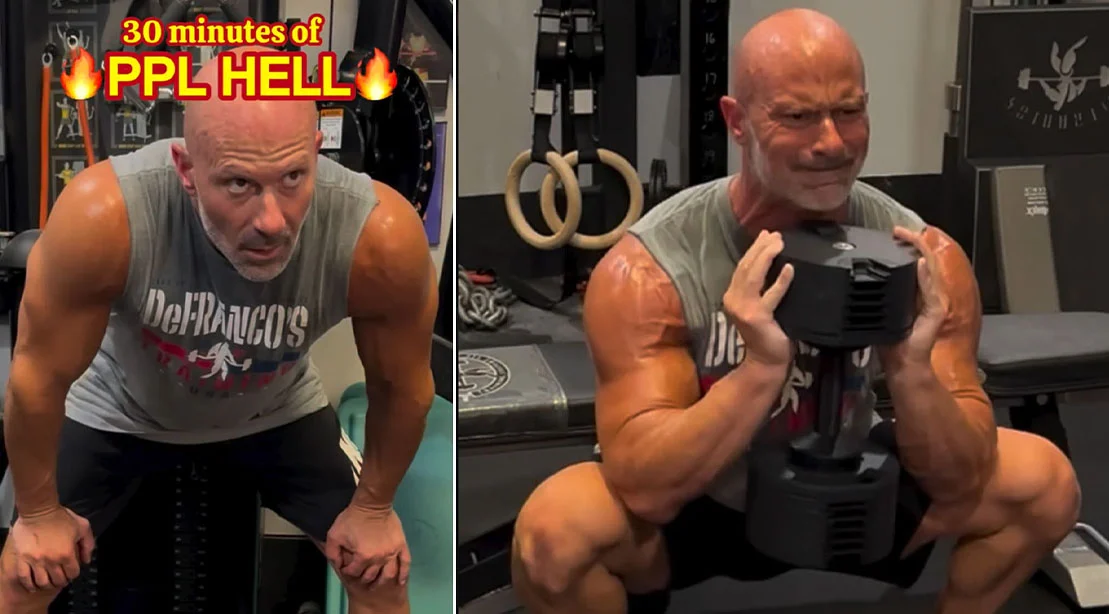
While the sweltering heat of late summer often serves as a siren song for relaxation, beckoning people to remain poolside with a cold drink, Joe DeFranco is busy stoking a different kind of fire. As the mastermind behind the elite physical conditioning of NFL icons, UFC champions, and WWE titans, DeFranco has built a career on turning human potential into high-performance machinery. His latest offering—a grueling, high-intensity circuit he calls "30 Minutes of PPL Hell"—is not for the faint of heart, but for those seeking to transform their physiques through efficiency and brute force.
The Man Behind the Muscle: A Legacy of Excellence
For the uninitiated, Joe DeFranco is more than just a personal trainer; he is a titan of the strength and conditioning industry. Based out of his renowned "DeFranco’s Gym," he has spent decades refining the methodologies that create "magazine-cover" physiques. His client roster reads like a "Who’s Who" of professional sports. From helping NFL hopefuls shave seconds off their 40-yard dash times to preparing combat athletes for the punishing five-round wars of the Octagon, DeFranco’s reputation is built on one core philosophy: results.
His recent foray into digital fitness coaching via his Instagram platform—where he commands an audience of over 220,000 followers—is a strategic pivot toward accessibility. He is stripping away the complex, multi-hour routines favored by aesthetic bodybuilders and replacing them with time-compressed, high-yield circuits designed for the modern professional.
The Core Concept: "PPL Hell"
The "PPL Hell" workout stands for Push, Pull, Legs—the foundational pillars of balanced resistance training. However, DeFranco’s interpretation is far from a standard gym session. It is a metabolic conditioning experience designed to torch body fat while simultaneously fostering muscle hypertrophy.
The strategy is simple on paper but deceptive in practice: perform three fundamental compound movements in a continuous circuit for a total of 30 minutes. The objective is not to race through the movements with light weights; rather, it is to maintain a significant load that challenges the neuromuscular system while keeping the heart rate elevated.
The Mechanics of the Circuit
The genius of this routine lies in its selection of movements. Each exercise is a "bang-for-your-buck" compound lift that recruits multiple muscle groups at once.
- Bench-Assisted Dumbbell Rows: This movement acts as the primary pulling exercise. In an era where sedentary office life has left millions with rounded shoulders and weakened posterior chains, the dumbbell row is the ultimate corrective. By utilizing a bench for support, the lifter can isolate the lats, rhomboids, and traps without the lower-back fatigue that often plagues standing variations.
- Goblet Squats: As the "leg" component of the PPL split, the goblet squat is unparalleled. It forces the athlete to maintain an upright torso, heavily engaging the quadriceps, glutes, and adductors, while demanding significant stabilization from the core and lower back.
- Shoulder-Tap Pushups: This serves as the "push" element. By incorporating a shoulder tap, the lifter introduces an anti-rotational core component to a standard chest-building exercise. It targets the pectorals, triceps, and deltoids while requiring the core to prevent the hips from swaying, thus turning a chest move into a full-body stability challenge.
Chronology of a High-Intensity Session
To understand why DeFranco calls this "Hell," one must look at the physiological progression of the 30-minute block.
- Minutes 0-10: The Warm-Up Phase. During the first third of the session, the goal is to establish the rhythm. With a dumbbell weight set at roughly 30 to 35% of body weight, the lifter should feel strong. The heart rate begins to climb, and the central nervous system (CNS) wakes up.
- Minutes 11-20: The Metabolic Threshold. This is where the fatigue sets in. The lactic acid begins to build up in the muscles. The mental challenge is to maintain form—specifically in the shoulder taps and the depth of the goblet squats—despite the mounting exhaustion.
- Minutes 21-30: The "Hell" Zone. As the final ten minutes approach, the conditioning aspect of the workout takes center stage. The goal is no longer just moving weight; it is managing the cardiovascular strain. It is at this stage that the "PPL Hell" moniker earns its keep.
Supporting Data: Why Load Matters
One of the most common critiques of modern circuit training is the tendency to sacrifice load for speed. DeFranco is vocal in his opposition to this trend. "Unlike most circuit training," he explains, "the goal here isn’t to grab the lightest dumbbells in the gym and mindlessly bang out reps."
The science supports his stance. According to the National Strength and Conditioning Association (NSCA), to achieve significant hypertrophy (muscle growth), the body must be exposed to mechanical tension. By keeping the dumbbells at 30-35% of one’s body weight, the athlete ensures they are staying within a "strength-building" range rather than merely performing cardio. This hybrid approach—strength endurance—is the secret weapon of athletes who need to be both powerful and athletic.
Official Responses and Expert Perspectives
Industry experts who have reviewed DeFranco’s methodology highlight his emphasis on "anti-desk" programming. By balancing the pushing movements (pushups) with pulling movements (rows), DeFranco mitigates the risk of shoulder impingement, a common injury among amateur gym-goers.
"DeFranco isn’t just training for the look," says Dr. Marcus Thorne, a sports physiologist. "He’s training for the longevity of the joints. The selection of the goblet squat over a traditional barbell back squat is also a brilliant choice for general populations, as it places significantly less compressive force on the spine while still delivering massive stimulation to the lower body."
Implications: A New Era of Time-Efficient Training
The primary implication of the "PPL Hell" circuit is the death of the "I don’t have time" excuse. In 30 minutes, an individual can perform more effective, scientifically backed training than most people accomplish in two hours of aimless gym wandering.
Customization for Every Level
DeFranco is careful to note that this routine is scalable. For the beginner, the 30-minute duration can be trimmed to 15 or 20 minutes as they build the necessary work capacity. For the advanced athlete—the "DeFranco-level" trainee—the intensity can be dialed up. By elevating the feet on a bench for the shoulder-tap pushups, the leverage shifts, placing significantly more weight on the upper body and increasing the tension on the pectoral muscles.
Furthermore, the "progressive overload" principle remains key. As the weeks pass, the goal is not necessarily to add more time, but to increase the number of total reps completed within that 30-minute window. This provides a quantifiable metric of progress, which is essential for long-term motivation.
The Psychological Dimension
Beyond the physical, there is a distinct psychological component to DeFranco’s programming. He emphasizes "trusting the process" and maintaining a positive mindset. The gym, in DeFranco’s view, is a laboratory for character development. If you can push through 30 minutes of intentional, controlled, and difficult physical labor, you are training your mind to endure challenges outside the gym walls.
"Simple on paper. HELL in practice," DeFranco admits. This transparency is what makes him a respected figure. He doesn’t sell a "get fit quick" gimmick; he sells the reality of sweat, grit, and consistent effort.
Conclusion: Is This Workout for You?
"30 Minutes of PPL Hell" is a testament to the fact that you do not need an endless amount of time or a complex array of machinery to transform your body. You need a plan, you need the right intensity, and you need the discipline to stick to the circuit until the timer hits zero.
Whether you are a busy parent, a corporate professional, or a seasoned athlete looking to shake up your routine, DeFranco’s circuit provides a blueprint for success. It is a reminder that the best results often come from the simplest, most brutal movements. So, grab your dumbbells, hydrate, clear your schedule for half an hour, and prepare to test your limits. Just remember: when the "hell" begins, the transformation is well underway.
Follow the movement: For more training insights, programming tips, and professional coaching from Joe DeFranco, you can follow his journey and workout archives on Instagram. Always consult with a physician before starting any new, high-intensity exercise regimen, and ensure your form is consistent to avoid injury.