Published: July 17, 2026
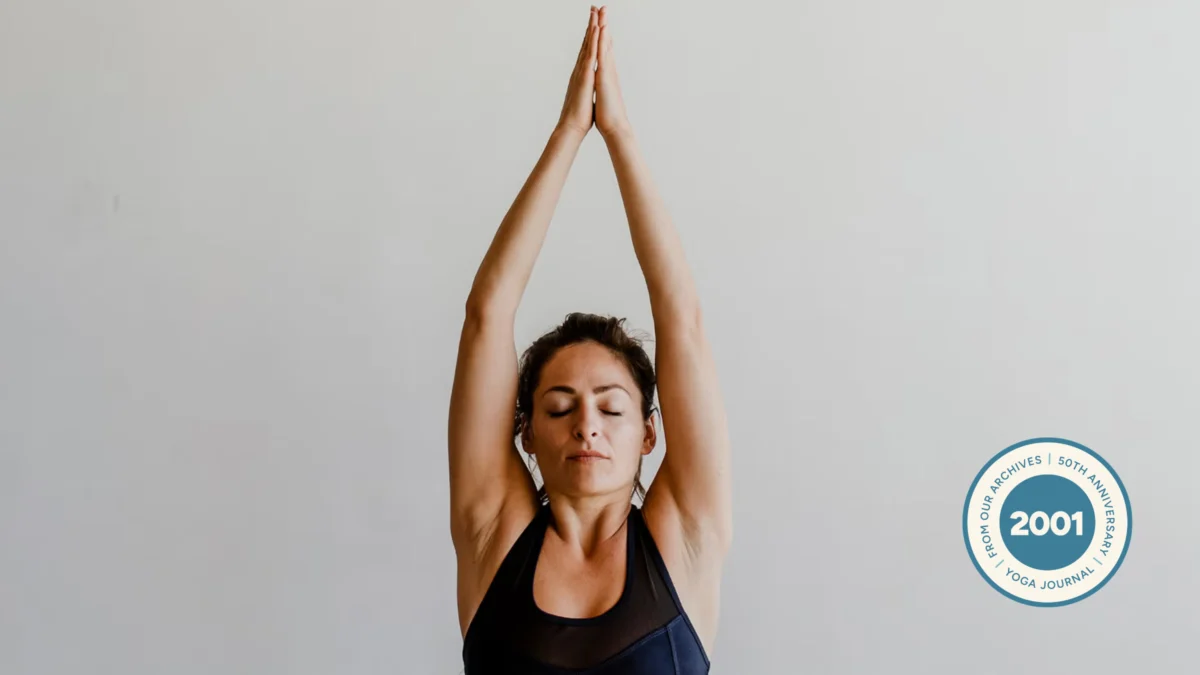
In the modern yoga studio, where the focus often drifts toward gravity-defying arm balances and deep, complex binds, the humble Urdhva Hastasana (Upward Salute) frequently resides in the shadows. It is the pose of the morning yawn, the intuitive stretch we perform upon waking, and often the most overlooked transition in a Sun Salutation. Yet, as practitioners delve deeper into the biomechanics and energetic philosophy of the practice, it becomes clear that Urdhva Hastasana is not merely a warm-up; it is the blueprint for the entire asana lexicon.
Originally featured in the March-April 2001 issue of Yoga Journal as part of its esteemed archives series, the lessons of Urdhva Hastasana remain as vital today as they were a quarter-century ago. By moving past the "beginner’s trap"—the assumption that a simple shape offers little utility—we unlock the fundamental principles of alignment, breath, and energy that serve as the foundation for every advanced posture in yoga.
The Chronology of an Intuitive Movement
For most, the relationship with Urdhva Hastasana begins long before the first yoga class. It is a primal, reflexive act. Upon rising, we roll from our beds, stand with heavy eyes, and instinctively reach our arms toward the ceiling, arching the spine in a natural decompression of the vertebrae. This movement serves a physiological purpose: it wakes the nervous system and facilitates the flow of prana, or life force, after hours of stagnation.
When brought into the controlled environment of a yoga studio, however, this intuition is often replaced by rote execution. Beginners may feel a sense of accomplishment in the ease of the pose, but this pride can become an obstacle. By treating the pose as a "check-box" exercise rather than an exploration, practitioners miss the subtle shifts in weight and breath that define true mastery. The journey from unconscious morning stretch to intentional asana is the defining trajectory of a dedicated yogi.
Supporting Data: The Physics of the Upward Salute
The efficacy of Urdhva Hastasana lies in its alignment with Newtonian physics—specifically the third law of motion: for every action, there is an equal and opposite reaction. In the context of yoga, this is the secret to true elevation.
To achieve a full, graceful expression of the Upward Salute, one cannot simply reach upward. To go up, one must fundamentally go down. This paradoxical grounding is the "supporting data" of the pose. When a practitioner feels the soles of the feet softening into the floor, a natural counter-resistance is created. This ground-force acts as the launchpad for the spine.
The Mechanics of Grounding
- Rooting: Standing with feet together, one must distribute weight evenly across the entire surface of the feet. This creates a foundation that signals the legs to engage without tension.
- The Pelvic Floor: By exhaling and softening the organs toward the pelvis, the navel draws inward, creating a stable "center" or bandha.
- The Vertical Ascent: As the legs firm and the spine lifts, the arms begin their ascent. This is not a forced muscular reach; it is an effortless extension. The arms should feel light, as if they are being carried by the breath rather than the deltoids.
The Three Pillars of Practice
Mastery of Urdhva Hastasana requires a systematic approach to the entry, the hold, and the release. Each phase is an opportunity to refine the relationship between effort and surrender.
1. Entering the Pose
The entry should be characterized by a coordinated effort directed from the abdominal center. As you inhale, imagine the breath expanding across the back. The shoulders should remain surrendered, avoiding the common tendency to "hike" them toward the ears. At the peak, the palms meet, the shoulder blades spread, and the chin draws slightly inward. For those with cervical spine sensitivity, the gaze should remain forward until the strength of the upper back can safely support the extension of the neck.
2. Being in the Pose
The depth of Urdhva Hastasana is found in the stillness. Once the arms are raised, the practitioner must "plumb the depths" by dropping the inner body. By softening the frontal ribs and the top of the lungs, the heart space expands. This creates a literal increase in thoracic volume, allowing for deeper, more rhythmic inhalations. If the weight shifts off-center, the practitioner must use this internal observation to micro-adjust, ensuring the energy flow remains vertical.
3. Exiting the Pose
The exit is not a collapse, but a conscious return to center. As the palms remain together in a prayer position (Namaste), the descent of the hands serves as a "clearing" movement. Passing the throat, heart, solar plexus, and navel, the hands guide the energy downward. This phase is designed to leave the practitioner in a state of heightened awareness, carrying the stillness of the pose into the rest of the sequence.
Implications: The Sutra as a Metaphor
The Yoga Sutras of Patanjali are often described as "threads" (sutras). They are minimal, condensed concepts that hold the tapestry of yogic philosophy together. Urdhva Hastasana serves as the physical embodiment of this concept. It is the "thread" that holds a sequence together.
The implications for the practitioner are profound: when we master the "simple" poses, we stop seeking complexity for the sake of ego. We begin to understand that the most advanced yoga is often the most refined, quiet, and intentional. The pose is a resolution of complementary opposites—upward reach and downward grounding, active extension and passive surrender.
Professional Perspectives on Energetic Alignment
In the years since this archive piece was originally penned, the physiological understanding of "energetic alignment" has gained mainstream traction. Modern kinesiology in yoga now confirms that the "subtle energy" described by ancient practitioners corresponds to the activation of the transverse abdominis and the elongation of the spinal erectors.
"When we talk about the intelligence of a pose," says senior yoga instructor Marcus Thorne, "we are really talking about sensory feedback. Urdhva Hastasana is the primary tool for teaching a student how to feel their own center of gravity. If you can’t find length in this simple shape, you will likely struggle to maintain integrity in more complex backbends like Urdhva Dhanurasana (Wheel Pose)."
The consensus among contemporary teachers remains clear: the pose is a laboratory. It is a space where the practitioner learns to coordinate breath, muscle, and mind in a confined, vertical plane. Those who rush through Urdhva Hastasana to get to the "harder" poses are essentially skipping the foundational reading of their own physical language.
Conclusion: The Harmony of Opposites
Urdhva Hastasana is more than a stretch; it is a declaration of presence. By integrating the physical mechanics of grounding and the philosophical concept of the sutra, we transform a mundane movement into a profound practice.
As we look back at the archives of 2001, the message remains timeless. The pursuit of the "advanced" should never come at the expense of the "essential." By returning to the Upward Salute with fresh eyes, we find that the seed of every great pose is already contained within the simplicity of reaching up while staying firmly rooted in the earth. In that union of opposites, we discover the true creative energy of the practice—a harmony that is as applicable to our daily lives as it is to our time on the mat.
Whether you are a veteran practitioner or a newcomer to the fold, the next time you find yourself in Urdhva Hastasana, take a moment to pause. Feel the feet, center the breath, and remember that in the world of yoga, the most profound revelations are often found in the most simple, upward reaches.