









As the United States Supreme Court convenes to hear the high-stakes case of Monsanto v. Durnell, a firestorm of public outrage has descended upon Washington D.C. At the heart of the controversy is a fundamental question of legal precedent: Can a multi-billion-dollar corporation use federal regulatory inaction as a shield against state-level liability claims for products linked to severe health outcomes?
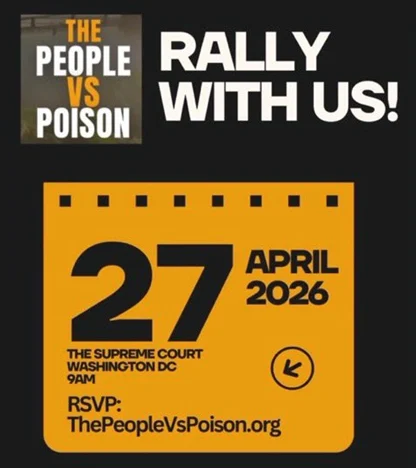
The "People vs. Poison" rally, a coalition of activists, farmers, and public health advocates, has mobilized in front of the Supreme Court, signaling that the outcome of this case will define the landscape of corporate accountability for decades to come. Among the prominent figures leading the charge are activist Vani Hari—widely known as the "Food Babe"—and the advocacy group Farm Action. For these organizations, the case is not merely about a specific weed killer; it is about the right of citizens to seek redress when corporate products cause catastrophic harm.
The Core Conflict: FIFRA and the Immunity Bid
The legal dispute centers on glyphosate, the active ingredient in Roundup, the world’s most widely used herbicide. Monsanto, now a subsidiary of the German chemical giant Bayer, has found itself embroiled in tens of thousands of lawsuits from individuals claiming that exposure to Roundup led to the development of non-Hodgkin lymphoma and other cancers.
To date, Bayer has paid out over $10 billion in settlements to cancer victims. However, the company is now seeking to stop the bleeding. In Monsanto v. Durnell, the company is arguing for a sweeping interpretation of the Federal Insecticide, Fungicide, and Rodenticide Act (FIFRA).
Monsanto contends that if the Environmental Protection Agency (EPA) has not mandated a cancer warning on a product label, state law cannot impose such a requirement. In essence, the company argues that federal regulatory silence constitutes a preemptive "blanket" that shields the manufacturer from "failure-to-warn" lawsuits. If the Supreme Court rules in favor of Monsanto, it would effectively strip citizens of their ability to sue under state tort laws for damages related to chemical exposure, provided the EPA has not explicitly labeled the substance as a carcinogen.
Chronology of a Legal and Public Health Crisis
The path to the Supreme Court has been paved by decades of scientific debate and legal maneuvering.
- 1974: Monsanto introduces Roundup to the global market, marketing it as a revolutionary, non-toxic weed killer.
- 2015: The International Agency for Research on Cancer (IARC), an arm of the World Health Organization, classifies glyphosate as "probably carcinogenic to humans." This classification served as the catalyst for the modern wave of litigation.
- 2018: The landmark Johnson v. Monsanto trial concludes with a jury finding that Roundup caused a school groundskeeper’s cancer, awarding him $289 million in damages.
- 2020: Bayer agrees to a $10.9 billion settlement to resolve the majority of pending lawsuits, though the settlement does not admit liability.
- 2025–2026: As thousands of cases remain pending, Bayer elevates the legal fight to the Supreme Court, seeking a ruling that would create a federal preemption bar, effectively ending the litigation pipeline.
- Present: The Supreme Court hears Monsanto v. Durnell while protestors gather outside, framing the decision as a litmus test for corporate influence in the American judiciary.
Supporting Data: The Human Cost
The sheer volume of litigation underscores the gravity of the situation. With tens of thousands of plaintiffs, the human cost of glyphosate exposure has become a central theme of the "People vs. Poison" movement.
Advocates point to internal Monsanto documents unearthed during discovery in earlier trials, which critics argue show that the company was aware of potential health risks while simultaneously engaging in public relations campaigns to minimize the danger. Furthermore, the economic power of Bayer has allowed it to exert significant pressure on the regulatory process.
According to reports from organizations like U.S. Right to Know, the current administration’s Department of Justice has filed a brief in support of Monsanto. Critics argue this move is particularly concerning given the "revolving door" phenomenon, where officials move between high-level government positions and the law firms representing major chemical corporations. This alignment between corporate interests and federal legal strategy has fueled the narrative that the system is "rigged" in favor of large-scale industry.
Official Responses and Stakeholder Positions
The Industry Stance: Regulatory Certainty
Bayer and its allies maintain that the legal system is being used to bypass the scientific findings of the EPA. They argue that if every state were allowed to dictate its own labeling requirements based on varying interpretations of carcinogenicity, the agricultural industry would face an impossible regulatory patchwork. From their perspective, the EPA is the sole body authorized to determine label warnings, and its decisions should be final and binding nationwide.
The Advocate Stance: Preserving the Right to Sue
Farm Action and other members of the coalition argue that the EPA’s approval process is historically prone to industry influence and under-resourced scientific review. They argue that state-level courts act as a vital "check and balance" on corporate power.
"Monsanto, owned by Bayer, has mounted an aggressive campaign to secure immunity, leveraging its outsized market power to influence policymakers," Farm Action stated in a recent press release. The group argues that Bayer’s threat to pull Roundup from the market is a "strategic pressure tactic," intended to intimidate the court and the public into accepting their vision of corporate immunity.
Implications: A Landmark Decision for U.S. Law
The implications of Monsanto v. Durnell extend far beyond the agricultural sector. If the Court grants Monsanto the immunity it seeks, the ruling could establish a precedent that prevents consumers from holding corporations liable for hazardous products whenever a federal agency has not explicitly warned against them.
1. The Erosion of State Authority
If the Court rules that FIFRA preempts state law, it will fundamentally shift the balance of power from the states to the federal government. This would limit the ability of state courts to protect their citizens from emerging health risks that have not yet been fully acknowledged by federal bureaucrats.
2. Regulatory Capture and Accountability
A victory for Monsanto would likely decrease the incentive for corporations to engage in rigorous internal safety testing. If a company can rely on the EPA’s often slow-moving regulatory process as a "get out of jail free" card, the motivation to proactively warn the public about potential risks may vanish.
3. The Future of the Food System
For farmers and consumers, the case represents a crossroads. Will the agricultural industry be held to the standard of public health, or will the "profit-first" model be legally shielded from the consequences of environmental and personal harm?
As the "People vs. Poison" rally continues, the message from the streets is clear: the public is no longer willing to accept "regulatory approval" as a substitute for safety. Whether the Supreme Court agrees remains to be seen, but the intensity of the protests outside the building serves as a stark reminder that the court of public opinion is already in session.
As we look toward the final verdict, one thing is certain: the outcome will define the next chapter of the relationship between industrial giants and the people they feed. The "People vs. Poison" movement, in its effort to draw attention to the proceedings, has ensured that the eyes of the nation remain fixed on the bench, demanding transparency, justice, and accountability in an era where the line between corporate profit and public safety has become dangerously blurred.