










One look at the Dragon Flag is all it takes to realize that you are witnessing the gold standard of bodyweight mastery. The body remains rigid, moving as a single, unbreakable unit with minimal points of contact. This is the hallmark of the most elite core exercises: the ability to resist movement and maintain absolute stiffness while the body is under extreme mechanical stress.
Popularized by martial arts icon Bruce Lee, the Dragon Flag has transcended its origins in the 1970s to become a staple for modern athletes, gymnasts, and strength enthusiasts. It is more than just an abdominal exercise; it is a full-body recalibration of how you create and maintain tension. For those looking to bridge the gap between "show" muscles and "go" performance, the Dragon Flag stands alone as the ultimate litmus test of core integrity.
The Genesis of a Legend: Bruce Lee’s Training Philosophy
To understand the Dragon Flag, one must look at the man who popularized it. Bruce Lee was a pioneer of functional training long before the term became a fitness industry buzzword. His training regimen was centered on the concept of "total-body control"—the idea that power does not come from isolated muscles, but from the ability to link the extremities to a rock-solid core.
Lee utilized the Dragon Flag not merely to achieve his famously chiseled aesthetic, but to enhance his striking speed and precision. In martial arts, power is generated from the ground, transferred through the core, and expressed through the limbs. If the core is weak or "leaky," kinetic energy is lost. By performing the Dragon Flag, Lee developed the ability to create and maintain intense, full-body tension, which translated into the explosive speed and crushing power he displayed in his films and demonstrations.
Defining the Dragon Flag: Anatomy of an Anti-Extension Movement
At its technical core, the Dragon Flag is an "anti-extension" exercise. While many traditional ab movements, such as crunches, rely on spinal flexion, the Dragon Flag forces the rectus abdominis to fight against gravity to prevent the spine from arching.
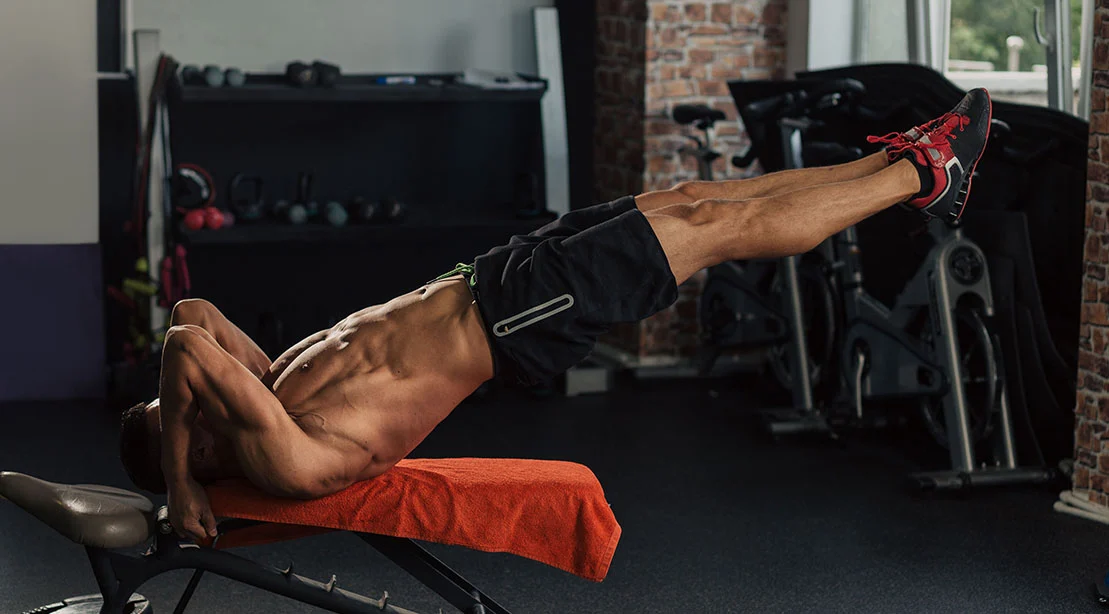
The athlete lies supine, gripping a sturdy object behind their head, and lifts the entire body until it is nearly vertical, supported only by the upper back and shoulders. The legs are then lowered slowly while maintaining a perfectly straight line from the heels to the shoulders.
What separates the Dragon Flag from simpler core moves is the long lever. In physics, the further a weight is moved from the base of support, the greater the torque required to control it. By extending the legs—the heaviest part of the lower body—far away from the anchor point (the shoulders), the load on the abdominal wall increases exponentially.
The Science of Tension: Why Your Core Matters
The Dragon Flag is not a movement that can be "muscled" through with bad form. It requires the synchronization of multiple muscle groups working in concert to create a state of internal rigidity.
1. Rectus Abdominis
The primary driver of the movement, the rectus abdominis works isometrically to prevent the rib cage from flaring and the lumbar spine from hyper-extending. As you lower your body, the "abs" must fight the gravitational pull that seeks to drag your lower back toward the floor.
2. Transverse Abdominis (TA)
Often called the body’s "natural weightlifting belt," the TA provides internal pressure and stiffness. During the Dragon Flag, the TA contracts to stabilize the spine, creating a pressurized cylinder that allows the limbs to move without causing structural collapse in the midsection.
3. Obliques
The internal and external obliques are responsible for preventing rotation. During the descent, any slight instability can cause the torso to twist. The obliques work to ensure that the body stays on a perfectly straight path, acting as the "guy-wires" of the human frame.
4. Lats and Upper Body
By gripping the bench, the athlete engages the lats. This is not just for stability; pulling back on the anchor point creates a cross-body tension that radiates down into the core, effectively locking the upper body into the movement.
5. Glutes
The glutes are the often-overlooked secret to a successful Dragon Flag. Strong glute contraction is essential for hip extension; if the glutes relax, the hips drop, the lever shortens, and the mechanical load on the core is significantly reduced.
Common Pitfalls: Why Most Fail the Dragon Flag
The transition from "attempting" to "mastering" the Dragon Flag is fraught with technical errors. Because the exercise is so demanding, the body will instinctively look for the "path of least resistance," which usually manifests as broken form.
The "Broken Hip" Syndrome
When the hips flex during the descent, the body is no longer a straight line. This is a compensation strategy to shorten the lever and reduce the load on the abs. To fix this, you must prioritize "glute-squeeze" as the primary cue. If you cannot maintain a straight line, your progression is too advanced; move to a tuck-variation.
The Rib-Flare
Losing the rib-to-pelvis connection is a sign that the rectus abdominis has reached its limit. When the ribs flare, the spine enters extension, putting the lumbar discs at risk. Athletes must learn to pull their ribs down into their pelvis, effectively "stacking" the torso.
Neglecting the Negative
Many beginners focus solely on the "up" phase. However, the true value of the Dragon Flag lies in the eccentric (lowering) phase. Dropping too quickly—or allowing gravity to take over—is a wasted opportunity. The descent should be a slow, controlled 3-to-5-second count. If you cannot control the descent, you are not performing a Dragon Flag; you are merely falling.
The Strategic Programming: How to Integrate It
Because of the high central nervous system (CNS) demand, the Dragon Flag should be treated as a skill-based exercise. It is not meant to be performed to failure in a high-repetition format.
The Progression Path
- The Tuck Dragon Flag: Keep the knees tucked toward the chest while keeping the torso straight. This shortens the lever and allows for mastery of the shoulder-anchor position.
- The One-Legged Dragon Flag: Extend one leg while keeping the other tucked. This introduces an asymmetry that forces the obliques to work harder to maintain balance.
- The Eccentric-Only Full Dragon Flag: Focus entirely on the lowering phase, using your legs to get into the starting position, then focusing on a 5-second, perfect-form descent.
- The Full Dragon Flag: The ultimate expression—full extension, slow descent, and total control.
Programming Suggestions
- Beginner: 2–3 sets of 3–5 eccentric-only reps. Focus on the feeling of the "straight line."
- Intermediate: 3 sets of 4–6 reps. Experiment with a partial range of motion, stopping before the form breaks.
- Advanced: 3–4 sets of 3–5 full, slow-tempo reps. Rest 90 seconds between sets to ensure full recovery of the CNS.
Implications for Athletic Performance
The implications of mastering the Dragon Flag extend far beyond the gym. For athletes involved in contact sports, grappling, or explosive lifting, the ability to maintain a rigid core under load is the difference between a high-performance output and injury.
When you train the Dragon Flag, you are training your brain to recruit motor units more efficiently. You are teaching your body that "stiffness equals strength." In a sport like rugby, this core rigidity allows an athlete to absorb a tackle without losing their center of gravity. In weightlifting, it ensures that a heavy barbell does not buckle the spine during a squat or overhead press.
Conclusion: Quality Over Quantity
The Dragon Flag is not a movement to be rushed. It is a testament to the fact that the most effective exercises are often the simplest in theory but the hardest in practice. It requires patience, a meticulous eye for detail, and a commitment to quality over quantity.
By treating the Dragon Flag as a skill—a practice of mind-muscle control—you unlock a level of core strength that is impossible to achieve with machines or standard floor exercises. You are not just building muscles; you are building a structure capable of handling extreme forces, maintaining perfect alignment, and moving with the precision of a master. Whether you are chasing the legacy of Bruce Lee or simply looking to bulletproof your physique, the Dragon Flag is the ultimate tool to turn your core into a force-transmitting powerhouse.