










In the modern fitness landscape, the greatest barrier to consistency is rarely a lack of motivation—it is a lack of time. For Becky Greenan, the powerhouse fitness coach known to her one million-plus Instagram followers as “Built by Becky,” the struggle is relatable. As a “married mama of two,” Greenan has turned the logistical constraints of parenthood and professional life into a masterclass in efficiency.
Her philosophy is simple: you do not need a fully equipped commercial gym, a heavy barbell, or an hour-long commute to achieve significant glute hypertrophy. By leveraging the versatility of resistance bands, Greenan has developed a six-move routine that serves as a game-changer for those operating under a tight schedule. This article explores the mechanics, implications, and expert methodology behind her viral, time-efficient glute protocol.
The Core Philosophy: Why Resistance Bands?
While traditional heavy lifting remains the gold standard for maximal strength, resistance bands offer a unique mechanical advantage: constant tension. Unlike free weights, which rely on gravity, resistance bands provide an ascending resistance profile—the further you stretch the band, the harder the muscle must work.
For beginners, this provides a safer learning curve; for seasoned lifters, it offers a way to induce metabolic stress without the systemic fatigue associated with heavy compound lifts. Greenan advocates for this approach not just as a “travel hack,” but as a legitimate training modality. Whether you are navigating a busy workday, traveling, or managing household responsibilities, the ability to stimulate muscle growth in a living room or a hotel suite removes the "all or nothing" mentality that often leads to training abandonment.
Chronology of the Routine: A Six-Move Breakdown
Greenan’s routine is designed to be performed in 2 to 3 sets of 10 to 20 repetitions per move. This volume is specifically curated to induce the "pump"—a buildup of blood and metabolic byproducts that signals to the muscle that it is time to adapt and grow.
1. The Glute Kickback
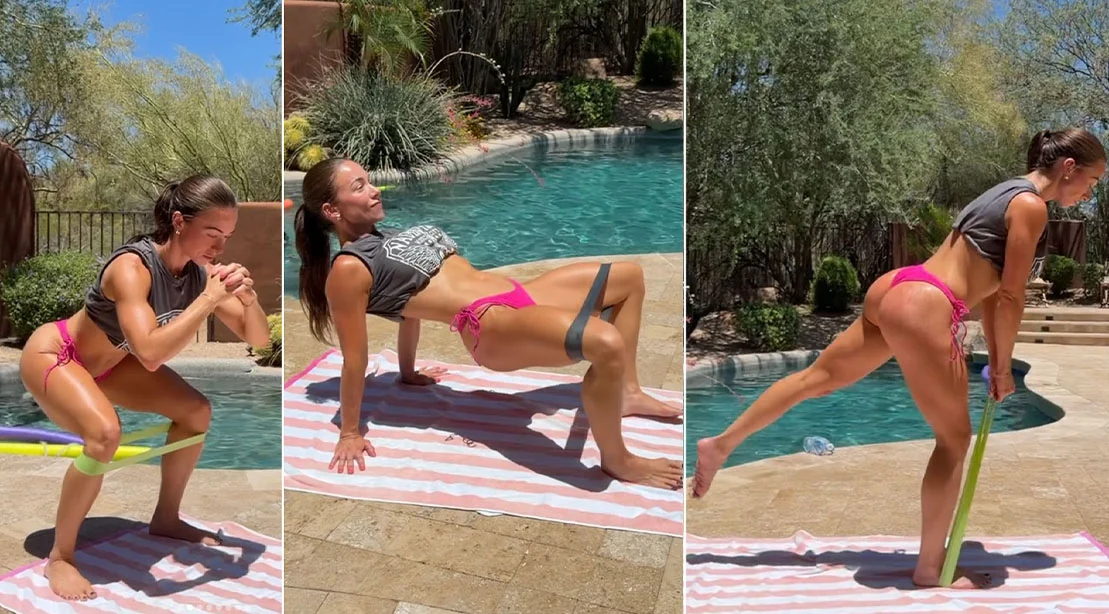
The routine opens with the glute kickback, an isolation exercise that targets the gluteus maximus. By anchoring the band at the feet, the movement forces the user to extend the hip against resistance. This exercise is critical for developing the mind-muscle connection, ensuring that the glutes—rather than the lower back—are driving the extension.
2. Banded Squat Jumps
To introduce an explosive element, Greenan incorporates banded squat jumps. The addition of the band forces the athlete to fight against internal rotation of the knees, effectively forcing the gluteus medius to engage throughout the entire kinetic chain. Bracing the core is non-negotiable here; the landing must be soft and controlled to protect the joints while maximizing power output.
3. The Modified Hip Thrust
Perhaps the most iconic glute exercise, the hip thrust, is modified here for home use. By adding an abduction element at the peak of the movement—pulling the knees outward against the band—you move from a simple glute contraction to a comprehensive engagement of the hamstrings, erector spinae, and abductor complex.
4. Banded Single-Leg RDL (Romanian Deadlift)
Balance is the hidden variable in lower-body development. The single-leg RDL requires stabilization from the core and the small muscles of the ankle. As you hinge at the hip, the band adds resistance during the most difficult part of the movement: the ascent. This forces a deep "squeeze" at the top of the rep, ensuring the glutes are fully shortened.
5. Static Squats with Backward Toe Taps
This move is a test of muscular endurance. By holding a static squat, you keep the glutes and quads under constant tension. The addition of backward toe taps adds an element of dynamic instability, forcing the obliques and hamstrings to fire to maintain posture. It is a grueling combination that challenges the cardiovascular system as much as the posterior chain.
6. Sway Squats (The Finisher)
To cool down and flush the muscles with blood, Greenan utilizes sway squats. This lateral movement opens the hips and provides a much-needed stretch to the adductors. It serves as the perfect bookend to the session, ensuring that the hips remain mobile while the muscles are fully fatigued.
Supporting Data: The Science of Banded Training
Recent studies in sports science have begun to validate what bodybuilders have known for decades: resistance bands are highly effective for hypertrophy. A study published in the Journal of Strength and Conditioning Research noted that elastic resistance training produces similar electromyography (EMG) activation levels in the gluteal muscles when compared to traditional machine-based exercises.
The key lies in "Time Under Tension" (TUT). Because bands are lightweight and portable, users can easily perform sets to failure without the safety concerns of a failing barbell. Greenan’s emphasis on 10 to 20 reps per set is supported by the hypertrophy range, which generally suggests that 8 to 20 repetitions provide the ideal balance between mechanical tension and metabolic stress.
Expert Perspective: Integrating the Routine
We spoke to several fitness professionals regarding the efficacy of Greenan’s approach. "The primary issue most people face with glute growth is ‘glute amnesia’—where the muscles simply don’t fire correctly because they are inhibited by long periods of sitting," says Dr. Sarah Jenkins, a sports physiotherapist. "Greenan’s routine is brilliant because it forces hip abduction and extension in a controlled manner, effectively ‘waking up’ the gluteus medius and maximus."
However, the experts caution that progression remains vital. Just as you would add plates to a barbell, you must eventually increase the resistance of your bands. Greenan’s advice to check the color-coding of bands is practical, but users should also focus on slowing down the tempo of each repetition—the "eccentric" or lowering phase—to increase the difficulty without needing a heavier band immediately.
Implications for the Modern Athlete
The implications of this training style are profound. By democratizing the gym—making it accessible to anyone with a $15 set of bands—Greenan is shifting the fitness narrative away from exclusive, expensive facilities and toward self-efficacy.
- Accessibility: The barrier to entry is virtually zero.
- Mental Health: Regular exercise, even in short, 20-minute bursts, has been shown to reduce cortisol levels and improve mood, which is essential for busy parents and professionals.
- Longevity: By focusing on functional movements like hinges and squats, this routine promotes hip health and lowers the risk of lower-back pain associated with sedentary desk jobs.
Conclusion: Consistency Over Complexity
Becky Greenan’s "Built by Becky" brand is a testament to the fact that you do not need to spend hours in the gym to see physical changes. By prioritizing quality of movement and utilizing the specific advantages of resistance bands, you can achieve a robust, well-toned posterior chain on your own terms.
Whether you are a busy mother, a corporate professional, or a frequent traveler, the message is clear: your environment does not dictate your results. With the right focus and a pair of bands, you can build strength, confidence, and gains—anytime, anywhere.
To stay updated on Becky Greenan’s latest fitness tips and to follow her journey, you can visit her on Instagram at @built.by.becky.
Quick Reference: Choosing Your Band
- Light (Yellow/Light Blue): Ideal for warm-ups or high-rep endurance sets.
- Medium (Red/Green): The "sweet spot" for most compound exercises in this routine.
- Heavy (Black/Purple): Best reserved for advanced users or exercises where you have a strong mechanical advantage, such as the hip thrust.
Note: Always consult with a physician before beginning a new exercise program, especially if you have pre-existing hip, knee, or back issues.