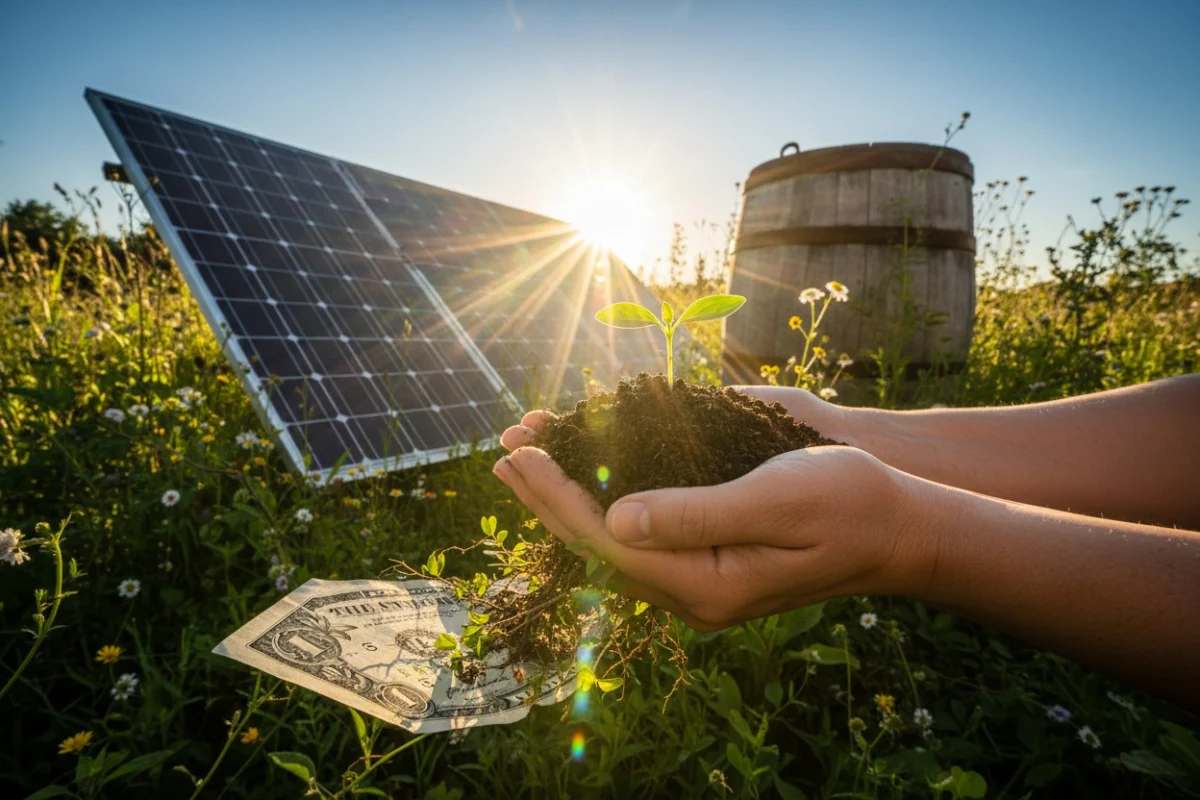
In the modern era, the average individual defines success by the digits displayed on a banking app or the balance of a retirement portfolio. However, a growing movement of economists, ecologists, and self-reliance advocates is challenging this fundamental premise. They argue that we have fallen victim to the greatest economic deception in history: the conflation of "money" with "wealth."
To understand this paradigm shift, one must first recognize that money is not an asset in itself, but merely a voucher—a temporary claim check on the earth’s natural resources. As global financial systems face unprecedented volatility, a return to the "source" of value—sunlight, clean water, fertile soil, and biological autonomy—is being framed not just as a survival strategy, but as the only path to genuine prosperity.
The Anatomy of the Financial Deception
The current financial system is built upon a debt-based architecture, often described by critics as a "house of cards." Unlike the tangible value found in a productive ecosystem, fiat currency relies on the collective belief in promises that are increasingly difficult to fulfill.
The Illusion of Fiat
Fiat money—currency that has no intrinsic value and is not backed by a physical commodity—has decoupled humanity from the natural world. By convincing the populace that accumulating these digital numbers is synonymous with becoming "rich," institutional structures have effectively redirected human labor away from the cultivation of resources and toward the maintenance of a debt-based system.
Nature as the Only True Capital
If one observes a food forest, they witness a self-sustaining system of abundance. Sunlight, rain, and microorganisms work in concert to generate energy and nutrition without the need for a ledger. In this model, "wealth" is the ability to produce what is required for life. Conversely, the fiat system requires a middleman at every stage of existence, skimming value through taxation, price gouging, and systemic inflation.
Chronology: From Barter to Bureaucracy
The shift from natural wealth to institutional dependence did not happen overnight. It was a gradual erosion of autonomy that has accelerated in the last century.
- The Agrarian Era: For millennia, wealth was synonymous with land, livestock, and stored harvest. Access to nature’s gifts was direct, and the "middleman" was virtually non-existent.
- The Industrial Transition: As societies moved into cities, the reliance on external supply chains for food, water, and energy intensified. This created the first significant "tollbooths" between the individual and their basic needs.
- The 1971 Shift: The collapse of the Bretton Woods system marked the final separation of the U.S. dollar from gold. This initiated the era of pure fiat currency, where money creation became disconnected from any physical tether.
- The Current Digital Epoch: Today, we operate in a system of high-frequency trading and algorithmic banking. While this has created the illusion of efficiency, it has also rendered the individual increasingly vulnerable to systemic collapses, as their "wealth" exists only as an entry in a third-party database.
Supporting Data: The Cost of Dependence
The financial toll of relying on external supply chains is staggering. According to Bureau of Labor Statistics (BLS) data, the average American household spends nearly $6,800 annually on food alone. This expenditure represents a transfer of wealth from the individual to a vast network of distributors, retailers, and lobbyists.
The Math of Self-Reliance
When an individual invests in solar panels, rainwater catchment, or a home garden, they are essentially opting out of the "tollbooth" economy.
- Energy Autonomy: Solar energy bypasses utility monopolies and avoids the taxes embedded in grid-tied energy consumption.
- Water Sovereignty: Rainwater harvesting provides a fundamental life resource free of meters and municipal surcharges.
- Nutritional Independence: Growing one’s own produce reclaims the $6,800 average spend while ensuring the quality of the intake, effectively "tax-proofing" a portion of one’s lifestyle.
The Biological Pharmacopoeia: Your Body as an Asset
Perhaps the most egregious "middleman" intervention occurs in the medical sphere. The human body is a sophisticated bio-chemical machine capable of producing endogenous antioxidants, repair enzymes, and immune cells.
The Sunlight Paradox
Public health guidelines have long warned against sun exposure, contributing to a global epidemic of Vitamin D deficiency. Research, such as that highlighted by Marc Sorenson, suggests that this "sunlight phobia" has been a catalyst for a surge in chronic diseases. By utilizing the sun to produce Vitamin D, individuals access a free, nature-provided health intervention that is far more effective than many synthetic alternatives.
Botanical Wisdom
Historically, cultures utilized the "botanical pharmacopoeia"—herbs, tinctures, and tonics—as the first line of defense against illness. The modern medical establishment, however, has incentivized the pathologizing of natural processes, preferring to patent synthetic substitutes for natural compounds. Reclaiming the knowledge of natural medicine is not just a health choice; it is a declaration of economic independence from the pharmaceutical industrial complex.
Official Responses and The "Golden" Alternative
The establishment often labels moves toward self-reliance as "fringe" or "unproductive." However, as the volatility of fiat currencies continues to rise, even traditional financial institutions are beginning to acknowledge the necessity of "honest money."
The Return of Precious Metals
Industry leaders, including figures like Andy Schectman, have highlighted the resurgence of gold and silver as the only historically reliable stores of value. With the integration of technologies—such as platforms that allow for instantaneous transactions using physically held gold—the barrier to using "honest money" is dropping. The argument is that while fiat currency fails throughout history, gold has remained the constant denominator through the rise and fall of every major civilization.
The Impending "Financial Reset"
Many experts now openly discuss the inevitability of a global financial reset. In such a scenario, the accumulation of fiat currency will likely prove to be a liability. Wealth, in this context, will be redefined by the "hard assets" one holds: physical gold, land, productive seeds, and the skills to maintain health without external reliance.
Implications: The Path Toward a New Golden Age
The transition toward nature-based abundance has profound implications for the structure of society.
1. The Decentralization of Power
When individuals produce their own energy, food, and medicine, they strip the "middleman" of their leverage. A population that does not rely on a centralized grid for survival is a population that is significantly harder to coerce or surveil.
2. The Redefinition of Success
The "new wealth" is not defined by the amount of paper currency in a vault, but by the "time-wealth" and "health-wealth" of the individual. If one spends forty hours a week chasing currency to pay for basic necessities that could be sourced directly from nature, they are effectively trading their life-force for paper promises.
3. A Return to Stewardship
Realizing that money is merely a voucher for nature’s gifts changes our relationship with the environment. If the earth is the source of all value, then the health of the soil and the purity of the water become the most important economic indicators. Protecting these resources becomes a matter of self-interest rather than abstract environmentalism.
Conclusion: Reclaiming the Source
The system is designed to interpose itself between you and the source of all life. It creates a dependency loop that keeps you chasing digital numbers while your true treasury—the sun, the soil, and your own biological potential—sits neglected right outside your door.
We are entering an era where the divide between those who are "system-dependent" and those who are "source-connected" will become the defining feature of human society. To be wealthy is to be capable of sustaining life through the gifts provided by creation.
The advice for the modern age is simple but radical: Stop trading your finite time for the infinite printing of fiat promises. Grow a tomato. Install a solar panel. Capture the rain. Harness the healing power of the sun. The moment you step outside and reclaim your connection to the source, you have achieved a level of wealth that no government can tax, no bank can seize, and no inflation can erode.
True prosperity is not found in a ledger; it is found in the dirt, the light, and the air. It is time to go to the source.