









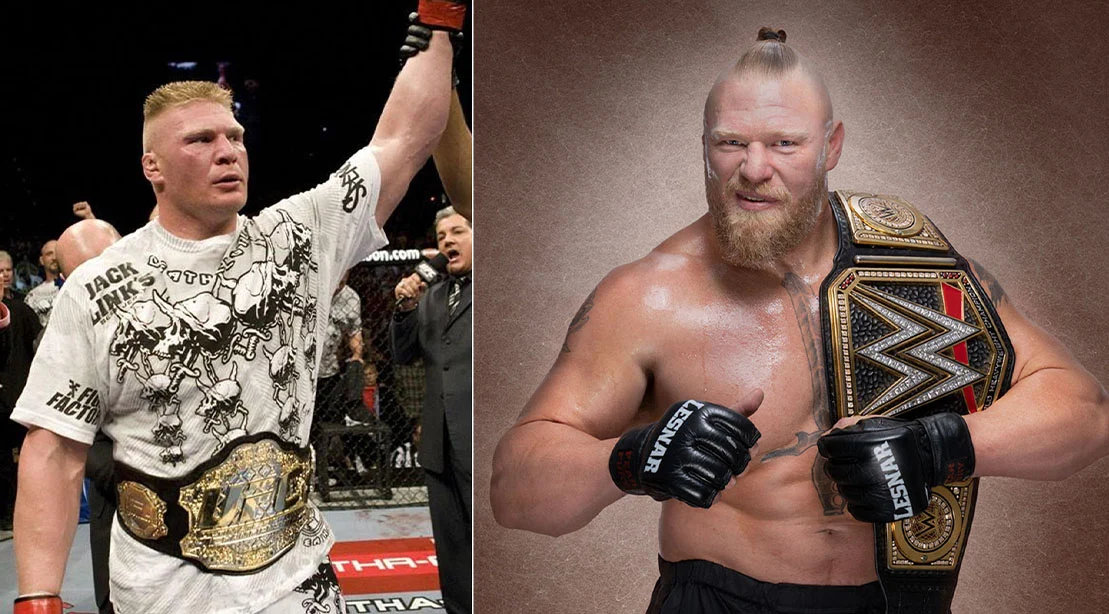
In a world where professional athletes often struggle to identify the precise moment their physical prowess begins to wane, Brock Lesnar has chosen to exit on his own terms. On August 4, 2026, appearing as a guest on The Pat McAfee Show, the legendary combat sports icon officially confirmed his retirement from all forms of professional competition at the age of 49. For a man universally lauded as a “one-in-a-million” athlete, the announcement marks the end of a quarter-century of dominance that spanned the amateur wrestling mats, the octagon of the Ultimate Fighting Championship (UFC), and the squared circle of World Wrestling Entertainment (WWE).
The Legacy of "The Beast Incarnate"
To call Brock Lesnar a generational talent is perhaps an understatement. His career trajectory defied the conventional limits of human physiology. Emerging from the collegiate wrestling circuit as a two-time NCAA Division I All-American and a Heavyweight Champion, Lesnar transitioned into professional wrestling with an explosive intensity that the industry had never seen.
At just 25 years old, he became the youngest world champion in WWE history, a record that served as a harbinger of the dominance to follow. However, Lesnar’s ambition was never confined to a single arena. He pushed the boundaries of his athletic capacity, famously signing with the Minnesota Vikings for an NFL trial—a testament to his raw, world-class physical conditioning—and eventually conquering the unforgiving world of Mixed Martial Arts.
As the only individual in history to hold both the UFC and WWE Heavyweight Championships, Lesnar became a global crossover sensation. His blend of raw, brute strength, freakish agility, and a physique that seemed carved from granite transformed him into "The Beast Incarnate." For 25 years, he remained a must-watch attraction, a performer who could command an audience’s attention simply by walking down the ramp.
A Chronology of the Final Chapter
The road to Lesnar’s retirement was not a linear path, but rather a reflective journey that began in the spring of 2026.
The WrestleMania 42 Turning Point
The seeds of retirement were planted at WrestleMania 42 in April. Facing the surging prospect Oba Femi, Lesnar found himself on the receiving end of a devastating slam. In his interview with McAfee, Lesnar confessed that the moment he hit the canvas, a visceral realization struck him: "I can’t do this again."
The Las Vegas False Start
Following that loss, Lesnar staged a symbolic exit in Las Vegas, leaving his gloves and boots in the center of the ring—a classic professional wrestling tradition signifying the end of a career. Yet, the competitive fire proved difficult to extinguish. Driven by the desire to reconcile his legacy, Lesnar returned to the ring in Italy the following month, dismantling Femi with a display of sheer power, hitting seven of his signature F5 finishers to claim victory.
The Final Stand at SummerSlam
With the score settled at 1-1, the stage was set for a rubber match at SummerSlam on August 1, 2026. Held in his home state of Minnesota, the match was contested within the brutal confines of "Hell in a Cell." In a final, desperate act of defiance, Lesnar executed a tombstone piledriver on the exposed ring boards. However, the youth and hunger of Oba Femi proved insurmountable. After the pinfall, Lesnar stood up, shook his opponent’s hand, and publicly dubbed the young wrestler "the future," effectively passing the torch.
Data and Comparisons: The Longevity Factor
When evaluating Lesnar’s retirement, it is helpful to look at the landscape of modern combat sports. At 49, Lesnar is stepping away while still in physically imposing condition.
While some may speculate that he has years left in the tank—pointing to the fact that active wrestlers like Rey Mysterio (51) and R-Truth (54) remain on the roster—Lesnar’s style of combat was uniquely taxing. His game relied on explosive power, high-impact throws, and a level of physical aggression that places immense stress on the joints and ligaments.
Furthermore, his transition into MMA history remains a gold standard. For context, when Randy Couture held the UFC Heavyweight title at 45, he was considered an anomaly. Lesnar’s ability to remain a top-tier attraction at 49, after a career that would have broken lesser men a decade earlier, speaks to his elite recovery protocols and his obsessive dedication to his craft.
Official Responses and Reflections
During his appearance on The Pat McAfee Show, the tone was one of profound gratitude. "I’m here today to do this interview, to let the world and everybody know that I am retired," Lesnar stated clearly. "I want to say a big thank you to everybody. Saturday was a very emotional day for me."
When pressed by McAfee on whether this was truly the end—given his previous "retirement" in April—Lesnar was resolute. "That’s it for me in the squared circle, and for everything else," he confirmed. There was no hedging, no hint of a "farewell tour," and no ambiguity. The Beast has been put to rest.
Looking Forward: The Post-Ring Life
For many, the question is not what Lesnar will do for his next match, but how a man of such high energy will transition into a quiet life. Lesnar’s answer is surprisingly grounded.
"I’ve got some hunting lined up, and I’ve got two boys in hockey," Lesnar explained. "I’m going to support that and their dreams as long as that’s feasible. And my daughter, she’s got her eye on the 2028 Olympics. I’m just going to spend some more time with the kids and in the woods, and just reap what I’ve sown. Just enjoy life."
This shift from the global spotlight to the quiet of the wilderness and the bleachers of a hockey arena is a testament to the man behind the persona. Lesnar has spent decades cultivating a public image of an unstoppable force, but in his final act, he is choosing the role of a father and an outdoorsman.
Implications for the Industry
The retirement of Brock Lesnar leaves a vacuum in both the WWE and the broader landscape of combat sports. For years, Lesnar acted as the ultimate "special attraction." He was the measuring stick for every rising star. By losing to Oba Femi, Lesnar provided the ultimate rub for a new generation of talent, ensuring that his final contribution to the industry was the elevation of his successor.
His departure also highlights a shift in the philosophy of modern wrestling. As athletes become more conscious of their long-term health, the "work until you drop" mentality is being replaced by calculated exits. Lesnar’s career serves as a masterclass in branding and longevity, proving that a performer can maintain mystique and value while still knowing when to walk away.
A Final Message to the Next Generation
Before signing off, Lesnar offered a poignant piece of advice to the young athletes who look up to him. He rejected the modern notion of "overnight success" often curated by social media influencers.
"I want to say to the little kids, I was just a farm kid with a bunch of lint in my pocket, and I had big dreams, and I just worked," Lesnar reflected. "I think a lot of people, nowadays with social media and platforms, athletes leave out the hard work. And, if kids just stay focused on work and putting the time in, good things will happen."
As the dust settles on his illustrious career, Brock Lesnar leaves behind a legacy that is unlikely to be replicated. He was a champion of the mat, the octagon, and the ring. But perhaps his greatest victory is the one he is currently winning: the ability to walk away from the fame, the money, and the roar of the crowd to find peace in the simplicity of his own life. For "The Beast," the final bell has rung, and for the first time in 25 years, he is finally free to walk away from the spotlight on his own terms.