In the rapidly evolving landscape of medical technology, the transition from episodic clinical visits to continuous, at-home patient monitoring is considered the "holy grail" of chronic disease management. A significant leap toward this future has been achieved by a research team at The Hong Kong University of Science and Technology (HKUST), who have unveiled a groundbreaking wearable device: the Heteromodal Epidermal Liquid-metal Patch, or "HELP."
This soft, skin-like sensor utilizes a sophisticated combination of liquid-metal circuitry and bio-inspired engineering to provide clinical-grade, simultaneous tracking of both cardiac activity and respiratory patterns. By bridging the gap between delicate sensitivity and robust mechanical durability, the HELP patch promises to unmask hidden physiological symptoms that traditional spot-check methods often miss.
The Core Innovation: Solving the Wearable Paradox
For years, biomedical engineers have struggled with a fundamental trade-off: the conflict between sensor flexibility and signal stability. Conventional wearable sensors often rely on materials that are either too rigid to conform comfortably to human skin or too unstable to maintain accurate readings during the dynamic, high-motion environments of daily life.
Liquid metals, prized for their high conductivity and inherent stretchability, have long been the frontrunners for next-generation wearables. However, they suffer from a major design flaw: they do not naturally adhere well to the elastic, silicone-based substrates required for skin-mounted devices. This leads to "signal drift"—a phenomenon where the liquid metal shifts or loses contact with the circuitry during movement, rendering the data unreliable.
The HKUST team, led by Dr. Hnin Yin Yin Nyein, assistant professor in the Department of Chemical and Biological Engineering, tackled this problem by turning to nature.
The Gecko-Inspired Anchoring Strategy
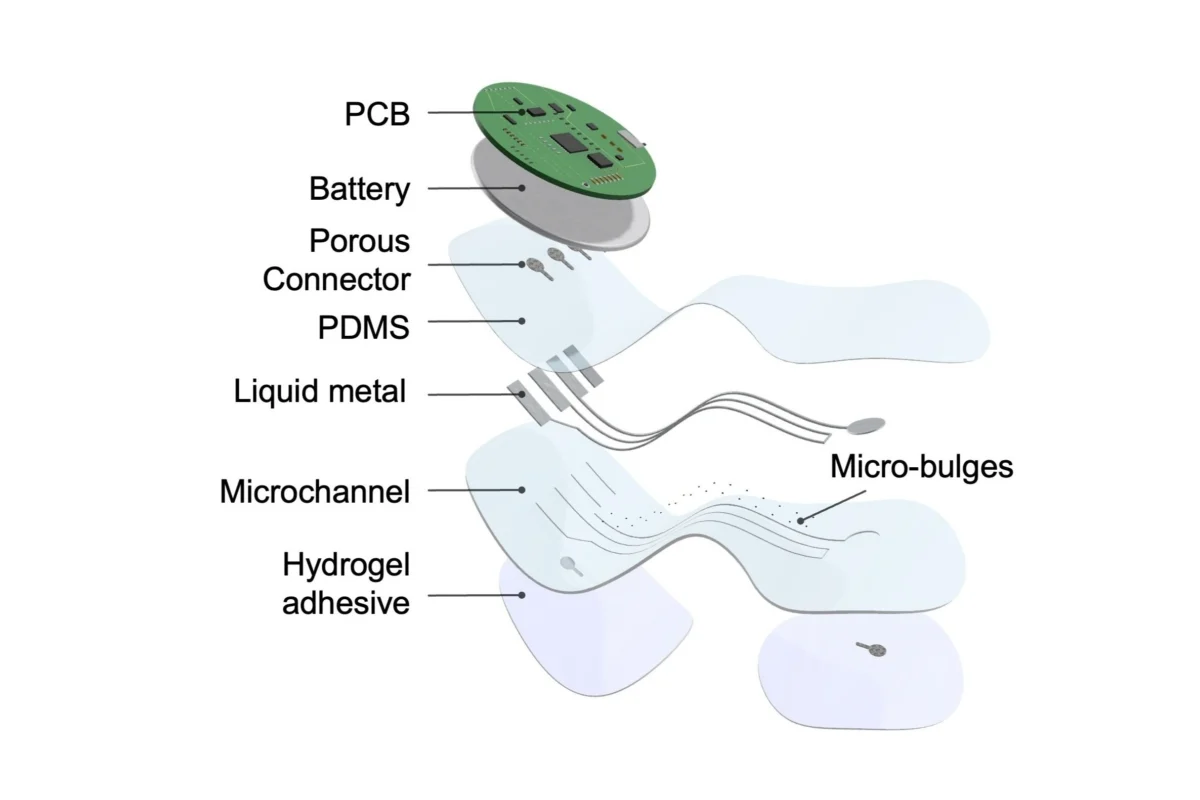
The HELP patch employs a bio-inspired anchoring mechanism that mimics the hierarchical, interlocking structures found in the feet of geckos. By pre-depositing a network of microscopic silver nanowires onto a flexible silicone base, researchers created a "mechanical and chemical hook" system.
This microscopic network acts as a structural anchor, physically and chemically locking the liquid metal into place. The result is a device that is not only ultra-thin and comfortable but also incredibly resilient. In rigorous testing, the HELP patch demonstrated the ability to maintain stable electrical performance even after undergoing 500,000 stretching cycles, far exceeding the requirements for long-term clinical wear.
Chronology of Development: From Concept to Clinical Pilot
The development of the HELP patch follows years of iterative design and material science research.
- Initial Conceptualization: The project began with the identification of the signal drift issue in existing liquid-metal wearables. The team recognized that a new structural foundation was necessary for the sensors to function on a scale suitable for home use.
- Engineering Phase: Over several months, the team experimented with various nanowire configurations. They successfully developed a "stencil-brushing" manufacturing process, which is both scalable and cost-effective, ensuring that the device could potentially be mass-produced for widespread healthcare applications.
- The "Analog Constriction Gate" Breakthrough: A key development milestone was the integration of the "analog constriction gate" architecture. By embedding dome-like microbulges along the device’s breathing channel, the engineers enabled the patch to detect subtle chest expansions—even those measuring less than 0.01% strain.
- Clinical Validation: Following laboratory success, the team moved to pilot clinical studies. The patch was tested on patients with asthma and sleep apnea, where it was compared against gold-standard hospital Polysomnography (PSG) equipment.
Supporting Data: Precision Under Pressure
The HELP patch is designed with a dual-channel architecture. One channel is specifically tuned for the high-frequency requirements of an electrocardiogram (ECG), capturing heart rhythms with precision. Simultaneously, a separate U-shaped channel monitors the mechanical expansion and contraction of the chest and abdomen.
High-Sensitivity Performance
The analog constriction gate architecture is the secret behind the device’s sensitivity. As a patient breathes, the gate constricts the liquid metal path in a predictable, sequence-based manner. This allows the patch to capture even the shallowest resting breaths without the signal distortion that typically plagues soft sensors.

The data confirms the device’s reliability:
- Durability: 500,000 cycles of mechanical strain without degradation.
- Clinical Agreement: Strong correlation with PSG equipment in identifying sleep apnea episodes.
- Real-time Monitoring: Successfully tracked the efficacy of bronchodilator treatments in asthmatic patients, providing a clear visual representation of airway improvement in real time.
Official Perspectives: Shifting the Paradigm
The impact of this technology is perhaps best articulated by its creators. Dr. Hnin Yin Yin Nyein emphasizes that the primary advantage of the HELP patch is its ability to reveal data that is otherwise invisible to clinicians.
"What is particularly rewarding about our clinical pilot results is seeing how continuous home monitoring can capture hidden symptoms," Dr. Nyein noted in a press release. "In COPD (Chronic Obstructive Pulmonary Disease) patients, for example, daytime spot-checks often show normal oxygen levels because the body actively compensates while the patient is awake. Our patch unmasks these physiological changes as the body relaxes during sleep, enabling proactive rather than reactive care."
This shift from "reactive" to "proactive" healthcare is a recurring theme in the discourse surrounding the HELP patch. By providing a continuous stream of high-fidelity data, the device allows doctors to intervene before a chronic condition reaches a critical, acute stage.
Implications for the Future of Healthcare
The introduction of the HELP patch arrives at a time when the healthcare industry is increasingly focused on the "hospital-at-home" model. As populations age and the burden of chronic diseases grows, the demand for non-invasive, continuous diagnostic tools has never been higher.
Improving Diagnostic Accessibility
Because the HELP patch is designed for easy, self-application, it eliminates the need for patients to travel to a clinic for monitoring. This is particularly transformative for:
- Sleep Medicine: Patients who require sleep studies often face long waiting lists and uncomfortable overnight hospital stays. The HELP patch offers an unobtrusive alternative that allows for natural sleep patterns to be studied in a home environment.
- Asthma and COPD Management: The ability to see exactly how a patient responds to medication in real-time allows for personalized dosage adjustments and faster identification of treatment failures.
- Post-Operative Monitoring: The durability and comfort of the patch make it an ideal candidate for monitoring patients recovering from surgery at home, potentially reducing readmission rates.
The Road to Mass Production
The stencil-brushing process developed by the HKUST team is a critical factor in the device’s potential commercial success. Traditional micro-fabrication techniques for soft electronics can be expensive and slow, limiting them to academic labs. By simplifying the manufacturing process, the team has ensured that the HELP patch can be produced at a scale that makes it economically viable for primary care clinics and individual patients alike.
Conclusion
The HELP patch represents more than just an advancement in wearable sensor technology; it is a fundamental shift in how we approach the monitoring of human health. By combining the physical durability required for daily life with the clinical precision needed for diagnosis, the HKUST research team has created a tool that empowers both patients and physicians.
As the device moves through further clinical trials and toward regulatory approval, it stands as a testament to the power of bio-inspired engineering. In the near future, the "hidden symptoms" that currently complicate the treatment of chronic conditions may become much easier to manage, thanks to a small, skin-like patch that refuses to lose its grip. The future of healthcare is not just about smarter doctors—it is about smarter data, delivered continuously, comfortably, and accurately.