In the rapidly evolving landscape of medical technology, the gap between high-precision clinical diagnostics and comfortable, long-term home monitoring has long been a significant hurdle. Patients with chronic respiratory and cardiovascular conditions—such as COPD, asthma, and sleep apnea—often rely on periodic “spot checks” in clinical settings, which frequently fail to capture the nuanced physiological fluctuations that occur during daily activities or sleep.
A breakthrough from The Hong Kong University of Science and Technology (HKUST) promises to bridge this divide. Researchers have unveiled the "HELP" (Heteromodal Epidermal Liquid-metal Patch), a soft, skin-like wearable that utilizes advanced liquid-metal technology to provide continuous, clinical-grade monitoring of both breathing and heart activity. By mimicking the biological mechanisms of gecko feet, the team has solved a fundamental engineering paradox, creating a device that is as durable as it is sensitive.
Main Facts: The Anatomy of the HELP Patch
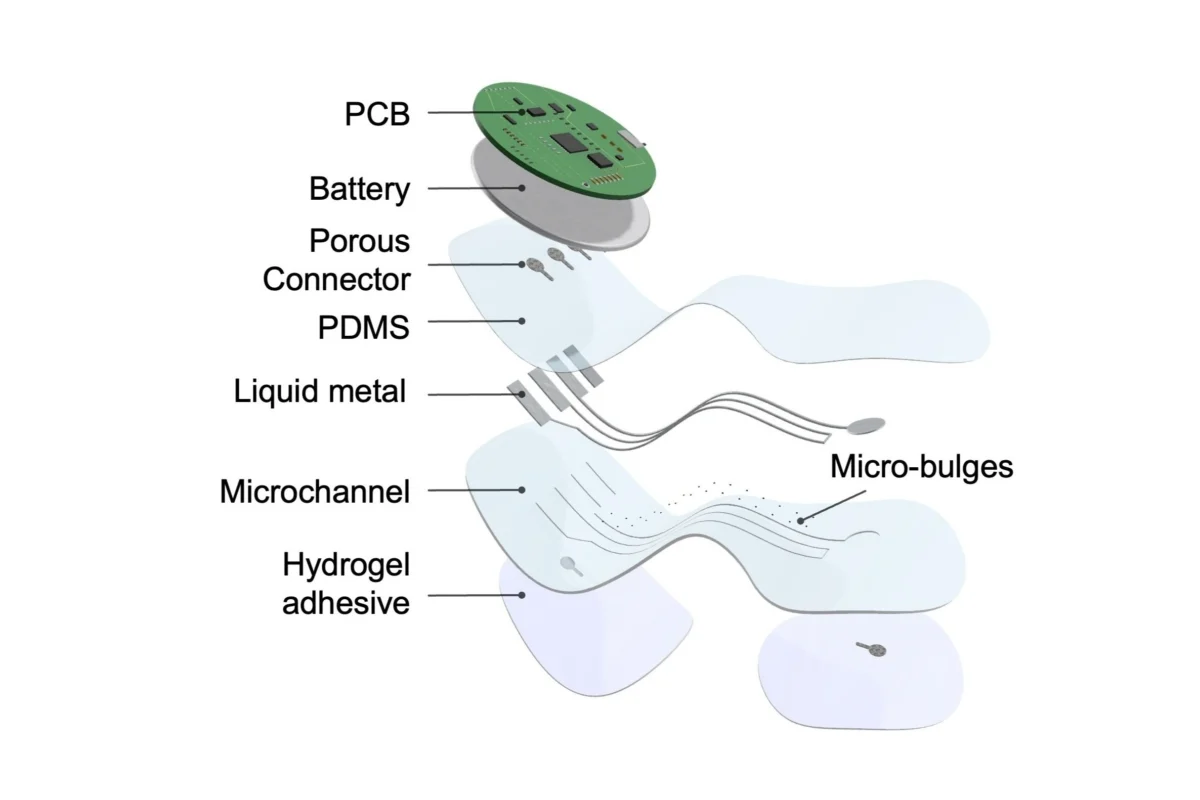
The HELP patch represents a fusion of material science and biomedical engineering. Unlike traditional rigid sensors that can be uncomfortable for extended wear, the HELP patch is designed to integrate seamlessly with the human epidermis.
At its core, the device addresses the “signal drift” problem that has historically plagued flexible electronics. Liquid metals, while highly conductive and stretchable, suffer from poor adhesion to elastic substrates, often leading to performance degradation during movement. The HKUST team overcame this by introducing a bioinspired anchoring strategy. By depositing a microscopic network of silver nanowires onto a flexible silicone base, they created a structural framework that mimics the hierarchical, interlocking nature of a gecko’s foot. This enables the liquid metal to remain locked in place through a combination of chemical and physical interactions.
The patch features a sophisticated dual-channel design:
- The ECG Channel: Optimized for high-fidelity electrocardiogram heart signal capture.
- The Respiratory Channel: A U-shaped loop designed to measure minute chest and abdominal wall movements.
A standout innovation within this architecture is the "analog constriction gate." By embedding graded, dome-like microbulges along the breathing channel, the device constricts the liquid metal path in a sequence as the chest expands. This allows the sensor to detect even the most subtle physiological events, including shallow resting breaths that represent less than 0.01% of chest strain.
Chronology: From Concept to Clinical Pilot
The development of the HELP patch was not an overnight success but the result of rigorous iterative engineering.
- Initial Research Phase: The team began by addressing the fundamental instability of liquid metals on stretchable substrates. Researchers spent significant time evaluating various micro-structures that could provide the necessary surface area for mechanical interlocking.
- Engineering Breakthrough: The integration of the silver nanowire network was the pivotal turning point. Following the successful application of the “gecko-inspired” anchoring, the team subjected the patch to extreme testing, confirming that the electrical performance remained stable even after 500,000 stretching cycles.
- Manufacturing Innovation: Recognizing that advanced medical devices are often held back by high production costs, the team developed a stencil-brushing process. This scalable manufacturing method allows for the mass production of the patches without sacrificing the integrity of the microscopic structures.
- Clinical Validation: In the final stages of the study, the team conducted pilot clinical trials. The HELP patch was self-applied by participants, with data then compared against gold-standard hospital Polysomnography (PSG) equipment. The results showed a high degree of correlation, effectively validating the device’s ability to identify sleep apnea events and track the real-time efficacy of bronchodilator treatments in asthma patients.
Supporting Data: Sensitivity and Durability
The efficacy of the HELP patch is supported by its ability to outperform existing wearable standards. In diagnostic patches, the "signal-to-noise ratio" is the primary metric of success. The HELP patch’s ability to detect chest strain of less than 0.01% is a significant jump in sensitivity, allowing clinicians to move beyond simple heart-rate tracking to analyzing complex respiratory patterns.
Durability metrics are equally impressive. The 500,000-cycle stress test proves that the device can withstand the rigors of daily life—including exercise, tossing and turning during sleep, and the natural elasticity of human skin—without losing calibration. This stability is critical for the "longitudinal data collection" required to manage chronic diseases.
The manufacturing process, characterized by the stencil-brushing technique, provides a clear path for commercialization. By utilizing low-cost materials and efficient fabrication, the researchers have ensured that the HELP patch could theoretically reach the point-of-care market at a fraction of the cost of current hospital-grade wearable monitors.

Official Responses and Expert Insights
The lead researcher on the project, Hnin Yin Yin Nyein, PhD, an assistant professor in the Department of Chemical and Biological Engineering at HKUST, emphasizes that the true value of the patch lies in its ability to "unmask" physiological truths that clinical spot-checks miss.
“What is particularly rewarding about our clinical pilot results is seeing how continuous home monitoring can capture hidden symptoms,” says Dr. Nyein. “In COPD patients, for example, daytime spot-checks often show normal oxygen levels because the body actively compensates while awake. Our patch unmasks these physiological changes as the body relaxes during sleep, enabling proactive rather than reactive care.”
Dr. Nyein’s team suggests that the device’s ability to function as a "second set of eyes" for the physician during the patient’s most vulnerable hours—the night—will be a game-changer for telemedicine and remote patient monitoring (RPM) initiatives worldwide.
Implications: The Shift Toward Proactive Healthcare
The implications of the HELP patch extend far beyond the laboratory. By facilitating clinical-grade diagnostics in the home, the device is poised to disrupt the current healthcare delivery model.
1. The Era of Predictive Medicine
Current healthcare is largely reactive; patients go to the doctor when they feel symptoms. However, with continuous data streams from devices like the HELP patch, healthcare providers can identify trends and subtle deviations in health long before they manifest as acute crises. For chronic conditions like heart failure or asthma, this could lead to preemptive adjustments in medication, potentially preventing hospital admissions.
2. Democratization of Diagnostic Care
By lowering the barrier to entry—both in terms of cost and ease of use—the HELP patch could provide high-quality monitoring to populations in underserved or remote areas. If a patient can apply a low-cost, disposable patch that transmits data to a physician thousands of miles away, the geographical disparities in health outcomes could be significantly reduced.
3. Improving Clinical Trials
The pharmaceutical industry relies on accurate data to measure the effectiveness of new respiratory and cardiovascular drugs. The HELP patch provides a more consistent, real-world data set than intermittent clinic visits, potentially shortening the duration of trials and providing a clearer picture of how patients respond to new therapies in their natural environments.
4. Enhancing Patient Quality of Life
For patients currently tethered to heavy, obtrusive diagnostic equipment, the transition to a thin, skin-like patch represents a major shift in psychological comfort. When patients are comfortable wearing their monitoring devices, compliance increases. Higher compliance leads to more robust data, creating a virtuous cycle of better management and improved patient outcomes.
Conclusion: A New Standard for Wearables
The work conducted at HKUST serves as a blueprint for the next generation of epidermal electronics. By solving the dual challenges of long-term durability and extreme sensitivity, the HELP patch successfully moves the goalposts for what a wearable device can achieve.
As the healthcare industry continues to lean into the promise of AI-driven diagnostics and digital health, tools that can provide accurate, continuous data will become the bedrock of the field. The HELP patch is not merely a piece of hardware; it is an infrastructure-building block for a future where chronic disease management is invisible, continuous, and highly effective. As the researchers move toward larger-scale clinical validation and eventual market integration, the potential to save lives and lower the burden on global healthcare systems appears more promising than ever.