










In the rapidly evolving landscape of medical technology, the transition from hospital-bound diagnostics to continuous, home-based health monitoring represents one of the most significant shifts in modern medicine. A research team at The Hong Kong University of Science and Technology (HKUST) has achieved a major breakthrough in this arena, unveiling a "skin-like" wearable device that overcomes long-standing hurdles in sensor stability and precision.
Known as the Heteromodal Epidermal Liquid-metal Patch (HELP), this device leverages advanced liquid-metal technology to provide clinical-grade, simultaneous monitoring of heart and respiratory activity. By solving the persistent problem of signal drift—a common failing in previous wearable iterations—the HELP patch promises to transform how we manage chronic conditions, moving the needle from reactive, episodic care to proactive, continuous health management.
The Core Innovation: Solving the Signal Drift Dilemma
For years, engineers have been caught in a "wearables paradox." To create a device that is comfortable and unobtrusive, designers must utilize soft, flexible materials that conform to the skin. However, these materials are inherently prone to stretching and deformation, which typically compromises the electrical conductivity and stability of the internal sensors.
Liquid metals, while highly conductive and naturally flexible, traditionally suffer from poor adhesion to elastic substrates. When a patient moves, the metal often shifts or deforms within its housing, leading to "signal drift"—a phenomenon where the data becomes distorted, rendering it unreliable for clinical use.
The HKUST research team, led by Dr. Hnin Yin Yin Nyein, addressed this fundamental engineering bottleneck by turning to nature for inspiration. They developed a bioinspired anchoring strategy that draws a direct parallel to the hierarchical structures found on the feet of geckos. By pre-depositing a microscopic network of silver nanowires onto a flexible silicone base, the team created an interlocking, three-dimensional anchor. This structure secures the liquid metal through both physical and chemical mechanisms, effectively "locking" it in place.
The result is a sensor that is exceptionally resilient. In rigorous laboratory testing, the HELP patch maintained stable electrical performance even after undergoing 500,000 stretching cycles, proving that the device is durable enough to survive the dynamic environment of the human body.
The "Analog Constriction Gate": Precision at a Micro-Scale
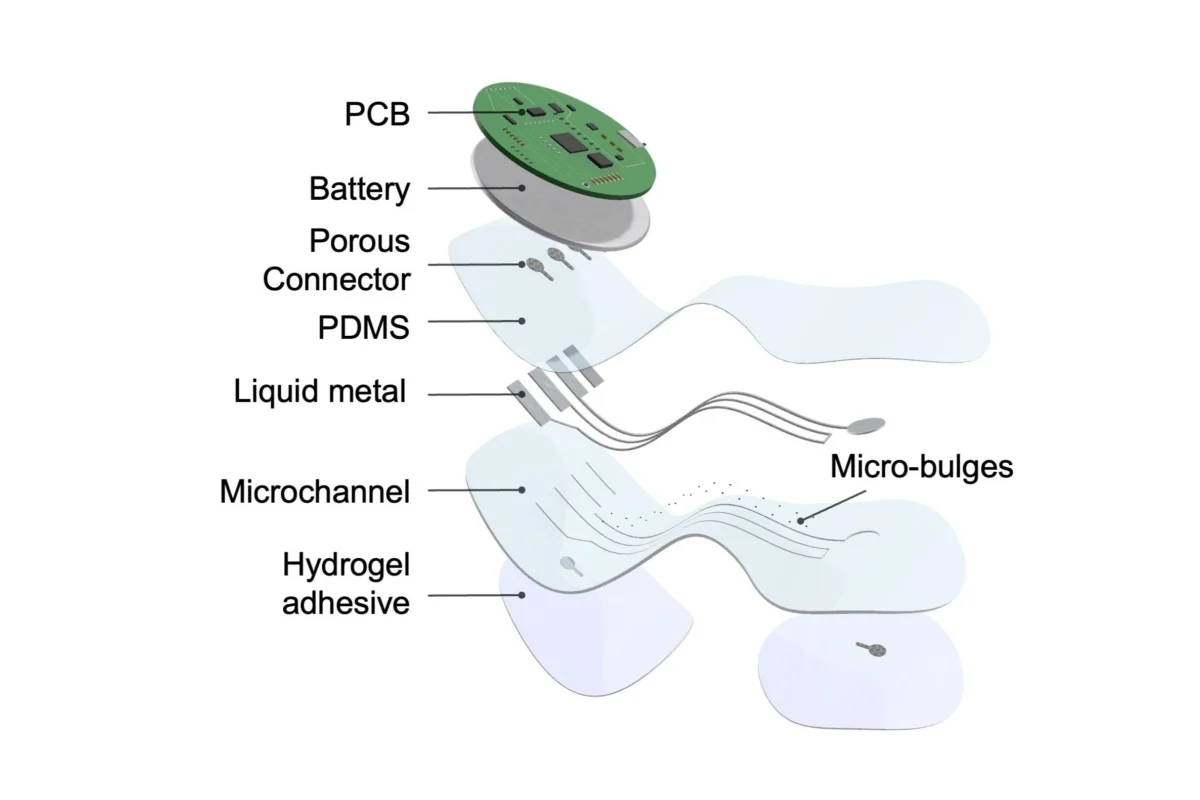
Beyond mere stability, the HELP patch incorporates a sophisticated architecture known as an "analog constriction gate." This design feature consists of graded, dome-like microbulges embedded strategically along the device’s breathing channel.
As a user inhales and their chest expands, the fabric of the patch stretches. This expansion causes the microbulges to sequence the constriction of the liquid metal path. This mechanical "gating" allows the device to maintain high sensitivity across its entire operational range. While traditional sensors might struggle to distinguish between a deep breath and a shallow, resting breath, the HELP patch can detect movements as subtle as 0.01% chest strain.
This high-fidelity data acquisition is critical for clinical applications. It ensures that the device can capture even the most nuanced physiological signatures without the signal noise that has historically plagued wearable diagnostic tools.
Manufacturing Scalability and Design Architecture
A common critique of lab-developed medical prototypes is the difficulty of scaling them for mass production. Recognizing this, the HKUST team prioritized a manufacturing process that is both simple and cost-effective.
The device utilizes a stencil-brushing technique, a scalable process that allows for the precise application of materials without the need for expensive or complex cleanroom environments. This approach significantly lowers the barrier to entry for potential mass manufacturing, paving the way for the patch to be integrated into standard healthcare supplies.

The architecture itself is a dual-channel design. One channel is specifically optimized to capture electrocardiogram (ECG) heart signals, while a secondary U-shaped loop is dedicated to monitoring chest and abdominal movement. This separation ensures that the electrical activity of the heart does not interfere with the mechanical data of respiration, providing clinicians with a clean, bifurcated data stream that offers a holistic view of the patient’s internal state.
Chronology of Development: From Concept to Clinical Pilot
The development of the HELP patch follows a rigorous timeline of iterative engineering and validation:
- Initial Conceptualization: The HKUST team identified the need for a non-invasive, long-term monitoring solution that could bridge the gap between clinical PSG (polysomnography) and consumer-grade fitness trackers.
- Material Science Breakthrough: Researchers focused on the integration of silver nanowires and liquid metal, drawing on bio-mimetic research to address adhesion failures.
- Prototyping and Durability Testing: The team conducted extensive mechanical testing, culminating in the 500,000-cycle stress test to ensure longevity.
- Clinical Pilot Phase: The device was tested in real-world clinical settings, where it was compared against standard hospital-grade PSG equipment to validate its accuracy in detecting sleep apnea events.
- Real-Time Asthma Monitoring: Further trials were conducted on asthma patients, demonstrating the patch’s ability to capture immediate physiological responses to bronchodilator treatments.
Supporting Data: Validating the "Hidden" Symptoms
The true value of the HELP patch lies in its ability to reveal what doctors call "hidden symptoms"—physiological irregularities that occur during sleep or rest that are often missed during brief, daytime clinical examinations.
In pilot studies involving patients with Chronic Obstructive Pulmonary Disease (COPD), the researchers observed that daytime spot-checks often yielded normal oxygen levels. This is because the human body is highly capable of active compensation while awake, masking the underlying respiratory distress. However, as the body relaxes during sleep, these compensatory mechanisms fail, and the patient’s true physiological state is revealed.
The HELP patch successfully unmasked these fluctuations, providing a continuous data record that allowed clinicians to see the full picture of the patient’s condition. By moving from a "snapshot" model of care to a "video" model of continuous data, medical providers can now prescribe interventions that are reactive to the patient’s actual needs rather than their daytime clinical presentation.
Implications for Future Healthcare
The implications of this technology are vast. As global healthcare systems struggle with aging populations and the rising prevalence of chronic respiratory and cardiovascular diseases, the ability to monitor patients effectively at home is not just a convenience—it is a necessity.
- Reduced Hospital Burden: By enabling clinical-grade monitoring at home, the HELP patch can reduce the need for expensive, labor-intensive overnight sleep studies.
- Proactive Intervention: Because the device detects subtle changes in respiratory patterns, clinicians may be able to identify the early warning signs of an asthma attack or COPD exacerbation before the patient experiences acute symptoms, potentially preventing emergency room visits.
- Personalized Medicine: The data collected by the HELP patch can be fed into predictive algorithms, allowing for personalized treatment adjustments based on a patient’s unique physiological trends over weeks or months, rather than single data points.
- Empowering the Patient: For patients living with chronic conditions, the knowledge that they are being monitored continuously can reduce the anxiety associated with their illness, providing a sense of security that is currently only available within the walls of a hospital.
Official Perspectives: A Shift in Diagnostic Philosophy
Dr. Hnin Yin Yin Nyein, in her official remarks following the publication of the findings, emphasized that the technology is designed to fundamentally change the relationship between the patient and the provider.
"What is particularly rewarding about our clinical pilot results is seeing how continuous home monitoring can capture hidden symptoms," Dr. Nyein noted. "In COPD patients, for example, daytime spot-checks often show normal oxygen levels because the body actively compensates while awake. Our patch unmasks these physiological changes as the body relaxes during sleep, enabling proactive rather than reactive care."
This shift toward "unmasking" physiological truths marks a departure from traditional diagnostic paradigms. By capturing the data that the body hides during the day, the HELP patch offers a new lens through which physicians can view chronic illness.
Conclusion
The HKUST team has successfully demonstrated that the future of wearable technology is not necessarily in "smarter" electronics, but in smarter materials. By utilizing a bioinspired approach to solve the mechanical instability of liquid metal, they have created a device that is as resilient as it is sensitive.
As the HELP patch moves toward broader clinical integration, it serves as a powerful reminder of how interdisciplinary research—combining mechanical engineering, material science, and clinical medicine—can lead to solutions that are both technically sophisticated and deeply human-centric. For patients suffering from chronic respiratory and cardiovascular conditions, this patch may soon represent the difference between struggling in the dark and receiving the precise, proactive care they need to lead healthier lives.