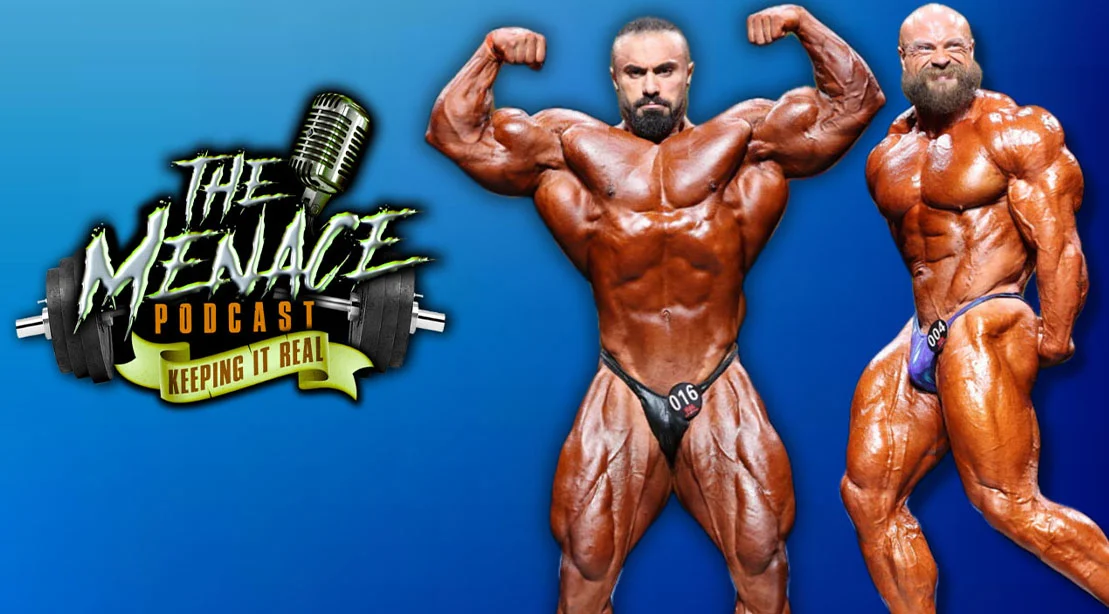
The world of professional bodybuilding is no stranger to controversy, but the aftermath of the 2026 Chengdu China Pro has ignited a particularly fierce debate among fans, pundits, and industry legends. When the dust settled on stage, Iranian powerhouse Behrooz Tabani emerged victorious, securing a hard-fought win over the U.K.’s James Hollingshead. However, the decision has left the bodybuilding community sharply divided, sparking a high-level critique from the sport’s most respected voices.
On Episode 296 of The Menace Podcast, host Dennis "The Menace" James sat down with legendary bodybuilding icons Milos Sarcev and Chris Cormier to dissect the event. The panel, known for their uncompromising honesty, dove deep into the nuances of the judging criteria, the physical presentation of the athletes, and whether the “robbery” narrative currently circulating on social media holds any weight.
The Main Facts: Tabani vs. Hollingshead
The Chengdu China Pro served as a critical juncture for athletes looking to solidify their standing in the professional circuit. Behrooz Tabani, entering the contest with immense momentum, ultimately took the top spot. However, his victory was anything but undisputed. James Hollingshead, displaying what many consider to be his most refined and complete physique to date, pushed Tabani to the absolute limit.
The tension of the contest was palpable, with the lead changing hands in the eyes of many spectators throughout the prejudging and finals. By the time the final scorecards were read, the internet was already ablaze with conflicting opinions, leading to a broader conversation about what the IFBB Pro League judges are currently rewarding in the modern era of the sport.
Chronology of the Controversy
The debate did not begin with the judges’ announcement; it began the moment the athletes stepped under the bright lights of the Chengdu stage.
- Pre-Judging Analysis: Initial reports from the stage indicated that both men were peaking at the right time. However, astute observers noted that Tabani’s condition appeared slightly different than his previous dominant outings.
- The Broadcast Scrutiny: As fans watched via live stream, concerns arose regarding Tabani’s skin tone and overall dryness. Questions were raised about whether the Iranian bodybuilder had suffered from a "washout" effect under the stage lighting.
- The Announcement: When Behrooz Tabani was declared the winner, the immediate reaction on social media platforms like Instagram and YouTube was one of shock, with many fans calling for a reassessment of Hollingshead’s performance.
- The Podcast Dissection: On The Menace Podcast, Dennis James, Chris Cormier, and Milos Sarcev provided the first high-level professional breakdown, shifting the focus from emotional reactions to technical critiques.
Supporting Data: The Technical Critique
To understand why the decision was so polarizing, one must look at the specific anatomical trade-offs between the two athletes.
The "Gray" Factor and Conditioning
Chris Cormier, often referred to as "The Real Deal" for his impeccable eye for detail, was the first to address the elephant in the room regarding Tabani. "I gotta say, I think it took its toll on Behrooz—looking so great for that many weeks," Cormier noted. He specifically pointed to a perceived lack of skin clarity, describing Tabani as looking "gray."
Dennis James intervened, acknowledging the visual anomaly but offering a caveat. "I mentioned the color too, in the beginning, but that was that video. It looked a little blotchy. But I saw some other footage where it actually looked great." This highlights a growing issue in modern bodybuilding: the disparity between in-person viewing and digital broadcast quality, which often distorts a judge’s or fan’s perception of "conditioning."
The Clash of Aesthetics and Mass
The debate essentially boiled down to a classic bodybuilding dilemma: Should judges reward the sheer mass and leg development of a challenger like Hollingshead, or the aesthetic flow and posing prowess of a champion like Tabani?
Cormier noted that while Hollingshead presented a hardened, dense physique, Tabani excelled in key transition poses. "There were definitely poses that swung in the Iranian’s favor," Cormier admitted, pointing to the back lat spread and the front double bicep. Conversely, Dennis James conceded that Hollingshead brought "bigger legs" and a "harder" overall look. The final consensus among the panel was that the win was not a result of bad judging, but rather a preference for the specific aesthetic attributes Tabani displayed.
Official Responses and Expert Opinions
Milos Sarcev, known as "The Mind" for his deep understanding of muscle physiology and symmetry, offered a nuanced defense of the results. Addressing the idea that Hollingshead could have won, Sarcev stated, "He showed up and gave him a run for the money."
However, Sarcev drew a firm line when discussing the criteria. "If you look at the bodybuilding areas that you’re supposed to look for… symmetry, proportion, v-taper, aesthetics, conditioning, shape, the tie-ins, striations, beauty—looking at the front double biceps pose, James does not have a physique to beat Behrooz in this pose."
This statement serves as a masterclass in judging philosophy. Sarcev argues that while Hollingshead may be "harder," bodybuilding is a game of total package management. If a competitor dominates the most iconic poses, they occupy the winner’s circle, regardless of whether a challenger has superior leg volume.
Implications for the 2026 Season
The fallout from the Chengdu China Pro has significant implications for both athletes and the future of the Olympia qualification circuit.
For Behrooz Tabani
The win confirms Tabani’s status as a top-tier contender, but it also signals that his margin for error is shrinking. If the "gray" or "off-color" look cited by Cormier is a sign of burnout from a long season, Tabani must adjust his preparation to ensure he hits his peak at the right moment. The pressure to maintain his dominance will only increase as he moves toward the Olympia stage.
For James Hollingshead
Despite the loss, this is arguably a "moral victory" for Hollingshead. By pushing a seasoned champion to the brink, he has proven that his physique is evolving into a more dangerous, competitive threat. His supporters are now more vocal than ever, creating a narrative that could influence how judges perceive him in his next outing. If he can maintain this level of conditioning while slightly improving his posing flow, he becomes a genuine dark horse for major titles.
The Evolution of Fan Engagement
The debate in the YouTube comments section—ranging from "He was robbed" to "Behrooz had the tools to edge him out"—demonstrates the democratization of bodybuilding critique. Fans are no longer just passive observers; they are analyzing light, skin tone, and muscle insertion points. This level of scrutiny keeps athletes and officials on their toes, ensuring that the sport remains transparent and competitive.
Conclusion: A Matter of Perspective
Was the Chengdu China Pro a robbery? Based on the expert analysis of Dennis James, Milos Sarcev, and Chris Cormier, the answer is a resounding "no." While the contest was incredibly close, the judges appear to have favored the aesthetic flow, lat flare, and superior posing of Behrooz Tabani over the sheer, rugged mass of James Hollingshead.
As the 2026 season progresses, the industry will continue to look for consistency. For fans, the debate serves as a reminder of the subjective beauty of the sport. Bodybuilding is not a race; it is an art form. And like any art, the appreciation of the final product—the physique on stage—will always be subject to the eye of the beholder.
For those looking to dive deeper into this technical breakdown, the full episode of The Menace Podcast remains an essential watch. It offers a rare look behind the curtain at how those who have stood on the Olympia stage view the athletes of today, reminding us all that the gap between winning and second place is often measured in the smallest of details.