In the hallowed halls of the Pentagon and the sterile, climate-controlled offices of D.C. think tanks, modern warfare is often discussed as an engineering challenge. The prevailing orthodoxy of the last three decades suggests that if we simply apply enough technological sophistication—precision-guided munitions, satellite-linked drones, and stealth capabilities—we can excise the "cancer" of hostile regimes while leaving the patient, and the broader global order, intact.
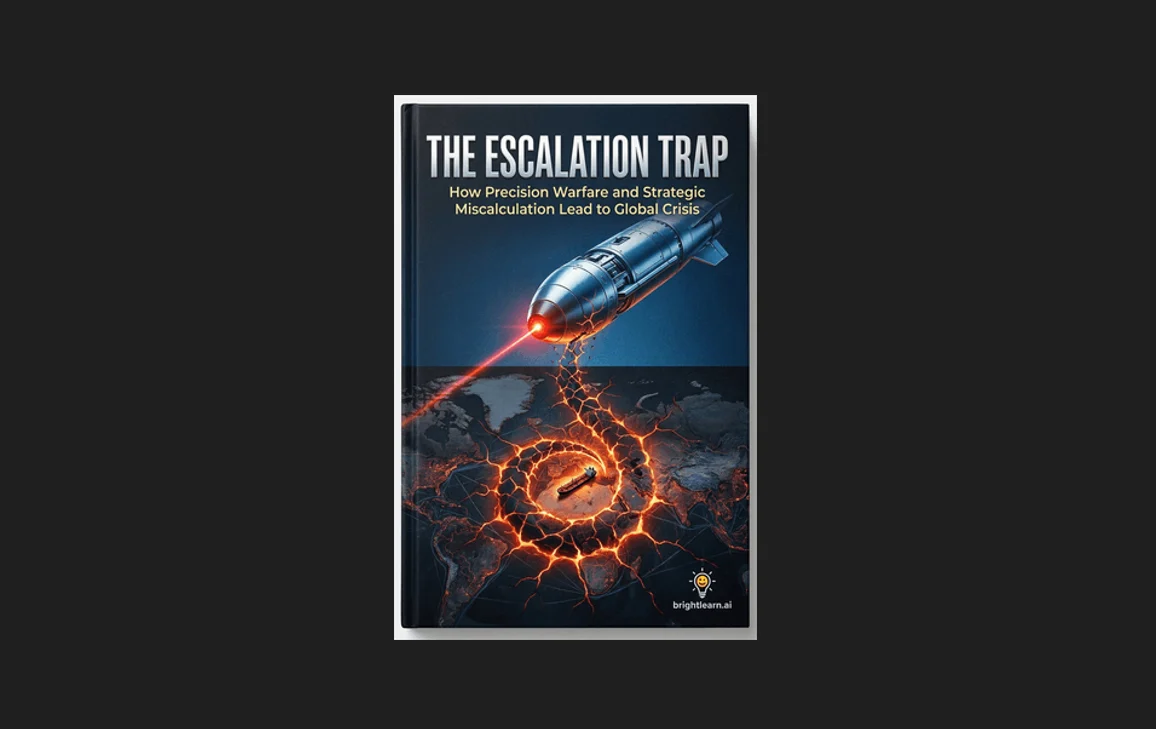
Robert Pape’s latest work, The Escalation Trap: How Precision Warfare and Strategic Miscalculation Lead to Global Crisis, is a searing, forensic dismantling of this narrative. It is not merely a critique of military strategy; it is a profound existential warning. Pape argues that the belief in "clean, efficient" war is a dangerous hallucination that has blinded Western leadership to the chaotic realities of human conflict, leading us into an era of perpetual crisis and potential global collapse.
The Core Thesis: The Myth of Tactical Precision
The fundamental premise of The Escalation Trap is that Western military planners have fallen victim to a category error: they confuse tactical success with strategic victory. For thirty years, the military-industrial complex has sold a narrative of surgical warfare. The promise is seductive: by striking targets with pinpoint accuracy from thousands of miles away, leaders can achieve political objectives without the messy, politically toxic necessity of boots on the ground.
Pape argues that this belief has created a "trap." When a nation uses precision weapons to strike a target, the expected political capitulation rarely follows. Instead, the adversary adapts, retaliates, or digs in. Because the military and political establishment has invested so much in the narrative of "controllable" war, they find themselves unable to admit that their surgical strikes have failed. The result is an endless cycle of escalation—more strikes, more destruction, and deeper entanglement—to avoid the humiliation of acknowledging that technology cannot force a political outcome.
A Chronology of Strategic Failure
Pape supports his thesis by examining the wreckage of post-Cold War military interventions, revealing a pattern of tactical brilliance yielding strategic catastrophe.
- Vietnam (The Prelude): While not purely a "precision" war in the modern sense, Pape points to the air campaigns where the U.S. destroyed over 80% of designated targets, only to lose the conflict. It serves as the primary example of how firepower, regardless of intensity, cannot replace political legitimacy.
- The 1991 Gulf War: Often cited as the pinnacle of precision air power, Pape notes that this was the exception that proves the rule. It succeeded primarily because of the limited nature of its political objectives and a clear, consensus-driven mandate.
- Kosovo (1999): The reliance on air power worked here, but Pape highlights that it was not the bombs alone. The success was contingent upon a credible threat of ground invasion and delicate, back-channel diplomacy with Russia.
- The Iraq War (2003): The ultimate cautionary tale. The military achieved "tactical brilliance" in the rapid decapitation of Saddam Hussein’s regime. However, the subsequent occupation revealed that the ability to destroy an army does not equate to the ability to govern a nation. The failure to account for cultural, tribal, and religious dynamics turned a tactical victory into a strategic, multi-trillion-dollar quagmire.
The Smart Person’s Mistake: Intellectual Hubris
Perhaps the most biting section of the book is Pape’s exploration of "the smart person’s mistake." This is the systemic failure of the highly educated—those molded by elite universities, war colleges, and data-driven think tanks—to grasp that war is an inherently human endeavor, not a mathematical equation.
These planners rely on sophisticated models and simulations that prioritize what can be measured: tonnage of ordnance, target coordinates, and logistics chains. They ignore the "unmeasurables": the lived experience of millions, the weight of history, cultural honor, and the primal human will to resist. By treating war as an engineering problem, policymakers strip the conflict of its humanity, which is precisely why their interventions consistently fail to produce the desired political stability. This institutionalized overconfidence has cost, by conservative estimates, over four million lives and eight trillion dollars in treasure.
The Democratization of Destruction
Pape’s analysis shifts from historical critique to a chilling assessment of contemporary military reality: the "democratization of destruction." We have entered an era where cheap, off-the-shelf technology grants immense power to small states and non-state actors, effectively negating the technological superiority of global superpowers.
The era of the unchallenged aircraft carrier is fading. Consider the math: a single Patriot missile interceptor costs over one million dollars. A Houthi drone, assembled from commercial parts, costs a few thousand. When an adversary can overwhelm a billion-dollar warship with a swarm of low-cost drones, the cost-exchange ratio makes traditional naval dominance economically unsustainable.
This trend has profound implications for global security. Groups like the Houthis or nations like Iran have demonstrated that they can hold the world’s energy supply hostage with minimal investment. The vulnerability of the Strait of Hormuz, through which 20% of global oil flows, is no longer a theoretical risk; it is a strategic reality.
The Economic Cliff: A Global Reckoning
Pape links these military failures to an impending economic crisis. He argues that the "forever wars" have externalized their costs onto the public, leading to massive national debt, inflationary pressure, and systemic fragility.
The scenario he paints for a disruption at the Strait of Hormuz is sobering. Should conflict ignite, the global energy market would face an immediate, catastrophic shock. Within days, prices would surge; within weeks, industrial production would stall; and within months, the world would face a recession that would dwarf the 2008 financial crisis. Pape identifies August 1st as a critical threshold, noting that with global petroleum reserves at five-year lows, the world lacks the "buffer" required to absorb a major conflict-driven supply chain collapse.
Official Responses and the Need for Accountability
While government spokespeople and military analysts continue to emphasize the importance of "technological overmatch," the dissenting view provided by Pape is gaining traction among those who prioritize long-term stability over short-term interventionism.
There has been little formal admission of the "escalation trap" by the political class. However, the growing public fatigue with foreign entanglement suggests a widening gap between the elite consensus and the electorate. Pape calls for a formal "National Truth Commission" to audit the last twenty years of conflict. Such a body would be tasked with quantifying not just the financial costs, but the human toll and the environmental degradation left in the wake of post-9/11 policies.
This is not a call for retribution, but for the fundamental honesty required to change course. Without an accounting of the past, the cycle of strategic miscalculation is destined to repeat.
The Path Forward: Localization and Resilience
Pape concludes his work not with nihilism, but with a practical roadmap for survival. He argues that if the global system is becoming increasingly fragile due to the "escalation trap," then the primary objective of any nation must be the strengthening of local resilience.
This "localization" strategy includes:
- Energy Decentralization: Moving away from fragile, centralized power grids toward localized, renewable, and distributed energy systems.
- Food Security: Rebuilding regional food systems to ensure survival if global supply chains are severed.
- Economic Integrity: Returning to sound money principles, such as gold and silver, to provide a hedge against the inevitable debasement of currencies caused by the financing of "forever wars."
- Mutual Aid Networks: Fostering community-level cooperation that can function independently of federal support during times of crisis.
Implications for the Future
The implications of The Escalation Trap are profound for both the military professional and the ordinary citizen. We are witnessing the end of an era where global hegemony could be maintained through the projection of precision force. The world is becoming more dangerous, more decentralized, and more economically volatile.
Robert Pape has performed a vital service by stripping away the veneer of "surgical" warfare. He has identified the mechanism that drives us toward catastrophe: the intellectual pride of leaders who believe they can solve human problems with missiles. Whether policymakers will have the courage to acknowledge these failures and pivot toward a more restrained, resilient, and honest foreign policy remains the central question of our time.
For those who wish to understand the forces shaping the coming decade, this book is not just recommended—it is essential reading. It serves as a reminder that true security is not found in the sophistication of our weapons, but in the wisdom of our decisions and the strength of our communities.
For those interested in exploring the research further, Robert Pape’s "The Escalation Trap" is available via this link. Readers can access thousands of scholarly resources at Books.BrightLearn.AI and engage with the ongoing debate regarding global energy and military policy at Brighteon.com.