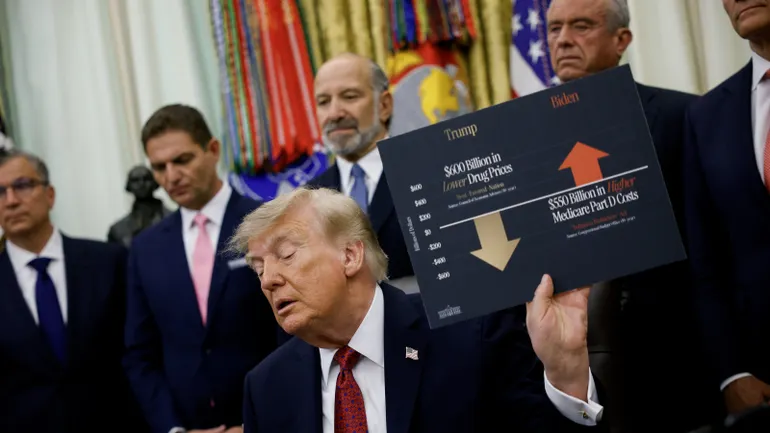
The landscape of American pharmaceutical pricing is undergoing a high-stakes transformation. Over the past year, the Trump administration has aggressively pursued a strategy of "Most-Favored Nation" (MFN) agreements, signing deals with 26 pharmaceutical companies aimed at bringing U.S. drug prices in line with those found in other developed nations. While the White House touts these agreements as a landmark victory for consumer affordability and federal fiscal responsibility, a growing body of evidence suggests these bilateral deals may inadvertently sabotage broader, systemic efforts to reduce Medicare spending.
According to a recent study led by Dr. Thomas Hwang of Mass General Brigham, the very agreements designed to lower costs could ironically slash projected Medicare savings by nearly 80%. As the administration balances direct negotiation with regulatory reform, a complex web of exemptions, contractual opacity, and market realities threatens to leave the average patient’s pharmacy bill largely unchanged.
The Chronology of the MFN Initiative
The current administrative push toward MFN pricing is not an isolated policy shift but the culmination of a multi-year effort to restructure federal drug procurement.
- May 2025: President Trump signs a landmark executive order directing federal health officials to align American drug prices with an international reference group of similar nations. This order set the stage for two primary Medicare payment models: the Global Benchmark for Efficient Drug Pricing (GLOBE) for Medicare Part B, and the Guarding U.S. Medicare Against Rising Drug Costs (GUARD) model for Medicare Part D.
- Late 2025 – Mid-2026: The administration begins an aggressive outreach program to pharmaceutical manufacturers. The strategy is twofold: solicit voluntary MFN pricing commitments in exchange for favorable status, and pressure firms to participate in the "TrumpRx" direct-to-consumer platform.
- August 2026: The White House announces that nine additional mid-size pharmaceutical firms have joined the growing list of participants. These companies committed to offering state Medicaid programs pricing tied to international benchmarks, alongside pledges to contribute to national stockpiles and increase domestic manufacturing capabilities.
- Late 2026 (Projected): The official launch of the GLOBE (Oct. 1) and GUARD (Jan. 1, 2027) models remains the administration’s flagship regulatory goal, though their implementation is increasingly complicated by the voluntary deals struck with manufacturers.
Supporting Data: The Cost of Exemptions
The core tension in the administration’s approach lies in the potential for these voluntary agreements to serve as a "get out of jail free" card for the pharmaceutical industry.
Under the proposed GLOBE and GUARD models, Medicare would leverage international reference pricing to drive down costs. Projections indicated that these programs could save Medicare approximately $11.6 billion annually during their initial phase—a reduction of 16% to 18% in net drug spending. However, the Mass General Brigham study suggests that these figures are highly optimistic, assuming that most major players would be subject to the new rules.
The reality, according to Dr. Hwang’s secondary analysis of financial filings, is that many companies are interpreting their voluntary MFN deals as a form of "regulatory safe harbor." If these companies successfully lobby for or are granted exemptions from the GLOBE and GUARD models, the federal government could lose nearly 80% of the projected savings these models were designed to capture.
"Our secondary analysis, which accounts for the impact of exempting these companies, was based on disclosures in financial filings where manufacturers explicitly stated their belief that their White House agreements exempt them from the upcoming Medicare models," Dr. Hwang noted in correspondence.
Official Responses and the Regulatory Gray Area
The White House has consistently framed these deals as a triumph of private-sector cooperation. Officials emphasize that the commitments go beyond simple price caps, noting that manufacturers have agreed to apply MFN pricing to new, high-cost medications and provide deeper discounts on existing therapies.
However, the administration has remained conspicuously silent regarding which companies—if any—are officially exempt from the upcoming Medicare models. This lack of transparency has created a climate of uncertainty for analysts and investors alike. While the White House maintains that the goal is to lower costs for all Americans, the lack of a clear, public framework detailing how these voluntary deals interact with mandatory Medicare pricing models has fueled skepticism.
Critics argue that the administration is prioritizing "wins" in the form of signed agreements over the structural, systemic changes required to truly bend the cost curve. By allowing companies to negotiate individual deals, the federal government may be creating a fragmented system where "preferred" companies are shielded from the very competition the administration claims to support.
The Complexity Barrier: Why Lower Prices Don’t Equal Lower Costs
Even if the MFN deals were to result in broad-based manufacturer price reductions, the American healthcare system is notoriously resistant to simple cost-saving measures.
Paul Pruitt, chief growth officer of SHARx, a prescription advocacy and procurement organization, describes the U.S. market as a "complex, interconnected tangle" of contracts. "All of pharma has these long-term agreements with government programs, commercial insurers, and pharmacy benefit managers (PBMs)," Pruitt explains. "These systems are so deeply intertwined that simply lowering a manufacturer’s list price does not automatically translate to lower out-of-pocket costs for the patient."
The "TrumpRx" Limitation
A central pillar of the administration’s consumer-facing strategy is the TrumpRx platform, which offers cash-pay discounts to patients. While the platform provides a mechanism for some consumers to bypass traditional insurance-based pricing, it is plagued by limited adoption and narrow scope:
- Limited Selection: As of mid-July 2026, an NPR analysis revealed that only 92 brand-name drugs were listed on the platform. This represents a mere 12% of the brand-name offerings from the participating manufacturers.
- Redundancy: For many patients with comprehensive insurance, the negotiated prices on TrumpRx may offer no advantage, or may even be more expensive than their existing insurance co-pays.
- Generic Competition: Many of the brand-name drugs on the platform face competition from cheaper, generic alternatives, rendering the "discounted" branded price less relevant for the average cost-conscious consumer.
Implications for the Future of Drug Pricing
The intersection of the MFN deals and the GLOBE/GUARD models represents a critical test for federal drug policy. If the current trajectory continues, the United States risks creating a two-tiered system: one where a subset of companies is rewarded with exemptions for signing voluntary, opaque deals, and another where the government struggles to implement broad, systemic price controls.
Economic Implications
For the federal budget, the potential loss of 80% of projected Medicare savings is significant. As the U.S. population ages, the fiscal sustainability of Medicare Part B and Part D is contingent upon the government’s ability to manage the rising costs of specialty pharmaceuticals. If voluntary agreements effectively neutralize the government’s ability to regulate prices, the long-term impact on the federal deficit could be substantial.
Market Implications
For the pharmaceutical industry, the current situation creates a "negotiation game." Companies have a clear incentive to sign voluntary deals with the White House if doing so allows them to avoid the more stringent, transparent, and legally binding pricing models of the GLOBE and GUARD frameworks. This creates a regulatory environment that favors companies with the resources to engage in high-level lobbying and bilateral negotiations.
Policy Implications
Ultimately, the primary implication is one of policy transparency. The American public is being presented with two contradictory narratives: one of aggressive, government-led price reduction, and another of fragmented, voluntary cooperation. Without clear, standardized rules that apply across the board, the true beneficiaries of these deals may remain the manufacturers themselves, rather than the patients at the pharmacy counter.
As the launch dates for the GLOBE and GUARD models approach, the burden of proof rests on the administration to demonstrate that these bilateral agreements are not merely a distraction from meaningful, comprehensive reform. Until the details of these agreements are made public and their interaction with Medicare models is fully explained, the promise of lower drug prices for the American public remains a complex, and increasingly uncertain, proposition.