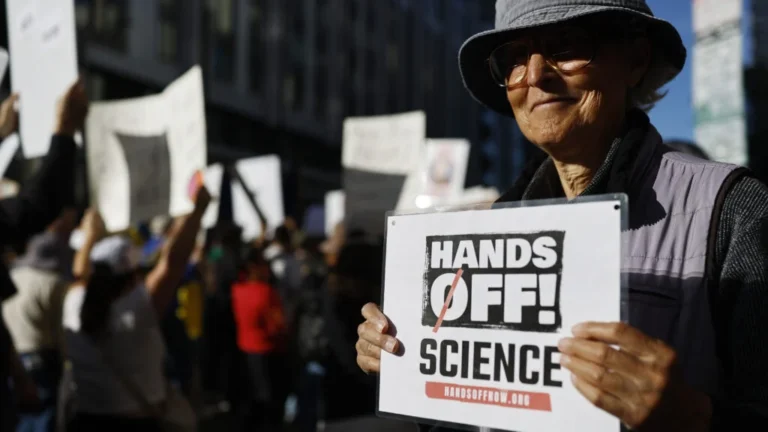






In a development that has sent shockwaves through the American scientific establishment, the White House is currently exploring a radical restructuring of how federal biomedical research is funded. The proposal, spearheaded by Russell Vought, Director of the Office of Management and Budget (OMB), would effectively end the traditional, peer-review-driven autonomy of the National Institutes of Health (NIH). By establishing a panel of political appointees with veto power over individual grants, the administration is signaling a shift toward ideological oversight of what has historically been a meritocratic, science-led process.
This move has ignited a firestorm on Capitol Hill, with lawmakers and health policy experts warning that such a mandate could cripple the nation’s research capabilities, politicize life-saving breakthroughs, and drive talent away from federal institutions.
The Genesis of the Conflict: A Clash in the Oval Office
The tension reached a breaking point during a contentious meeting at the White House this past Friday. According to reporting from The Washington Post, the confrontation was sparked by a specific directive from President Trump: a demand to slash funding for researchers at Harvard University.
NIH Director Jay Bhattacharya, who has been navigating an increasingly difficult relationship with the executive branch, reportedly resisted the order. Bhattacharya’s reluctance to treat federal research grants as political bargaining chips appears to have been the catalyst for the administration’s aggressive pivot. Frustrated by the lack of administrative compliance, the President directed Vought to draft an executive order that would create a formal oversight commission.
Under the proposed plan, this board would be tasked with reviewing—and signing off on—every single NIH grant. According to Politico, the board would include both Vought and Bhattacharya, and crucially, would require unanimous consent to approve funding. This structure essentially grants any single member of the board the power to kill a grant for any reason, political or otherwise.

Chronology: From Scientific Autonomy to Political Scrutiny
The push to politicize the NIH is not a sudden development but rather the culmination of years of escalating rhetoric regarding the role of elite academic institutions in federal research.
- Mid-2026: Tensions mount as the White House begins to scrutinize the ideological leanings of major research universities, with a particular focus on Harvard and other Ivy League institutions that have been critical of administration policies.
- September 2026: The friction between the NIH and the Oval Office becomes public as reports circulate about the President’s desire to defund specific academic departments.
- Friday, September 18, 2026: A pivotal meeting at the White House sees Russell Vought present the blueprint for the proposed "NIH Grant Commission." The President demands the immediate drafting of an executive order to institutionalize this oversight.
- September 19-20, 2026: News of the planned commission leaks, prompting immediate backlash from members of Congress, the scientific community, and advocacy groups.
The Mechanics of Oversight: How the Proposed Commission Functions
The proposed commission represents a departure from the "peer review" model that has governed the NIH since its inception. Currently, the NIH allocates roughly $45 billion annually through a rigorous, multi-tiered process. Applications are first reviewed by "Study Sections" composed of external scientists who evaluate the technical merit, feasibility, and potential impact of the research. Only the highest-scoring applications proceed to the Advisory Councils, which ensure the research aligns with the NIH’s broader mission.
The Vought proposal would insert a new, final layer of political gatekeepers. By requiring "unanimous" approval from a board that includes a political appointee from the OMB, the White House would effectively bypass the scientific community.
The Implications of Veto Power
Critics argue that this model is designed to facilitate "viewpoint discrimination." If a researcher’s work—or the research being conducted by their home institution—is perceived as politically inconvenient, the grant can be spiked. This would create a "chilling effect," where researchers might avoid controversial topics or steer away from institutions perceived as targets of the administration to ensure their funding remains secure.
Official Responses and Political Fallout
The response from Capitol Hill has been swift and largely critical. Both Democratic and some Republican lawmakers have expressed deep concerns about the precedent this sets.

"The NIH is the crown jewel of American science," one senior lawmaker noted in a private briefing. "To turn it into a clearinghouse for political patronage is not just a policy error; it is a direct threat to the health security of the United States."
Advocacy groups representing patients with rare diseases, cancer, and neurodegenerative conditions have also mobilized. The fear is that if grant approvals are stalled by political deadlock, the pipeline of drug discovery will dry up. "We are talking about years of work being held hostage by people who have no background in molecular biology or clinical trials," said a spokesperson for a leading medical research advocacy organization.
Meanwhile, the White House has remained tight-lipped regarding the specific timeline for the executive order, though sources close to the administration suggest that Vought is moving forward with the drafting process despite the vocal opposition.
The Broader Implications for Global Science
The potential politicization of the NIH carries risks that extend far beyond domestic policy.
1. The "Brain Drain" of Top Talent
Science relies on international collaboration and the free flow of ideas. If the U.S. government begins using research grants as a political weapon, the most talented scientists may look to Europe, Asia, or private industry, where research environments are perceived as more stable and free from political interference.

2. Economic Impact on the Biotech Sector
The NIH is the primary funder of "basic science"—the foundational research that allows biotech companies to develop new drugs. If the flow of basic research funding is interrupted or redirected based on political whim, the private sector’s ability to innovate will be severely hampered. The United States’ dominance in the global pharmaceutical market is built on the strength of its public-private research ecosystem. Dismantling the independence of the NIH could weaken this foundation, leading to long-term economic decline in the biotech sector.
3. Erosion of Public Trust
Perhaps the most damaging impact is the erosion of public trust in science. If the American public perceives that NIH grants are being manipulated for political gain, they will be less likely to trust the health recommendations or medical breakthroughs that emerge from these institutions. In an era where health misinformation is already rampant, the government must be seen as a neutral arbiter of scientific truth.
Looking Ahead: A Battle for the Soul of the NIH
As the debate intensifies, the scientific community is preparing for a protracted struggle. Several professional organizations have already begun drafting open letters to the President, urging him to reconsider the commission. Legal experts are also evaluating whether an executive order of this nature would withstand judicial review, given the NIH’s mandate to fund research based on scientific merit as outlined in its founding legislation.
The upcoming weeks will be decisive. If the White House moves forward with the order, it will trigger a constitutional and legislative battle that could define the relationship between the executive branch and the scientific community for decades to come.
The core question remains: Will the United States continue to be the world leader in biomedical innovation, or will it sacrifice that position in favor of a model where the pursuit of knowledge is subordinate to the pursuit of political compliance? For the scientists at Harvard, the NIH, and across the country, the answer to that question is not just a matter of academic interest—it is a matter of professional survival and national health.