This week, the world of professional physique competition undergoes a quiet but profound transformation. As the Olympia Weekend descends upon Las Vegas from September 24–27, 2026, the IFBB Pro League will officially crown its inaugural Fit Model Olympia champion. For the die-hard "old-school" bodybuilding enthusiast who views the sport strictly through the lens of mass, density, and extreme conditioning, this addition may seem like an unnecessary expansion. However, to understand Fit Model, one must view it not as a dilution of bodybuilding, but as a tactical attempt to reclaim the "fit and toned" aesthetic that many believe the Bikini division has drifted away from.
The Evolution of the Olympia: From Nine to Twelve
Since Larry Scott stood atop the first Olympia podium in 1965, the sport has undergone a relentless metamorphosis. The evolution has been additive; the IFBB Pro League has consistently carved out new categories to accommodate different body types and athletic priorities. Today, the lineup includes a staggering 12 divisions: Open, 212, Classic, Men’s Physique, Bikini, Figure, Wellness, Fitness, Women’s Physique, Women’s Bodybuilding, Wheelchair, and now, Fit Model.
While critics often joke that the federation has found every conceivable way to judge athletes in swimwear, the expansion is actually a reflection of the sport’s broader appeal. As the baseline for "competitive fitness" has shifted, the industry has realized that the traditional path—which demands grueling, stage-ready conditioning—acts as a barrier to entry for many athletes who maintain high-level fitness without the desire to push their bodies into extreme, contest-prep territory.
A Chronology of the Fit Model Movement
The rise of the Fit Model category is a response to a specific trend: the "creep" of muscularity.
- 2025 (The Amateur Launch): The NPC introduced the Fit Model division at the amateur level. The goal was to provide a stage for those who favored a balanced, athletic, and feminine physique that prioritized runway-ready aesthetics over the hyper-vascularity seen in other categories.
- 2026 (The Professional Pivot): Recognizing the popularity of the amateur division, the IFBB Pro League sanctioned professional Fit Model contests, paving the way for the ultimate validation: a spot on the Olympia stage.
- September 2026: The first-ever Fit Model Olympia takes place in Las Vegas, officially cementing the division into the qualification hierarchy of the world’s most prestigious bodybuilding event.
The Judging Criteria: The Art of "Less"
The most striking aspect of the Fit Model division is how explicitly it defines what it doesn’t want. In a sport that historically rewards the pursuit of "more"—more size, more separation, more detail—Fit Model mandates restraint.
According to the official guidelines, the judges are looking for a physique that is fit and toned but stops short of the development seen in the Bikini division. The criteria are surgical in their precision:
- Muscle Development: Competitors should possess enough muscle to define a feminine shape, but they must avoid the excessive development in the legs, glutes, arms, and delts that have become standard in other divisions.
- The "Anti-Detail" Mandate: Perhaps the most radical departure is the requirement for a smoother look. The rules explicitly forbid visible glute-ham tie-ins and hamstring separation. The midsection should appear fit and healthy, rather than "highly detailed" or stripped of body fat to the point of being competition-lean in the traditional sense.
- The Visual Benchmark: In a fascinating move, the IFBB has pointed to three-time Bikini Olympia champion Ashley Kaltwasser’s 2015 physique as the gold standard. By referencing a previous era of Bikini, the federation is essentially trying to "reset the clock" on the aesthetic expectations of the audience.
The Inevitable Cycle of "Physique Creep"
The history of the Olympia is a history of escalation. When the Bikini division was first introduced, it was intended to be the "softer" alternative. Over the last decade, however, the Bikini standard has hardened. Competitors are more muscular, their conditioning is tighter, and the "Bikini" of 2026 bears little resemblance to the "Bikini" of 2010.
This phenomenon is universal across the sport. Women’s Bodybuilding, Figure, and even the "classic" categories have all seen a steady migration toward more mass and deeper conditioning. Even the Classic Physique division, which was created to serve as a nostalgic homage to the golden era of the 1970s, now features competitors who, by 1970s standards, would be considered mass monsters.
Fit Model is the federation’s attempt to break this cycle. By codifying "less" as a judging metric, the IFBB is trying to prevent the division from becoming just another iteration of the Bikini class. But the question remains: Can they hold the line?
Presentation: A Departure from Tradition
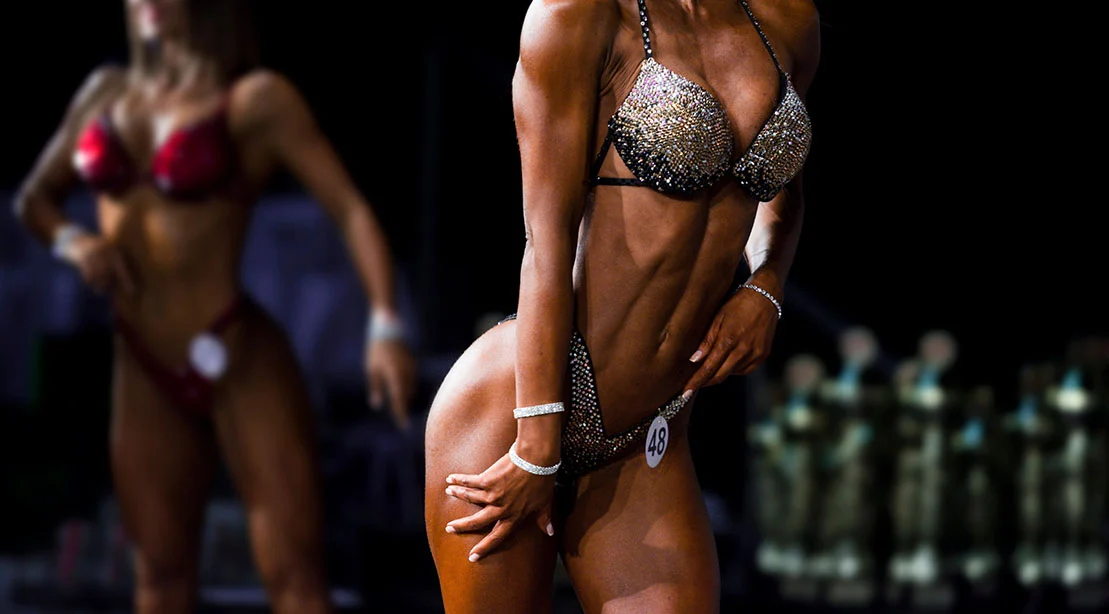
The presentation of Fit Model is deliberately distinct. There are no traditional bodybuilding mandatory poses, which often highlight muscular imbalances or extreme striations. Instead, competitors perform a simple front pose and a back pose. The attire is equally understated—plain-colored suits that eschew the elaborate, crystal-encrusted Swarovski "artillery" that has become the hallmark of modern Bikini competition. By requiring heels and emphasizing grace, the category leans closer to high-fashion modeling than to the grit of the gym floor.
Implications for the Future of Competitive Fitness
The introduction of Fit Model raises a fundamental question: Is there a market for a "not-quite-bodybuilding" stage show?
For the industry, the answer is a resounding "yes." There is a substantial demographic of women who train with intensity and dedication but find the extreme diet protocols required for traditional bodybuilding—where one must "diet until their glutes have geological features"—to be incompatible with their lifestyle or personal goals. Fit Model provides a venue for these women to participate in the sport they love without sacrificing their version of a healthy, feminine aesthetic.
However, the true test will occur this weekend in Las Vegas. The judges carry the burden of definition. If they reward a winner who is slightly too lean, or a runner-up who is slightly too muscular, the "creep" will begin immediately. Every athlete who competes in the future will model their prep after the physique that takes the gold.
If the judges remain strict, they create a permanent, sustainable home for a specific type of athlete. If they yield to the natural tendency toward "more," they will have simply created a 13th division that inevitably evolves into a 14th.
Conclusion: A Delicate Balance
The Fit Model Olympia is a high-stakes experiment in aesthetic control. By explicitly referencing the past to define the future, the IFBB Pro League is acknowledging that the relentless pursuit of "bigger and harder" isn’t the only way to celebrate human potential.
As the lights go up in Las Vegas this weekend, the focus will not just be on who wins the inaugural title. It will be on the standard they set. The sport is watching, and for the sake of the division’s longevity, one can only hope that the judges—and the competitors—choose wisely. If they can maintain the intended aesthetic, Fit Model could become the most accessible and popular gateway into the world of professional physique competition, proving that sometimes, less truly is more.