








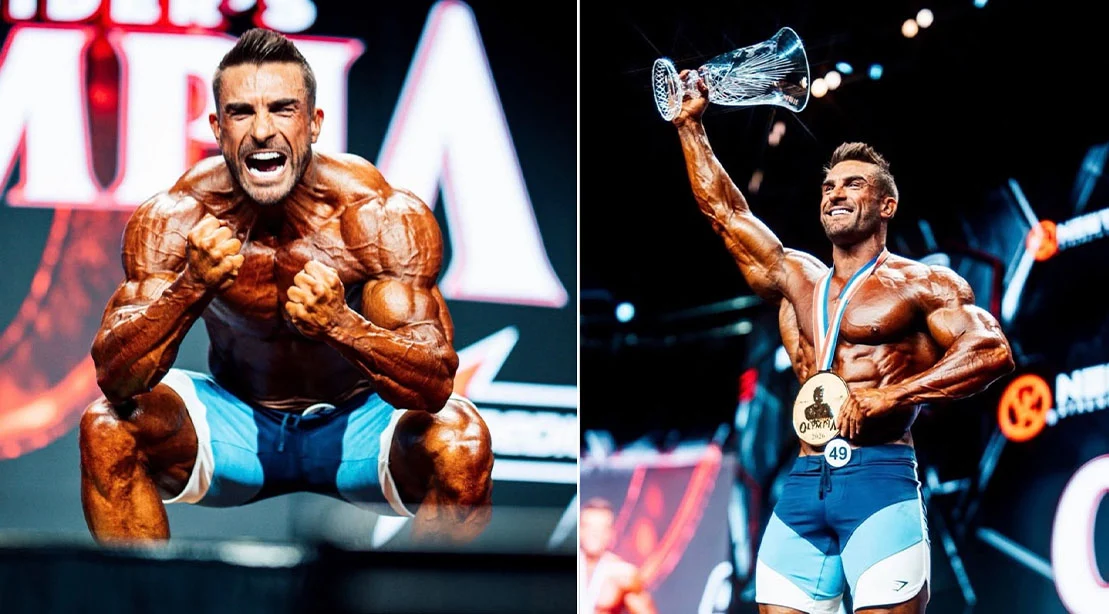
In the high-stakes world of professional bodybuilding, the Olympia stage is a crucible where physical perfection meets psychological fortitude. On September 26, 2026, British icon Ryan Terry cemented his place in the sport’s pantheon by clinching his fourth consecutive Men’s Physique Olympia title. By doing so, he equaled the legendary record set by Jeremy Buendia, marking a historic milestone in the division.
However, the glitz and glamour of the Orleans Arena masked a harrowing reality. Less than 24 hours after his victory, during an emotional winner’s seminar in Las Vegas, Terry revealed that his path to the 2026 title was nearly derailed by a catastrophic injury that almost forced him to withdraw from the competition entirely.
A Legacy Defined by Resilience
Ryan Terry’s journey to the pinnacle of bodybuilding is the stuff of legend. His rise was not meteoric but methodical, characterized by a refusal to yield. After nine attempts, he finally captured his first Olympia title in 2023, proving that consistency is the ultimate currency in professional bodybuilding.
Since that breakthrough, the RT Fit Gym owner has transformed from a top-tier contender into a dominant force, maintaining a vice-like grip on the division. Yet, the 2026 prep was arguably the most difficult chapter of his career. While fans observed a man who seemed more focused and mentally fortified than ever, the reality behind the scenes was a desperate race against a ticking clock.
The Chronology of a Crisis: Seven Weeks from Disaster
The trauma began seven weeks before the competition. While executing a routine training session, Terry suffered a herniated C5 disc in his neck. For a bodybuilder whose physique relies on precise symmetry, muscle fullness, and the ability to hit demanding poses, a cervical spine injury is potentially career-ending.
The Turning Point
"We can talk about it now," Terry admitted to an audience at the Palms in Las Vegas on September 27. "This has been the hardest prep I’ve ever gone through."
The injury wasn’t just a physical setback; it was a psychological assault. Terry described moments of profound vulnerability, sitting in his kitchen with his wife, overwhelmed by the realization that his window to history might be closing. For the first time in his career, the prospect of missing the stage was not just a fleeting fear—it was a looming probability.
The Road to Recovery
With the Olympia weeks away, Terry and his support team pivoted from traditional bodybuilding training to an intensive, multifaceted medical rehabilitation program. To maintain his conditioning while mitigating the damage to his C5 disc, Terry utilized:
- MBST (Magnetic Resonance Therapy): A cutting-edge treatment designed to stimulate cellular repair and accelerate tissue recovery.
- Aggressive Chiropractic Care: To manage the spinal misalignment caused by the herniation.
- Acupuncture: To alleviate the chronic pain and inflammation radiating through his upper extremities.
- Specialized Physical Therapy: Guided by his best friend, who worked tirelessly to ensure that Terry could maintain his muscle mass without exacerbating the nerve entrapment.
Despite these interventions, the damage was severe. "I’ve trapped the median nerve," Terry disclosed. "I’ve still got pins and needles in my fingers even to this day."
The Performance: Defying the Physical Toll
When Terry stepped onto the stage on September 26, 2026, he was not the 100% version of himself that he had hoped to present. He was, by his own admission, in significant discomfort. Yet, the hallmark of a true champion is the ability to compartmentalize pain.
Facing an elite lineup—including stalwarts like Ali Bilal, Kyron Holden, and Erin Banks—Terry delivered a performance that was, in many ways, his most impressive. The judges, blinded to the underlying injury by the quality of his presentation, rewarded his symmetry and conditioning with his fourth consecutive title.
Bridging Eras: The Terry-Buendia Dynamic
Matching Jeremy Buendia’s record of four consecutive titles is a symbolic torch-passing moment. The rivalry, which has played out largely in the public eye, was characterized by mutual respect during the post-show press conference.
"Massive, massive respect to Jeremy," Terry said, reflecting on the weight of the achievement. "That must have been a hard thing to watch. For me to match his record—a record he has held since the early days of the division—it must have been a hard night for him. But he took it so well."
Terry noted that Buendia was one of the first to offer his congratulations, an act of sportsmanship that underscored the camaraderie inherent in the upper echelons of the sport. "I’m eternally grateful to be matching him now," Terry added, acknowledging the standard that Buendia set for all who followed.
Implications for the Future
The aftermath of the 2026 Olympia has done more than just add a trophy to Terry’s shelf; it has fundamentally changed the narrative of his career. By succeeding while injured, Terry has elevated his status from a "physique specialist" to a "tenacious survivor."
The Road to 2027
During the seminar, Terry silenced any rumors of retirement. In fact, he confirmed his intention to return for the 2027 Olympia with a singular goal: to surpass the record he currently shares and claim a fifth title.
The implications for the division are profound. If Terry can secure a fifth victory, he will stand alone as the most decorated athlete in the history of the Men’s Physique category. However, the path forward will require cautious management of his long-term health. The C5 herniation serves as a stark reminder of the physical cost of excellence at the professional level.
A Testament to Support Systems
Throughout the ordeal, Terry was quick to shift the focus away from his own willpower and onto his team. His acknowledgment of his wife, his training partners, and the medical professionals who worked in the shadows highlights a critical, often overlooked aspect of bodybuilding: it is, despite the individual nature of the sport, a collective effort.
The success of the 2026 Olympia campaign was not just a result of genetic gifts or iron discipline; it was a triumph of medical science, psychological support, and a refusal to let a catastrophic injury dictate the terms of his legacy.
Conclusion: The Legend Continues
Ryan Terry’s fourth Olympia win will be remembered for the physique he displayed on stage, but his legacy will be defined by what he endured to get there. In a sport that demands perfection, Terry proved that the greatest victory is not the absence of pain, but the ability to perform in spite of it.
As the bodybuilding world turns its eyes toward the 2027 Olympia, the narrative is no longer just about who can build the most aesthetic physique. It is about whether anyone can stop the man who has already proven he can conquer both the competition and his own physical limitations. For now, the champion returns to the gym—not just to prepare for another show, but to continue a legacy that has already secured its place in history.
To keep up with Ryan Terry’s recovery and his training journey toward the 2027 Olympia, you can follow him on Instagram.