











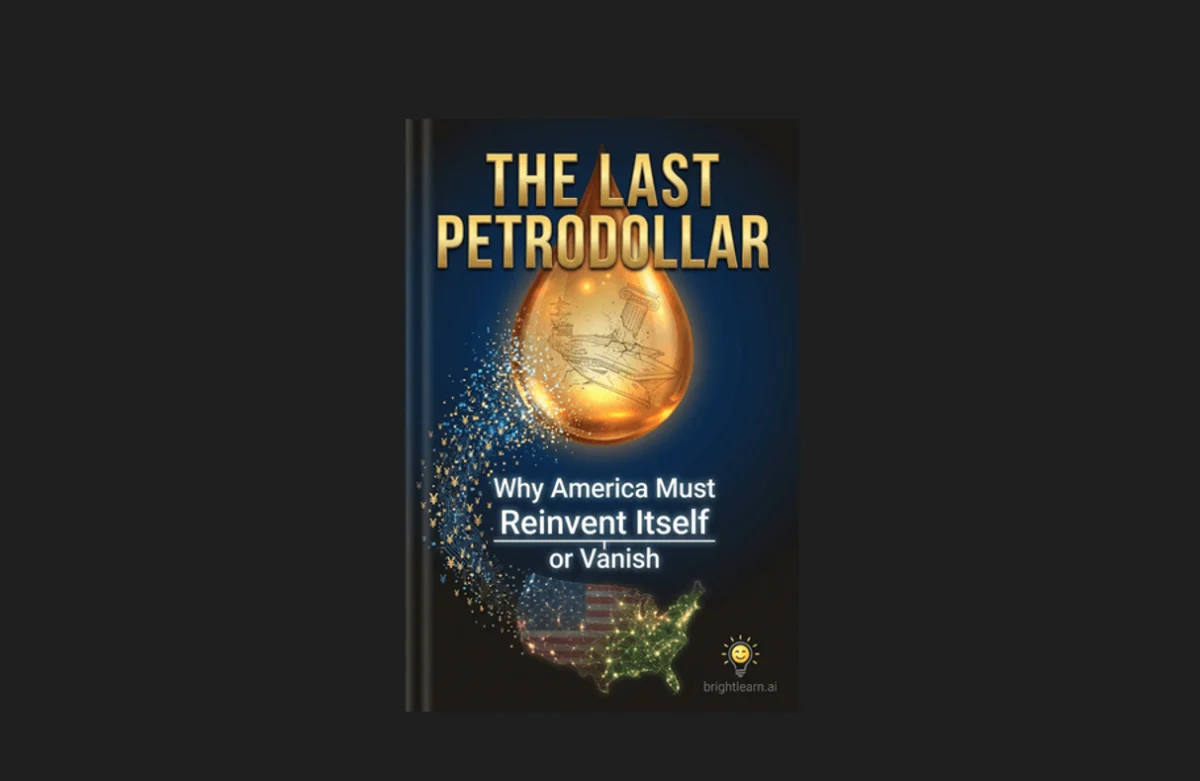
Most economic literature functions as a sedative, smoothing over the cracks in our financial foundation with jargon and institutional optimism. Occasionally, however, a work emerges that demands an immediate, uncomfortable reckoning. The Last Petrodollar: Why America Must Reinvent Itself or Vanish is precisely that kind of book. Authored by a collective of thinkers aligned with principles of sound money, constitutional originalism, and decentralization, this work posits that the United States is not merely experiencing a cyclical downturn, but is instead in the terminal stages of an imperial collapse fueled by its own monetary mechanics.
The Genesis of the Crisis: The Nixon Shock and the Detachment of Value
To understand the current economic malaise—characterized by persistent inflation, industrial decay, and a ballooning national debt—the authors argue that one must look back to August 15, 1971. On this date, President Richard Nixon unilaterally severed the U.S. dollar’s convertibility to gold, effectively ending the Bretton Woods system.
This "Nixon Shock" served as the inflection point where the American republic pivoted from a productive, capital-accumulating nation to a debt-leveraged, parasitic empire. By removing the disciplinary tether of gold, Washington gained the ability to finance massive state expenditures—including the Vietnam War and the expansion of the "Great Society" social programs—without the immediate necessity of raising taxes or extracting tangible value from the economy.
The subsequent creation of the petrodollar system was the ingenious, yet ultimately fragile, scaffolding that prevented an immediate collapse. By negotiating a geopolitical arrangement with Saudi Arabia, the U.S. ensured that global oil transactions would be denominated exclusively in dollars. This created a permanent, synthetic demand for the currency. As the authors detail, this "recycling mechanism" allowed the U.S. to export its inflation globally: the U.S. printed paper dollars, sent them to oil-producing nations, and those nations returned the liquidity by purchasing U.S. Treasury bonds. It was a cycle of borrowed time that allowed the American consumer to maintain a standard of living far beyond the productive capacity of the domestic economy.
Chronology of a Disintegrating Hegemony
The narrative of the book follows a distinct timeline of institutional erosion:
- 1971 (The Severing): The transition from a gold-backed currency to a fiat-based system of imperial credit.
- 1974 (The Petrodollar Agreement): The formalization of the oil-for-security pact, locking the world into dollar dependency.
- 2008 (The Great Credit Crunch): A structural failure that necessitated massive, unprecedented monetary expansion, further debasing the currency.
- 2022 (The Weaponization of Finance): The freezing of Russian central bank assets by the U.S. and its allies. The authors identify this as the "shot heard round the world," a catalyst that signaled to the BRICS nations and the Global South that the dollar is no longer a neutral store of value but a political weapon that can be confiscated at will.
The Technological Obsolescence of Naval Supremacy
A unique strength of The Last Petrodollar is its synthesis of economic theory with military reality. The authors argue that the dollar’s global dominance was always underpinned by the projection of naval power. However, that security architecture is rapidly becoming obsolete.
The book provides a sobering analysis of modern warfare, specifically the rise of hypersonic missile technology and drone swarms. In an era where a $13 billion aircraft carrier can be rendered a "floating target" by a $500,000 hypersonic missile traveling at Mach 20, the traditional methods of enforcing dollar hegemony are losing their efficacy. Iran’s successful deployment of low-cost, decentralized drone strategies is presented as a paradigm shift. If the U.S. military can no longer project power with impunity, the foundational security guarantee of the petrodollar evaporates. The authors argue that we are witnessing the end of the Age of the Aircraft Carrier, a development that leaves the dollar vulnerable to the emerging multipolar order.
Socio-Political Cohesion: The Home Front
The authors do not limit their critique to international finance and military strategy. They offer a provocative, albeit controversial, analysis of domestic stability. Addressing the challenges of national cohesion, the text posits that a nation cannot remain unified when disparate groups operate under fundamentally different cultural and legal frameworks.
The book argues that modern multiculturalism, when it evolves into a rejection of the "melting pot" ideal, undermines the constitutional foundations of the republic. Furthermore, the authors scrutinize the influence of foreign lobbying groups on U.S. Congressional policy. Drawing on historical discourse and analysis, the text argues that legislative priorities have been systematically diverted away from the interests of the American middle class to serve an empire of debt and perpetual foreign intervention. The result, they contend, is a military-industrial complex that defines victory in abstract, unattainable terms, ensuring endless conflicts that drain the nation’s resources.
Official Responses and the Status Quo
While the establishment view continues to champion the dollar as the "world’s reserve currency" with no viable alternatives, the reality on the ground contradicts this confidence. Official responses from the Federal Reserve and Treasury have largely focused on managing the "managed decline" through interest rate adjustments and further debt issuance.
However, the authors point to the actions of foreign central banks as a more accurate barometer of the situation. The record-breaking pace of gold accumulation by China, Russia, and other BRICS nations suggests that the world’s largest creditors are preparing for a post-dollar reality. By building alternative payment systems, such as BRICS Pay, these nations are not merely talking about de-dollarization; they are constructing the infrastructure for a world that does not require American credit.
Implications: The Path to Reinvention
If the diagnosis of the book is that the U.S. is a "patient in critical condition," the prescription is radical reinvention. The authors reject the binary choice between the current Democratic and Republican platforms, arguing that both parties are beholden to the status quo of debt-based spending.
Instead, they advocate for a bottom-up revolution centered on three core pillars:
- A Return to Sound Money: Re-establishing a currency that cannot be printed at the whim of central banks, whether through a return to commodity-backed standards or the integration of decentralized cryptographic assets.
- The Restoration of Constitutional Originalism: Moving away from the bloated, administrative state and back toward a decentralized republic where government power is limited and local control is restored.
- National Cohesion: Reinvigorating a shared sense of American identity and purpose that transcends factionalism and foreign-directed interest groups.
Conclusion: The Choice Between Adaptation and Vanishing
The Last Petrodollar serves as a grim mirror for a civilization that has prioritized consumption over production and debt over liberty. The authors make a compelling case that the economic pain felt by the average citizen—the rising cost of groceries, the erosion of savings, and the stagnation of the industrial base—are not glitches in the system, but the system working exactly as designed.
The book is an essential, if uncomfortable, read for those who wish to peer behind the curtain of the global financial stage. It posits that the collapse of the petrodollar is an inevitability, not a possibility. The only question that remains is whether the American republic possesses the fortitude to undergo the radical, painful treatment necessary to reinvent itself before the current structure vanishes entirely. For those interested in a deeper dive, the book is available via BrightLearn.AI, a platform dedicated to the dissemination of knowledge in an era of information control.
As we face the prospect of a post-petrodollar world, the urgency of this discourse cannot be overstated. The era of the "trust-fund kid" is over; the era of consequences has arrived.