











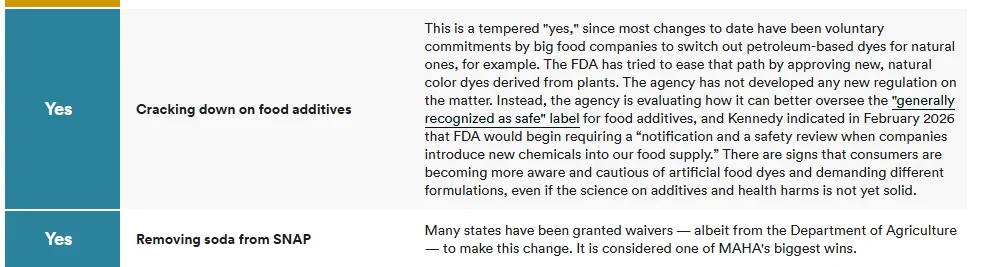
As the administration’s "Make America Healthy Again" (MAHA) initiative passes its one-year milestone, the focus of public health advocates and agricultural policymakers has shifted toward a rigorous assessment of its stated objectives. A recent, exhaustive analysis conducted by StatNews journalists Isabella Cueto and J. Emory Parker has provided a critical framework for this evaluation, dissecting 80 specific campaign and policy promises.

For those operating within the realms of food, nutrition, and public health, this audit is not merely an academic exercise; it serves as a roadmap of the current administration’s priorities. While the MAHA agenda touches upon a vast array of government functions, its impact on the American food system—ranging from agricultural subsidies to nutritional labeling and food safety—is profound. By categorizing these promises into those that have been realized, those currently in progress, and those that remain untouched, we can begin to discern the true trajectory of the current federal health strategy.

The State of Play: Main Facts and Policy Shifts
The MAHA platform emerged as a response to growing concerns over chronic disease rates, the prevalence of ultra-processed foods, and the perceived systemic failures of federal regulatory agencies like the FDA and the USDA. The administration’s approach has been characterized by a blend of deregulation and targeted interventions in the food supply chain.

At the core of the StatNews findings is a complex picture of bureaucratic maneuvering. While the administration has successfully prioritized certain high-profile regulatory shifts—often framed as "reclaiming" the food system from corporate interests—other, more granular policy goals have stalled due to legislative gridlock or internal administrative friction.

Crucially, the intersection of agriculture and health has become a battleground. Decisions regarding pesticide regulation, soil health initiatives, and the promotion of regenerative agriculture are no longer viewed as purely agricultural concerns; they are now central to the administration’s public health narrative. The StatNews analysis highlights that where progress has been made, it is often in areas that align with the administration’s stated goal of reducing the influence of large-scale industrial lobbyists, though critics argue that these actions often create new, unintended regulatory burdens.
A Chronological Perspective: One Year of Transformation
To understand the pace of change, one must look at the chronology of the MAHA initiative. According to data provided by Food Tank, the first year of the administration was defined by a rapid-fire series of executive actions and agency directives.
The First Quarter: Setting the Tone
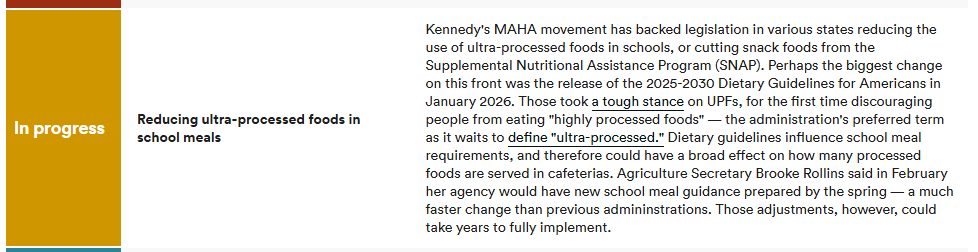
The initial phase focused on personnel shifts within the Department of Agriculture and the FDA. The appointment of individuals with backgrounds in alternative health and sustainable farming signaled a move away from the status quo. During this period, the administration focused on "low-hanging fruit"—executive orders aimed at reversing previous administration policies on school lunch nutritional standards and the removal of certain chemical additives from the federal food procurement list.

The Mid-Year Pivot
By the second quarter, the focus shifted to long-term structural changes. This included the initiation of a comprehensive review of the Dietary Guidelines for Americans. The process, typically a multi-year endeavor, was accelerated under the MAHA directive to incorporate more recent research on metabolic health and the impact of ultra-processed foods.

The Current Status
As of mid-2026, the administration is navigating the "implementation gap." Many of the policies announced during the campaign are now undergoing the rigorous, and often slow, process of federal rulemaking. This phase is critical because it is where the idealism of the campaign meets the reality of the Administrative Procedure Act, which requires public notice, comment periods, and thorough impact assessments.
Supporting Data: Assessing What Works and What Stalls
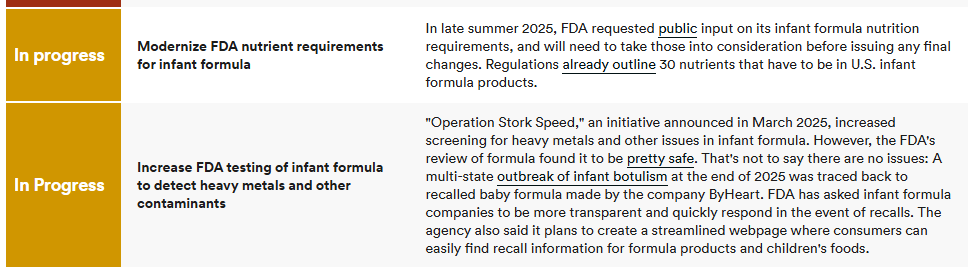
The StatNews audit categorizes the 80 promises into three distinct groups: those that have seen tangible success, those currently in the works, and those that remain dormant.

Achievements: Where Policy Met Action
The administration’s successes have largely been in areas where executive authority is strongest. This includes:

- Transparency Initiatives: Strengthening labeling requirements for "bioengineered" foods and moving toward clearer disclosures on the provenance of imported produce.
- Procurement Reform: Successfully implementing stricter nutritional criteria for food served in federal buildings and school programs receiving federal funding.
- Research Reallocation: Redirecting a portion of NIH and USDA research grants toward studies on the relationship between ultra-processed diets and autoimmune conditions.
In the Works: The Legislative and Regulatory Grind
Many of the most ambitious MAHA promises remain in the pipeline. These include:
- The "Clean Label" Mandate: A proposed overhaul of FDA rules regarding food additives, which seeks to ban several substances currently classified as "Generally Recognized as Safe" (GRAS). This has faced significant pushback from the food industry.
- Subsidization Reform: Efforts to realign crop insurance and farm subsidies to favor producers of fruits and vegetables over commodity crops like corn and soy. This remains a highly contentious issue on Capitol Hill.
Untouched Promises: The Dormant Agenda
Perhaps most revealing are the promises that have seen little to no action. These include significant overhauls of the SNAP (Supplemental Nutrition Assistance Program) eligibility requirements, which have remained stagnant despite early rhetoric about "health-based" restrictions on the types of food eligible for purchase. The lack of movement here suggests either a strategic choice to avoid a major political fight or the realization that such changes would face insurmountable legislative hurdles.

Official Responses and Stakeholder Perspectives
The administration’s defense of its progress rests on the argument that systemic change requires a methodical, step-by-step approach. "We are dismantling decades of corporate capture," an administration spokesperson noted in a recent briefing. They argue that the StatNews analysis, while thorough, fails to account for the "behind-the-scenes" work of re-staffing agencies with experts who prioritize long-term metabolic health over short-term industrial efficiency.

Conversely, industry groups, including the Grocery Manufacturers Association and various agricultural trade organizations, have voiced concerns. Their primary critique is that the MAHA agenda is built on "pseudo-science" and that the regulatory uncertainty created by these shifts is harming the supply chain. They contend that the administration is overreaching and that its focus on specific "healthy" food categories ignores the reality of consumer demand and affordability.

Public health advocates remain divided. Some, such as those at Food Tank, have praised the administration for keeping the conversation around food systems at the forefront of the national dialogue. Others remain skeptical, noting that for all the policy announcements, the fundamental drivers of food insecurity and poor nutrition—poverty and lack of access—remain largely unaddressed by the current administrative strategy.

Broader Implications for the Future of Nutrition
The implications of the MAHA initiative extend far beyond the current administration. By elevating nutrition and agricultural policy to a top-tier political priority, the administration has fundamentally changed the calculus for future policy debates.

- The Politicization of Nutrition: Food is no longer a secondary issue. The MAHA agenda has ensured that future elections will likely include debates over what the government considers "healthy" and how that definition should influence federal spending.
- Regulatory Volatility: The focus on overturning long-standing FDA and USDA precedents has created a more volatile regulatory environment. Businesses are now forced to plan for rapid shifts in labeling and ingredient compliance.
- The Shift Toward Preventive Health: The most lasting legacy of the MAHA era may be the explicit linkage between the food system and the national healthcare budget. By framing diet-related chronic disease as a national security and fiscal issue, the administration has set the stage for potentially massive, albeit controversial, interventions in the food market.
Conclusion: A Work in Progress
As we look at the data provided by StatNews and Food Tank, the takeaway is clear: the MAHA administration has successfully shifted the focus of American food policy, but the transition from rhetoric to reality is fraught with complexity.

The progress made in the first year is undeniable in its scope, yet the most difficult hurdles—those requiring broad legislative consensus or those that directly threaten the economic interests of the agricultural status quo—remain. For citizens, researchers, and industry stakeholders alike, the next year of the MAHA agenda will be the ultimate test of whether this movement can sustain its momentum or if it will be stifled by the inertia of the federal bureaucracy.

Ultimately, the audit serves as a vital reminder that in the arena of public policy, the distance between a campaign promise and a systemic change is measured in thousands of hours of regulatory labor, millions of dollars in lobbying, and an endless cycle of public debate. The MAHA agenda is, for better or worse, firmly entrenched in this cycle, and its impact will be felt in the American diet for years to come.