










The U.S. government has officially released the 2025–2030 Dietary Guidelines for Americans (DGAs), a document intended to serve as the North Star for the nation’s nutritional health. Framed under the overarching tagline of “eat real food,” the new guidelines take a decisive—and long-awaited—stand against the proliferation of ultra-processed foods and added sugars. However, beneath the polished, consumer-friendly branding lies a landscape of contradictions that has left nutrition scientists and public health experts concerned.
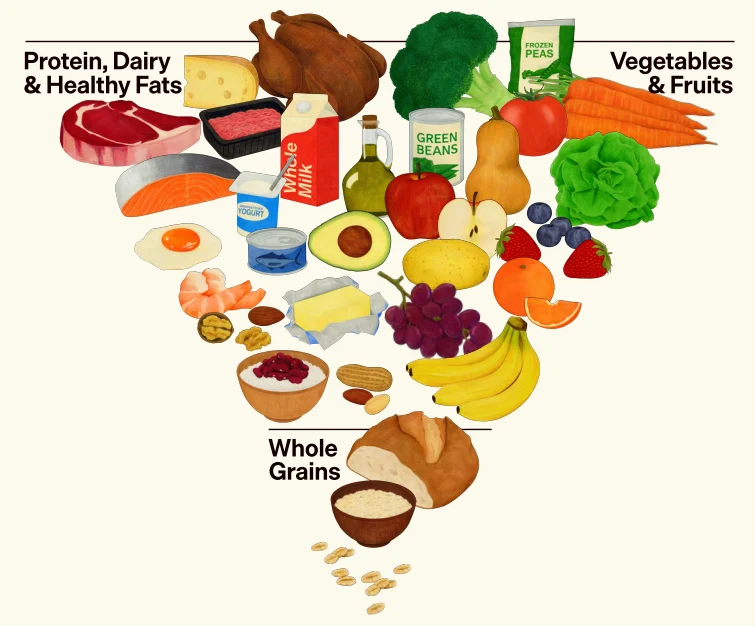
While the text advocates for a reduction in refined grains and sugary beverages, the newly introduced "New Food Pyramid" presents a visual hierarchy that appears at odds with the written recommendations, particularly regarding saturated fat. By elevating steak, butter, and full-fat dairy to prominent positions, the guidelines risk creating a "mixed message" environment that could undermine decades of cardiovascular health advocacy.
The Core Mandates: What the 2025–2030 Guidelines Propose
The 2025–2030 edition of the DGAs arrives with a renewed focus on the quality of calories rather than just the quantity. For the first time, the document explicitly calls out “highly processed foods,” a broad category that includes everything from sugar-sweetened beverages to refined, fiber-stripped carbohydrates like white bread.
A Hardline Stance on Sugar
Perhaps the most aggressive shift in this iteration is the guidance on added sugars. The guidelines now state that “no amount of added sugars or non-nutritive sweeteners is recommended or considered part of a healthy or nutritious diet.” This is a significant departure from previous versions, which allowed for a 10% daily caloric ceiling. Furthermore, the guidelines have extended the recommended age for avoiding added sugar for children from two years old to ten.
While the scientific community largely applauds the intent, the implementation remains nebulous. Experts note that the guidelines suggest a limit of 10 grams of added sugar per meal, yet the average consumer does not track nutrition by individual sitting, rendering this specific metric difficult to apply in real-world scenarios.
Chronology of the Controversy: From Scientific Rigor to Policy Pivot
To understand the confusion surrounding the current guidelines, one must examine the process by which they were formed. Typically, the DGAs are the culmination of a two-year, transparent, and rigorous review process conducted by the Dietary Guidelines Advisory Committee (DGAC)—a panel of independent scientists.
- The Advisory Report: The independent 2025-2030 Advisory Committee conducted an exhaustive synthesis of current nutrition science, operating under strict ethical guidelines and livestreamed public sessions.
- The Rejection: In a move that surprised many in the public health sphere, the current administration declined to adopt the full findings of the Advisory Committee.
- The Supplemental Pivot: In place of the Committee’s comprehensive report, a supplemental scientific analysis was commissioned, conducted by a group selected through a federal contracting process.
- The Release: The final DGAs were published this week, featuring a "New Food Pyramid" that many experts argue deviates significantly from the scientific rigor established by the initial Advisory Committee.
The lack of transparency regarding the authors of this supplemental analysis has become a flashpoint for critics. Dr. Deirdre Tobias, an assistant professor at the Harvard T.H. Chan School of Public Health who served on the original advisory committee, has been vocal about the departure from established standards. She notes that the new methodology lacks the replicability and freedom from non-scientific influence that the Department of Health and Human Services (HHS) historically demanded for the DGAs.
Supporting Data: The Saturated Fat Math Dilemma
The most glaring inconsistency in the new guidelines is the treatment of saturated fats. While the written text maintains the longstanding consensus that saturated fat should be limited to 10% of total daily calories, the visual imagery of the "New Food Pyramid" contradicts this by featuring animal-based proteins and full-fat dairy as foundational elements.
The Breakdown of a "Healthy" Day
If an average adult on a 2,000-calorie diet attempts to follow the pyramid’s recommendations while adhering to the 10% saturated fat limit (approximately 22 grams per day), the math quickly fails:
- Whole Milk (8 oz): 5 grams of saturated fat.
- Full-fat Greek Yogurt (¾ cup): 6 grams of saturated fat.
- Cheddar Cheese (1 oz): 6 grams of saturated fat.
- Total: 17 grams of saturated fat.
By the time a consumer has finished their recommended daily dairy intake, they have already reached 77% of their total daily saturated fat limit. If they follow the pyramid’s suggestion to use butter or beef tallow as cooking fats, they instantly exceed the 10% threshold before even consuming their protein, fruits, or vegetables.
Dr. Frank Hu, chair of the Department of Nutrition at Harvard, warns that this lack of nuance regarding "fat quality" is dangerous. "There appear to be several contradictions within the DGAs," Hu notes. "The mixed messages surrounding saturated-fat-rich foods may lead to confusion and potentially higher intake of saturated fat, which is directly linked to increased LDL cholesterol and cardiovascular risk."
Official Responses and Industry Ties
The controversy is further fueled by reports that some reviewers involved in the supplemental analysis have disclosed financial ties to the beef and dairy industries. While the government maintains that all evidence was evaluated based on "scientific rigor," the optics of placing steak and butter in a position of prominence in a federal nutrition guide have drawn sharp criticism from consumer advocacy groups.
The guidelines also remain notably silent on the environmental impact of food choices. While the climate footprint of various protein sources—specifically the difference between plant-based proteins and industrial beef production—is a subject of intense scientific study, it remains entirely absent from the 2025–2030 document.
Implications for Public Health and Daily Life
The implications of these mixed messages are profound. Historically, Americans have struggled to follow the Dietary Guidelines, with adherence rates remaining chronically low. By introducing a visual pyramid that emphasizes animal products while simultaneously issuing written warnings about saturated fats and sugar, the government may be setting the stage for increased public confusion.
The "Protein Package" Problem
The new guidelines advocate for an increased protein intake—between 1.2 and 1.6 grams per kilogram of body weight. However, they fail to distinguish between protein sources. Nutrition science emphasizes the importance of the "protein package"—the fats, fibers, and minerals that accompany protein. A meal consisting of fish and legumes is nutritionally distinct from a meal of red meat, yet the guidelines treat them as interchangeable units of protein.
What Should Consumers Do?
In an era of conflicting information, the burden of nutritional literacy has fallen heavily on the individual. For those seeking clarity beyond the government’s latest release, health organizations suggest:
- Prioritize Whole Foods: Despite the confusion, the guidance to avoid "highly processed" foods remains a universally accepted pillar of good health.
- Focus on Fat Quality: Replace animal-based saturated fats (butter, lard, high-fat dairy) with unsaturated, plant-based fats like olive oil, nuts, and seeds.
- Consult Professionals: Because individual protein needs vary based on activity level and health status, a registered dietitian or healthcare provider is a more reliable source of information than a generic food pyramid.
- Look for Evidence-Based Alternatives: Resources such as the Healthy Eating Plate (developed by the Harvard T.H. Chan School of Public Health) offer an alternative model that is consistently grounded in transparent, peer-reviewed science.
Ultimately, the 2025–2030 Dietary Guidelines represent a missed opportunity to provide clear, actionable, and science-backed nutritional advice. As the nation grapples with record rates of diet-related chronic disease, the disconnect between policy and science has never been more consequential. Whether the public chooses to follow the new, visually-appealing but scientifically questionable pyramid or seeks more rigorous guidance will determine the health trajectory of the next generation.