








The Cancer Research Institute (CRI), a global leader in the pursuit of lifesaving immunotherapies, has officially announced the recipients of its prestigious 2026 Scientific Achievement Awards. This year’s honors celebrate two visionaries whose work has fundamentally altered the trajectory of modern medicine: Dr. Eric Vivier and Dr. Joseph Sun.
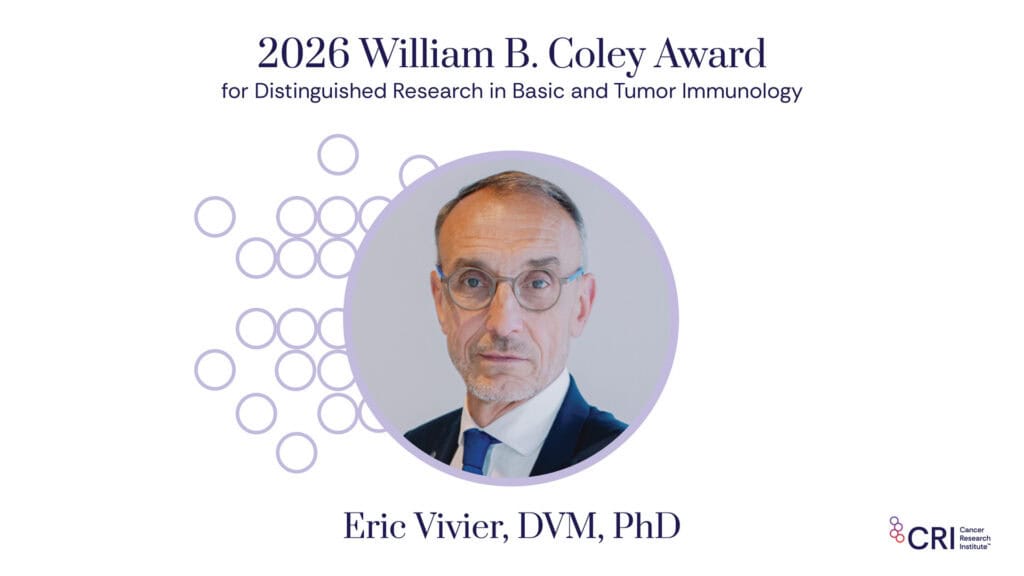
The awards recognize individuals whose contributions have not only advanced our basic understanding of how the immune system functions but have also catalyzed the development of next-generation therapies for patients battling cancer. Dr. Vivier has been named the recipient of the William B. Coley Award for Distinguished Research in Basic and Tumor Immunology, while Dr. Joseph Sun will receive the Frederick W. Alt Award for New Discoveries in Immunology.
The awards will be formally presented during the CRI’s Annual Awards Gala, set to take place on Tuesday, October 20, 2026, at the historic Guastavinos in New York City. This gala serves as a cornerstone event for the oncology research community, bringing together scientists, clinical investigators, and philanthropists to celebrate the breakthroughs that are turning the tide against cancer.
The 2026 Laureates: Profiles in Scientific Excellence
Eric Vivier, DVM, PhD: A Legacy in Innate Immunity
Dr. Eric Vivier, a Professor of Immunology at Marseille Medical School and the head of the Innate Lymphoid Cells laboratory at the Centre d’Immunologie de Marseille-Luminy, stands at the forefront of contemporary immunology. For decades, his research has centered on the "frontline" defenders of the human body: natural killer (NK) cells.
Dr. Vivier’s work has been instrumental in shifting the scientific paradigm regarding innate immunity. By uncovering the complex mechanisms through which NK cells identify and destroy malignant transformations, he has provided the bedrock upon which many modern immunotherapies are built. Beyond the laboratory, Dr. Vivier has bridged the gap between basic science and patient care. As a co-founder of Innate Pharma, he has successfully translated his findings into clinical development, proving that innate immunity is not merely a biological curiosity but a potent, actionable target for cancer treatment.
A Highly Cited Researcher since 2015, his professional mantle is heavy with accolades, including membership in the French National Academy of Medicine and the European Molecular Biology Organization (EMBO). His receipt of the William B. Coley Award serves as a testament to his enduring impact on the field.
Joseph Sun, PhD: Redefining Immunological Memory
Dr. Joseph Sun, a Member of the Immunology Program at Memorial Sloan Kettering Cancer Center and a Professor and Director of the Immunology and Microbial Pathogenesis Program at Weill Cornell Medical College, is being honored for his transformative work on the "memory" of the immune system.
Early in his career, while serving as a CRI Irvington Postdoctoral Fellow in the laboratory of Dr. Lewis Lanier at UCSF (2007–2009), Dr. Sun achieved a breakthrough that challenged established biological dogmas. He demonstrated that NK cells, traditionally classified as part of the innate immune system, are capable of exhibiting adaptive immune features—specifically, the ability to undergo clonal expansion and retain long-lived memory following viral exposure. This discovery effectively blurred the lines between the "innate" and "adaptive" branches of the immune system, providing a new framework for understanding how we might "teach" the immune system to remember and target cancer cells more effectively.
Chronology of Impact: From Bench to Bedside
The journey of these two scientists reflects the long-term commitment of the Cancer Research Institute to fostering innovation.
- 2007–2009: Dr. Joseph Sun conducts his seminal work as a CRI Irvington Postdoctoral Fellow. His research during this period provides the initial evidence that innate cells can possess adaptive memory, a concept that would redefine immunology in the following decade.
- 2015: Dr. Eric Vivier is designated a "Highly Cited Researcher," reflecting the global influence of his publications on NK cell biology and his leadership in the field of innate lymphoid cells.
- 2020–2025: Both scientists continue to publish high-impact studies, influencing international clinical trials and the development of new biotechnology platforms aimed at manipulating the tumor microenvironment.
- June 2026: The Cancer Research Institute officially announces the 2026 laureates, citing their collective influence on both basic science and the clinical application of immunotherapies.
- October 20, 2026: The Annual Awards Gala in New York City will honor these achievements.
- November 4–8, 2026: Dr. Vivier is scheduled to deliver the 2026 Coley Lecture at the Society for Immunotherapy of Cancer (SITC) Annual Meeting in Phoenix, Arizona, with his lecture slated for Sunday, November 8.
Supporting Data: Why These Discoveries Matter
The importance of the work conducted by Dr. Vivier and Dr. Sun cannot be overstated. Current statistics from the oncology community indicate that while traditional chemotherapy and radiation remain standard, immunotherapy has achieved durable, long-term responses in patients for whom no other options existed.
Dr. Vivier’s research into NK cells is particularly relevant to the development of "off-the-shelf" CAR-NK cell therapies. Unlike traditional CAR-T cell therapies, which often require complex and expensive autologous processing, NK-cell-based treatments offer the potential for standardized, scalable products.
Similarly, Dr. Sun’s focus on the molecular pathways that govern T-cell and NK-cell longevity addresses one of the most persistent hurdles in cancer treatment: immune cell exhaustion. In many cancers, the tumor microenvironment suppresses immune activity, causing T-cells to become "exhausted" and ineffective. By identifying the specific mechanisms that allow cells to maintain "memory" and functionality, Dr. Sun is providing the roadmap for creating more resilient, persistent immunotherapies that can withstand the hostile environment of a solid tumor.
Official Responses and Peer Perspectives
The scientific community has reacted with widespread approval of the choices for the 2026 awards. Among the most vocal supporters is Dr. Lewis Lanier, a prominent member of the CRI’s Scientific Advisory Council and the mentor who oversaw Dr. Sun’s early work.
"Dr. Sun has been an absolute leader in his field," Dr. Lanier remarked upon the announcement. "I am so happy that we are going to acknowledge him as being one of the superstars that launched their careers with his CRI Irvington Fellowship. His evolution from a postdoctoral researcher to a leader at one of the world’s most prestigious research institutions is exactly the trajectory the CRI aims to foster."
These sentiments reflect the mission of the Cancer Research Institute: to support scientists at every stage of their careers, from the early days of a fellowship to the late stages of international leadership.
Broader Implications for Global Oncology
The recognition of Dr. Vivier and Dr. Sun is not merely an honor for the individuals involved; it is a signal of where the field of cancer research is heading.
Bridging Innate and Adaptive Immunity
For years, the distinction between innate and adaptive immunity acted as a siloed approach to research. By rewarding the work of scientists who have actively sought to dismantle these silos, the CRI is encouraging a more holistic view of the immune system. We are moving toward a future where we can harness the rapid response of innate immunity alongside the precision and memory of the adaptive response.
The Evolution of Clinical Trials
The research of these two laureates is already informing the design of next-generation clinical trials. By focusing on the molecular pathways that drive immune persistence, researchers are now able to design trials that measure not just the immediate reduction in tumor size, but the long-term immune surveillance that prevents recurrence.
The Role of Philanthropy in Scientific Breakthroughs
The Cancer Research Institute’s commitment to these awards underscores the vital role that non-profit funding plays in high-risk, high-reward science. While governmental funding often favors incremental progress, CRI’s support of researchers like Dr. Vivier and Dr. Sun highlights the necessity of "blue-sky" research—work that initially seems purely theoretical but eventually becomes the foundation for therapies that save thousands of lives.
As the date of the Annual Awards Gala approaches, the medical community looks forward to the insights that will be shared by these two pioneers. Their work serves as a reminder that the war on cancer is being won one discovery at a time, through the persistence, curiosity, and brilliance of those dedicated to understanding the most complex biological system on Earth: the human immune system.
For those interested in attending the gala or learning more about the research of Dr. Vivier and Dr. Sun, further details will be released via the Cancer Research Institute’s official communication channels in the coming weeks.