





"I want to know I’m doing absolutely everything I can to preserve my health for as long as possible."
It is the modern mantra of the health-conscious individual. In an era dominated by high-performance podcasts, biohacking influencers, and a deluge of wearable technology, the quest for longevity has shifted from a simple desire to "stay in shape" to a rigorous, data-driven obsession. We are constantly told that we can fend off disease, remain lean and youthful well into our 100s, and essentially "hack" our way to an extended lifespan.

But there is a growing disconnect between the promise of "optimal" health and the reality of the average person’s life. Longevity advice has become increasingly expensive, complex, and time-consuming. Is this extraordinary effort truly necessary, or are we falling victim to a "more is better" fallacy that ignores the foundational pillars of human health?
The Myths and Realities of "Optimizing" Your Health
The current landscape of health advice is saturated with high-profile figureheads—renowned researchers, podcasters, and self-styled biohackers—who advocate for protocols involving everything from ice baths and continuous glucose monitors to expensive supplement stacks and precise hormonal interventions.

While the desire for control over one’s aging process is understandable, the "optimal" approach is rarely realistic for the general population. In fact, professional coaching data suggests that "optimal" is often unnecessary. Modest, consistent efforts toward well-being frequently outperform the intense, highly regimented protocols favored by the biohacking elite.
Myth: The "Basics" Are Not Enough
There is a prevailing belief that staying healthy requires cutting-edge, complex interventions. In reality, the fundamentals—regular exercise, a nutrient-rich diet, adequate sleep, stress management, and social connection—are remarkably potent. The reason most people fail to achieve their health goals isn’t a lack of access to exotic supplements; it is a failure to execute the simple, foundational habits with consistency. If you can perform these basic behaviors with 80 to 90 percent consistency, you are likely already operating at near-peak physiological optimization.

Myth: More Is Always Better
The "more is better" mindset often leads to the law of diminishing returns. There is a "sweet spot" for every health behavior. When you push beyond this threshold, the marginal gains in longevity decrease while the costs—in time, stress, and financial resources—skyrocket. Furthermore, excessive complexity can lead to "protocol fatigue," causing individuals to abandon healthy habits entirely when they become too difficult to maintain.
Myth: Cutting-Edge Strategies Offer Significant Benefits
Much of the current hype surrounding longevity—such as specific anti-aging compounds or extreme dietary restrictions—is based on research conducted in mice, observational studies, or theoretical models. Many of these fringe methods remain unproven in humans and, in some cases, carry unacknowledged safety risks. Foundational health behaviors, by contrast, are backed by decades of robust human clinical data.

Foundational Health Behaviors: The Data-Backed Blueprint
If you want to reduce your risk of chronic disease and maximize your healthspan, the science points to seven non-negotiable pillars.
1. Exercise: The U-Shaped Curve
Physical activity is the closest thing we have to a "fountain of youth." Research from Harvard alumni studies confirms that any amount of physical activity reduces the risk of all-cause mortality, regardless of genetics or initial body weight.

However, the relationship between exercise and health follows a U-shaped curve. While the transition from sedentary to active provides massive benefits, the "Extreme Exercise Hypothesis" suggests that at the highest volumes, benefits plateau and potential risks—such as heart arrhythmias or myocardial fibrosis—may emerge. The consensus suggests that 150 to 300 minutes of moderate aerobic activity, combined with three sessions of resistance training per week, provides the greatest return on investment.
2. Nutrition: The Power of Whole Foods
Nutrition does not need to be a complex algorithm. The evidence is clear: diets high in whole, minimally processed foods are associated with lower rates of cardiovascular disease, cancer, and depression. A target of five servings of fruits and vegetables daily appears to be the "plateau point" where disease risk reduction is maximized. Regarding protein, while the USDA minimum is 0.8g/kg of body weight, current research suggests that 1.2g/kg to 1.6g/kg is more appropriate for maintaining muscle mass and metabolic health, especially as we age.

3. Sleep: The Great Restorer
Sleep is arguably the most overlooked pillar of health. A reduction of even one hour of sleep below the seven-hour mark is associated with a significant increase in cardiovascular disease and type 2 diabetes risk. Deep sleep is essential for clearing beta-amyloid plaques from the brain, a key factor in preventing cognitive decline.
4. Stress Management: Finding the "Sweet Spot"
Chronic, unmanaged stress elevates inflammation and disrupts systemic health. However, stress itself is not inherently bad; it is a biological signal for growth. The goal is not to eliminate stress but to build "recovery capacity." Whether through breathwork, mindfulness, or simply time in nature, the aim is to ensure your recovery "jug" is filled in proportion to your stress "drain."

5. Social Connection: The Longevity Predictor
Perhaps the most surprising finding in longevity research is the impact of social relationships. The Harvard Study of Adult Development, spanning over 87 years, identified strong social connections as the single greatest predictor of longevity—surpassing wealth, IQ, and even genetic predisposition. Isolation, conversely, carries health risks comparable to smoking 15 cigarettes a day.
6. Minimizing Known Harms
Longevity is as much about what you don’t do as what you do. Smoking remains a leading cause of preventable death globally. Alcohol, while socially ubiquitous, is a known carcinogen. The World Health Organization (WHO) and other health bodies emphasize that there is no "safe" level of alcohol consumption, though the risks rise exponentially with heavy, regular use rather than moderate intake.

7. Preventive Health Measures
We often ignore "boring" preventive care. Routine dental care, regular screenings, wearing seatbelts, and sun protection are the unglamorous but essential habits that prevent catastrophic health events.
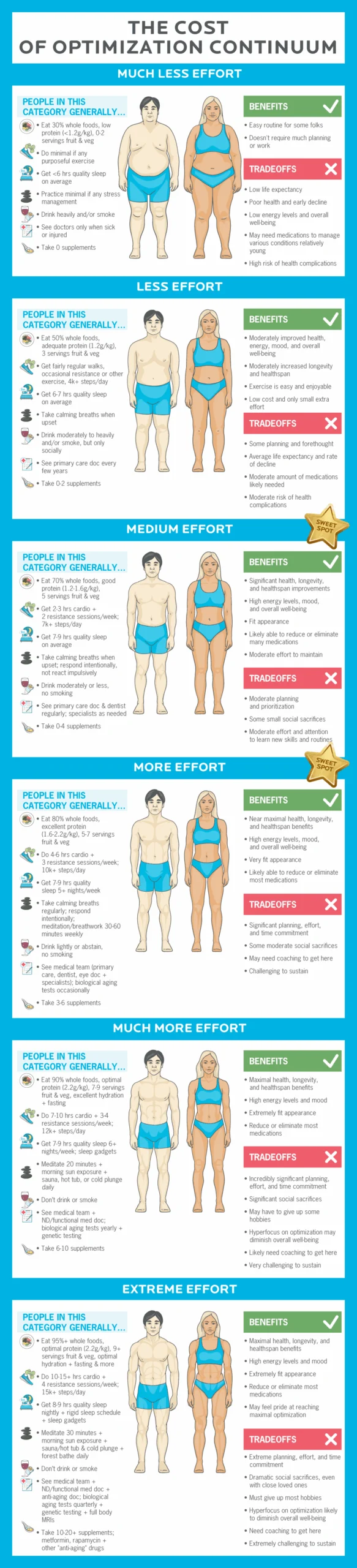
The Cost of Optimization: A Financial and Temporal Reality
When we compare a "moderately healthy" individual to an "optimizer," the divergence in lifestyle is staggering. An optimizer might spend three to four times the time and money—investing in continuous glucose monitors, specialized blood panels, boutique fitness classes, and an array of supplements—to achieve perhaps a 5 to 10 percent improvement in biomarkers over the person who simply follows the basics.

For most, the "optimizer" lifestyle requires a sacrifice of time and quality of life that is fundamentally unsustainable. When health optimization becomes an obsession, it often leads to orthorexia, social isolation, and an existential focus that erodes "Deep Health"—the integration of physical, mental, emotional, and social well-being.
Implications for the Future
The obsession with "optimizing" aging is a luxury that often distracts from the structural and behavioral shifts that actually move the needle on public health. The most effective longevity intervention isn’t a new supplement or an expensive diagnostic test; it is the democratization of the basics.

If you are currently struggling with your health, do not be intimidated by the loud voices on social media telling you that you need to optimize your hormones or track your ketone levels. Start by walking more, eating more whole foods, prioritizing seven hours of sleep, and reconnecting with your community.
These are not just "basic" steps; they are the most powerful, evidence-based tools for living a long, vibrant life. Your health is not a software program to be hacked; it is a life to be lived. By focusing on the fundamentals, you gain the freedom to enjoy that life fully—which, ultimately, is the greatest longevity hack of all.