










"I just bought a new BPA-free Tupperware set."
This comment, coming from my friend Anna, caught me entirely off guard. Anna is a powerhouse—a high-level legal professional known for her sharp, analytical mind and an uncanny ability to cut through corporate jargon and nonsense. She is a true skeptic who doesn’t suffer fools lightly. Yet, here she was, falling into a psychological trap that seemed to bypass her internal radar entirely.
Anna had been struggling to shed 15 pounds for over a year. She felt stuck, frustrated, and at a loss for how to reignite her progress. When she touted her new plastic-free food storage containers as a breakthrough, I asked, "Interesting. What inspired you to focus on that?"
"Well," she replied, "I’ve been reading about how microplastics in food containers can disrupt hormones and cause weight gain. I’m eliminating the toxins."
I squinted. I knew for a fact that Anna’s struggle wasn’t rooted in the chemical composition of her lunchbox. This conversation was happening immediately after she had confessed to me that she had been skipping the gym for weeks, relying on high-calorie takeout to survive long workdays, and sacrificing her health to "doom-scroll" on her phone until 2:00 AM.
When I gently suggested that she might see better results by getting consistent with her workouts or prepping simple homemade meals, her response was immediate: "Yeah, but I’ve tried that a thousand times. If it were that simple, it would have worked already."
Anna’s reaction is a textbook example of a phenomenon that plagues high-achievers and casual health-seekers alike: the pursuit of the "magic bullet" at the expense of the mundane.
The Chronology of Avoidance: Why We Choose Niche Over Necessary
The cycle of health-related procrastination follows a predictable, often tragic, timeline. It usually begins with a realization that we are not where we want to be physically or mentally.
- The Recognition Phase: We identify a discrepancy between our current state and our desired goal (e.g., losing 15 pounds).
- The "Complexity" Pivot: Instead of addressing the known, fundamental behaviors required to bridge that gap, we search for a "hidden" reason for our failure. We start researching the "optimal" workout, the latest hormone-disrupting plastics, or a specific supplement.
- The Displacement Activity: We invest time and money into these niche areas. Buying new gear or reading deep-dive articles feels like progress. It provides a dopamine hit of "doing something" without requiring the discomfort of changing our actual lifestyle.
- The Stagnation: Because the core issues—sleep, movement, and nutrition—remain unaddressed, the results never materialize.
- The Resignation: We conclude that the "simple" things don’t work for us, reinforcing the belief that we are somehow fundamentally broken or that our situation is uniquely complex.
This behavior is not a character flaw; it is a human defense mechanism. We prefer the mystery of a "hidden cause" because it offers hope for an easy, singular solution. Facing the reality that we need to change our sleep habits or prioritize cooking our own meals feels heavy, boring, and difficult.
The Statistical Reality of the Basics
It is easy to dismiss the "basics" as common knowledge. We all know we should exercise, eat protein, and sleep. Yet, data suggests that "common knowledge" is not "common practice."
According to recent public health research, only six percent of Americans consistently perform five foundational health behaviors: engaging in moderate-to-vigorous exercise, consuming a nutrient-dense diet, maintaining adequate protein intake, prioritizing 7–8 hours of quality sleep, and avoiding excessive alcohol or tobacco.
This means 94 percent of the population is missing the mark on at least one fundamental pillar of health.
When we look at this through a journalistic lens, the implication is clear: we are not failing because we lack "secret knowledge." We are failing because we are ignoring the most basic, evidence-backed requirements for human vitality. We are chasing the 1 percent of optimization while leaving the 99 percent of foundational work on the table.

The Three Primary Barriers to Consistency
If the path to health is known, why is it so rarely taken? Through years of observation, three primary barriers have emerged that prevent even the most competent individuals from achieving their goals.
1. Ambition Overload
We tend to believe that the future version of ourselves will have more time, more discipline, and more motivation. We commit to an hour of gym time, meal prepping every Sunday, and a 5:00 AM wakeup call, all while our current lives are already overflowing with stress and fatigue. When we inevitably crash, we blame our willpower rather than our unrealistic expectations.
2. The "Industry Secret" Fallacy
We are conditioned to believe that if something is simple, it must be ineffective. If "eat more vegetables" were the answer, why isn’t everyone in shape? This leads us to trust "hardcore" or "cutting-edge" strategies that are often unsustainable or, worse, completely unproven. We want to believe in a shortcut because the hard truth—that health is a lifelong, unsexy, daily grind—is unappealing.
3. The Perfectionism Trap
Many of us operate under the assumption that if we cannot do it perfectly, we shouldn’t do it at all. We believe we must be the person who meditates every morning and never misses a workout. When life throws a curveball—a late night at the office, a sick child, or just a bad day—we treat it as a total failure, leading to an "all-or-nothing" approach that eventually results in quitting altogether.
Bridging the Gap: A Four-Step Framework for Action
To break free from this cycle, we must shift our focus from "optimization" to "sustainability."
Step 1: Explore the "Why" Before the "How"
Before you change your diet or start a new fitness program, dig into your motivations. Why does this matter? What are the long-term consequences of staying exactly where you are? Using tools like "The 5 Whys" can help you move past superficial goals (like losing 15 pounds) to deeper, more sustainable drivers (like wanting to play with your kids without getting winded or having the energy to pursue your career with vigor).
Step 2: Prioritize Effective, Not Complex, Actions
Stop trying to do everything. Identify the one or two areas—movement, nutrition, or recovery—that would have the greatest impact on your life. If you don’t have a regular workout habit, don’t worry about the "perfect" lifting program. Just focus on a "movement practice" that you can actually maintain. Use a simple, daily action: "I will walk for 15 minutes every lunch break."
Step 3: Implement the "Dial" Method
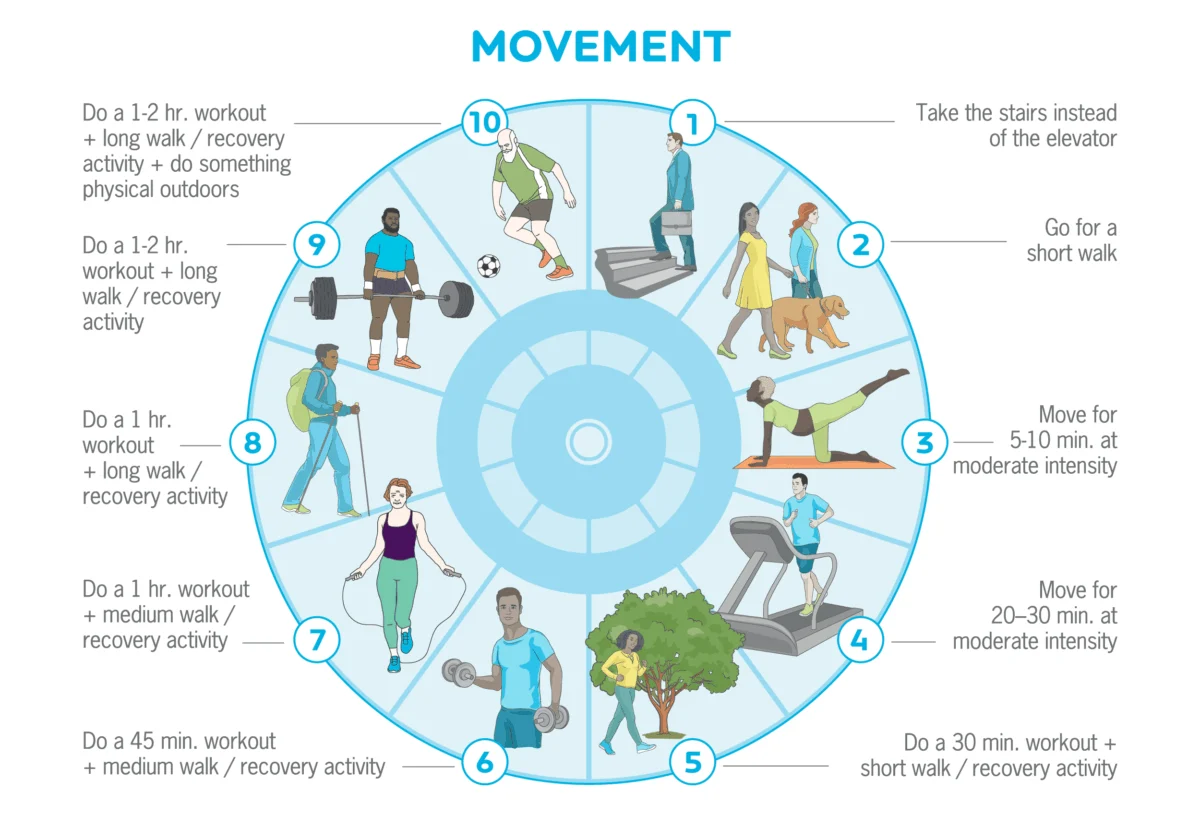
Treat your habits like a dial, not an on/off switch. On a good day, you might turn your "exercise dial" to a 10, going for a hard run and lifting heavy. On a terrible day, turn the dial to 1. That might mean doing five push-ups or just stretching for two minutes. By defining your "floor" (the minimum effort you can give on your worst day) and your "ceiling," you remove the binary failure trap. Doing the bare minimum is not failing; it is maintaining the habit.
Step 4: Build an Ecosystem of Success
Your environment is a stronger predictor of behavior than your willpower. If you want to eat better, make the "good" food the most convenient choice. If you want to exercise, set your gym clothes out the night before. Reduce the friction between you and the behavior you want to adopt. As behavior science confirms, "access" is the number one driver of human habits.
The Professional Implication: Embracing "C+" Effort
The irony of health and fitness is that the "perfect" approach is often the enemy of the "good" approach. When we demand an A+ performance from ourselves every day, we set the stage for burnout.
If you are a high-achiever, the idea of "C+ effort" might feel uncomfortable. But consider this: a C+ effort maintained for a decade is vastly superior to an A+ effort maintained for two weeks before a total collapse.
There is no shame in dialing it down. In fact, the ability to adapt your habits to the reality of a messy, unpredictable, and beautiful life is the hallmark of true competence. You don’t need a new set of plastic-free containers to change your health. You need to stop looking for the hidden door and start walking through the one that has been standing wide open in front of you all along.
The goal isn’t to be perfect. The goal is to be present, to be consistent, and to realize that "good enough" is, in the long run, the only thing that actually works.