







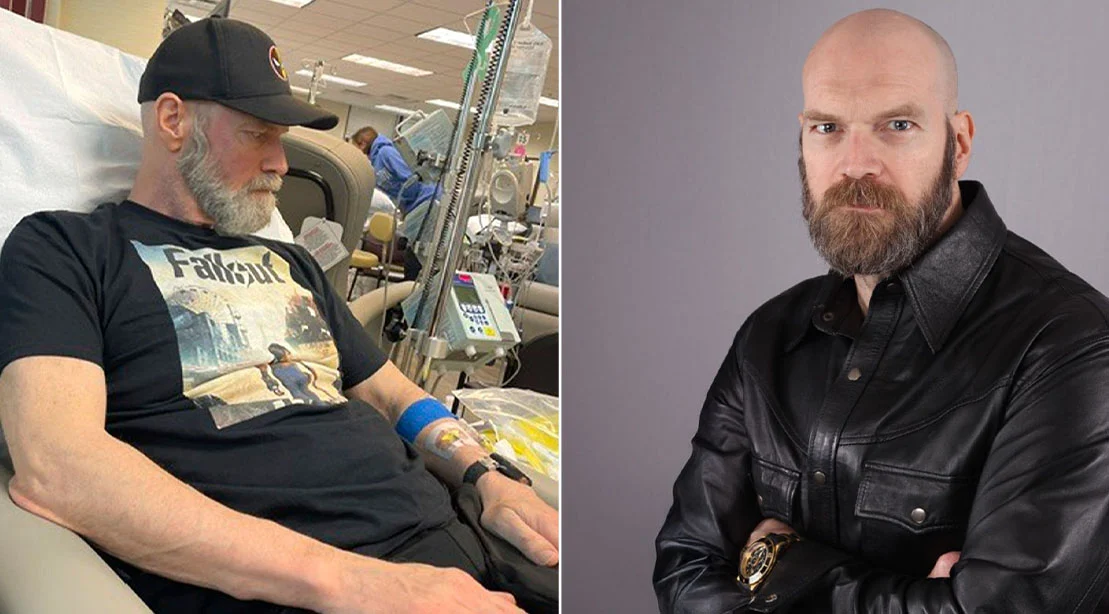
For decades, Tyler Mane has loomed large over the entertainment landscape. Standing at an imposing 6’8”, he carved out a reputation as one of the most formidable physical presences in both professional wrestling and Hollywood. Whether he was locking horns with André the Giant in the squared circles of Japan, battling icons like Sting and the British Bulldog in WCW, or portraying iconic cinematic villains—from the ferocious Sabretooth in X-Men and Deadpool & Wolverine to the terrifying Michael Myers in Rob Zombie’s Halloween franchise—Mane’s career has been defined by his sheer, hulking stature.
However, the man once known in the ring as "Big Sky" is currently engaged in a real-world struggle that transcends any scripted rivalry. Having recently completed his final round of chemotherapy for breast cancer, Mane has transitioned from the role of a Hollywood heavy to a real-life health advocate. By sharing the intimate details of his diagnosis and treatment, he is using his massive platform to dismantle the stigma surrounding male breast cancer, urging men to discard the "suck it up" mentality and prioritize their health above all else.
The Unlikely Discovery: A Life-Changing Curveball
The timeline of Mane’s diagnosis began during a period of professional momentum and personal growth. As the founder of Mane Entertainment—a production house known for championing "vertically gifted" actors and producing the popular The Last Spartan graphic novels—Mane was hitting his stride. Yet, as the calendar turned toward 2025, a shift in his health began to manifest.
Determined to improve his fitness and shed some weight, Mane embarked on a disciplined lifestyle overhaul. He cut alcohol entirely and intensified his training, resulting in significant fat loss. It was this very commitment to his health that led to the discovery of a small lump on the side of his chest.
"With losing that weight, I felt a lump in the side of my chest," Mane recounts in an interview with M&F. "I was like, ‘Oh, that’s just… I probably tweaked something. It’s nothing.’"
For many men, this is where the story would have ended—with a dismissive shrug and a refusal to acknowledge a potential problem. But Mane’s wife, Renae, refused to let the issue slide. Her persistence, combined with the recent, tragic loss of Mane’s brother to a sudden heart attack, shifted the actor’s perspective on his own mortality. He took his wife’s advice and sought medical evaluation.
The results were a shock: invasive ductal carcinoma (IDC). Accounting for approximately 80% of all breast cancer cases, this diagnosis was a sobering reminder that cancer does not discriminate by gender. "I was like, how can that be?" Mane reflects. "How could this be happening to me?"
Chronology of a Crisis: From Diagnosis to Treatment
Once the diagnosis was confirmed, the reality of the situation moved quickly. Medical professionals determined that Mane had an aggressive, fast-moving Oncotype, which necessitated immediate and decisive action.
The treatment regimen was grueling. Mane underwent four intense sessions of chemotherapy, each bringing its own set of physiological challenges. The side effects were immediate and cumulative; after the very first session, he lost his signature beard. By the second, he suffered from severe hives. By the fourth, the physical toll had left him unable to lift his arm above his chest.
Despite these setbacks, Mane maintained a focus on his recovery. He acknowledges that his initial approach to hydration was insufficient, leading to painful cramping, a mistake he corrected as he learned to navigate the rigors of clinical oncology. Following the conclusion of his chemotherapy, Mane is now entering a four-week course of radiation therapy. This stage involves daily, ten-minute sessions designed to eliminate any lingering cancer cells and ensure a comprehensive recovery.
The Stigma of Silence: Why Men Must Listen
Tyler Mane’s journey highlights a persistent public health crisis: the gender gap in medical consultation. Statistically, women are more proactive in seeking medical care, while men are up to 50% less likely to visit a doctor for non-emergency issues. This disparity is often fueled by rigid societal expectations of masculinity.
"Guys are like, ‘It’ll go away,’ ‘I gotta suck it up,’ ‘I’ve got to support the family,’" Mane explains. "No, you’ve got to be your best and biggest advocate for yourself."
The consequences of this "suck it up" culture are often fatal. In the United States, roughly 2,670 men will be diagnosed with breast cancer this year, with approximately 530 deaths expected. Many of these deaths could have been prevented through early detection. Mane’s own experience with the medical system was not without friction; even when he first presented his concerns, there was an initial clinical suggestion that the lump might be a benign lipoma.
"If the doctors say, ‘Oh, it’s probably nothing,’ say: ‘No, I want the tests,’" Mane insists. He recounts a powerful interaction at a recent convention where a fan approached him, noting that his father had passed away from stage 4 breast cancer because he had ignored the symptoms for too long. This interaction further solidified Mane’s resolve to use his experience to prevent similar tragedies.
Supporting Data: The Reality of Male Breast Cancer
It is a common misconception that breast cancer is exclusively a female disease. While the incidence rate in men is significantly lower than in women, the mortality rate can be higher—often due to late-stage diagnosis.
Key Clinical Insights:
- Invasive Ductal Carcinoma (IDC): This remains the most common form of the disease for both men and women, characterized by cancer cells that have begun to grow outside the ducts of the breast.
- The 40% Threshold: Research suggests that roughly 40% of the population will be diagnosed with some form of cancer in their lifetime. As Mane notes, "There’s a 100% chance that we know someone that has gone through it."
- The Importance of Early Screening: The survival rate for breast cancer is significantly higher when detected early. For men, this means being aware of changes in the chest area, including lumps, dimpling, or skin changes, and seeking immediate medical intervention.
Implications: A New Mission for "Big Sky"
As Mane navigates his "road back to the beard," his focus has shifted toward education and advocacy. He is launching a new podcast, Mane AF with Tyler & Renae, debuting on August 27, 2026. The platform is designed to be an open forum for medical professionals, celebrity guests, and survivors to discuss not just cancer, but the various health challenges faced by men in mid-life.
Mane is particularly passionate about curbing the spread of misinformation. In an era where "holistic" trends can sometimes lead individuals away from evidence-based medicine, Mane is firm in his stance: "See your doctor, because that’s where the science is. That’s where the training is. If chemotherapy is recommended, or radiology is recommended, do what you have to do to keep healthy." He emphasizes that while holistic practices can be a supportive component of a lifestyle, they should never replace the guidance of a trained oncologist.
Looking Ahead: The Comeback
Tyler Mane’s story is not one of victimhood, but of transformation. Having faced down some of the most iconic villains in fiction, he has now stared down a real-world predator and come out the other side with a clearer purpose.
His physical recovery is well underway. Though he lost roughly 10 pounds during the intense chemotherapy process, he is eager to return to the gym and regain his strength. His message is simple, yet profound: do not let ego or fear dictate your health outcomes. Whether you are a towering 6’8” Hollywood star or an average citizen, the biological rules remain the same.
"I had my last chemo yesterday, so we’re on the mend now," Mane says with a characteristic blend of grit and optimism. As he looks toward the future of his podcast and his upcoming projects, Mane is no longer just the man who played the villain; he is the man who proved that the strongest thing a person can do is ask for help.
For those looking to follow his progress or engage with his advocacy work, Tyler Mane remains active on social media, using his voice to ensure that no man feels he has to face the "curveball" of a cancer diagnosis in silence. In the end, his most important role may not be on the screen, but in the lives of the men he encourages to get checked—and, in doing so, saves.