







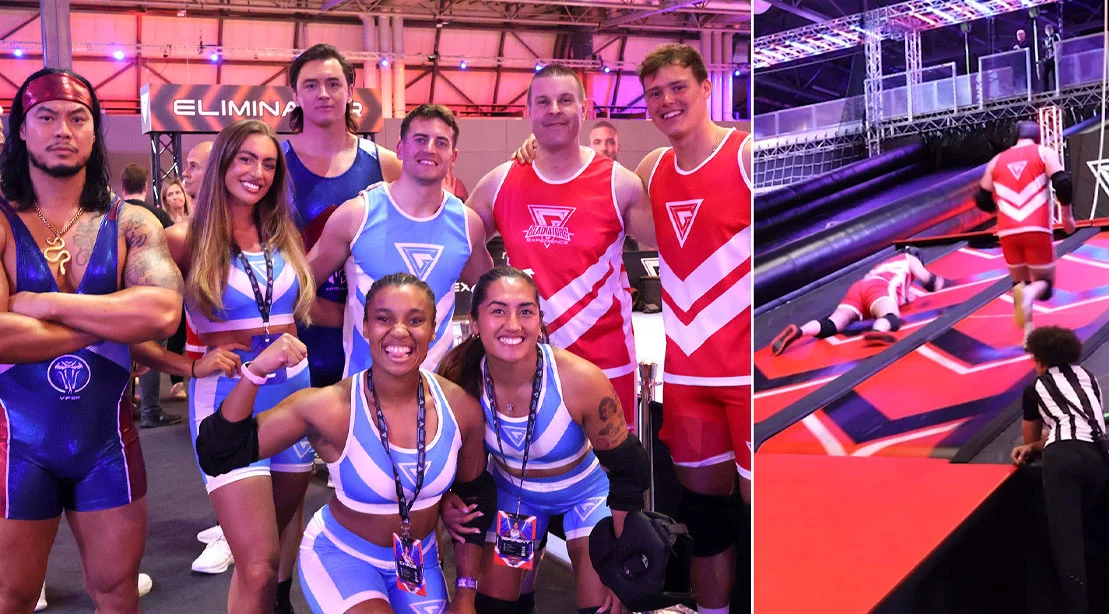
The siren sounds, the lights strobe, and the roar of a phantom crowd echoes through the cavernous halls of the National Exhibition Centre (NEC) in Birmingham. For a generation that grew up watching the spandex-clad titans of the 90s, the recent global revival of Gladiators—sweeping from the U.K. to Australia and France—has been more than just a television nostalgia trip; it has sparked a genuine cultural hunger to test one’s own physical mettle.
Now, that hunger has a home. The world’s first official “Gladiators Experience” has opened its doors in the U.K., offering the public a rare, high-octane chance to step off the sofa and into the arena. As a fitness writer for Muscle & Fitness who has survived training sessions with the world’s strongest men, endured the bone-rattling impacts of pro wrestling, and held my own against the England Rugby League team, I thought I knew what "tough" felt like. I was wrong.
The Call of the Arena: A Chronology of the Challenge
My arrival at the NEC was initially intended to be a observational, journalistic walkthrough. I had planned a polite tour, a few photographs, and perhaps a chat with the staff. However, the atmosphere inside the venue is designed for one thing: performance.
The turning point came when Nathan Bland, a formidable Gladiators contender and a record-breaking finisher of "The Eliminator," spotted me near the starting blocks. With a grin that suggested he knew exactly how much I would struggle, he issued a challenge: a race through the show’s most infamous obstacle course.
Phase 1: The Initial Surge
The moment the whistle blew, my professional detachment evaporated. The Eliminator is a masterpiece of psychological and physical torture. The opening obstacle—a series of beams requiring explosive vertical power—demanded an immediate, lung-busting jump. I managed to clear the first, but the intensity was instantaneous. As I hauled myself up the rope to the raised platform, the lactic acid began its familiar, biting ascent into my forearms.
Phase 2: The Vertical Climb
"This is the worst part," Bland remarked, his voice surprisingly calm as he paced alongside me. He was referring to the cargo net, a towering mesh that reaches toward the rafters. Every fiber in my body screamed for rest, but the momentum of the course carries you forward. Balancing on the narrow beams requires a focus that ignores the burning in your muscles—a mental shift that is the hallmark of every elite athlete.
Phase 3: The Crash and the Comeback
The zip wire, the iconic high-speed transition, proved to be my undoing. As I descended, I failed to tuck correctly, resulting in a landing that sent an audible crunch through my legs. The health and safety team was on me in seconds, but the adrenaline—that potent cocktail of pride and fear—fueled a quick recovery. With Bland’s encouragement, I pushed through the final balancing beams, sprinted (or rather, stumbled) up the infamous Travelator, and lunged for the finish line. I fell, I crawled, and I finished. I was battered and bruised, but I had touched the legend.
Supporting Data: The Science of the "Gladiator" Mindset
While the experience is designed for the public, it is grounded in the reality of the show’s athletes. What becomes clear when speaking with the professionals is that the "Gladiator" persona is a construct of immense discipline, but beneath the armor, they are human beings grappling with the same limitations as any gym-goer.
Take, for instance, Fire (Montell Douglas). As the British woman’s record holder for the 100m sprint (11.05 seconds), she is arguably the fastest human in the building. Yet, she admits that events like "Hang Tough"—which require upper-body endurance and grip strength rather than explosive leg power—take her into uncomfortable territory.
"The more you do it, the better you get," Fire explains. This philosophy is the cornerstone of the experience. Even the most elite athletes must adapt to their environment.
The Anatomy of Weakness
The diversity of the Gladiators’ strengths is what makes the experience so humbling for participants:
- Electro (Jade Packer): An IFBB Pro Bodybuilder and world-class sprinter. Her challenge? The "Unleashed" event, where the pace is set by the contender, leaving no room for error. "You’ve only got one shot," she says.
- Athena (Karenjeet Kaur Bains): A medal-winning powerhouse. She notes that her lower center of gravity—an asset in strength events—can become a liability on the higher, balance-heavy obstacles.
- The Contrast: It is a stark reminder that physical greatness is not a monolith. Livi Sheldon (Diamond) thrives on "The Wall," while Lystus Ebsosel (Cyclone) identifies it as a personal hurdle.
Official Responses: The Philosophy of the Arena
The Gladiators are not there to be cheerleaders. They are there to provide an authentic test. Gladiator Phantom, perhaps the most imposing of the group, offered a sobering take on the relationship between the hero and the contender.
"To begin with, I am not your friend," Phantom told M&F. "I want you to do the job without any handouts, without any aid. I want you to bring your best self, and then at the end of it, we can break bread."
This is the core of the Gladiators Experience. It is not about winning; it is about the "non-negotiable" demand to give your best effort. Despite the intensity, the feedback from the athletes is that the experience is fundamentally communal.
"It’s bringing what we do to life," says Fire. "But also, just how tough, and fun it is." This duality—the "tough" and the "fun"—is what makes the NEC event a success. It bridges the gap between the screen and the floor, stripping away the camera angles to reveal the raw, unvarnished truth of athletic competition.
Implications: Finding the Hero Within
What does this mean for the average person looking to get fit? The takeaway from my time on The Eliminator is profound: you don’t need to be a Gladiator to benefit from the "Gladiator" mindset.
The experience is a masterclass in pushing through perceived mental limits. When I was dangling from the cargo net, my brain was telling me to quit. When I hit the mat after the zip wire, my ego was telling me to stay down. The fact that I kept going wasn’t because of superior athleticism; it was because of the environment. The arena demands effort. It sets a stage that makes it impossible to hide from one’s own capabilities.
For those reading this who feel their fitness journey has plateaued, or who feel intimidated by the idea of high-intensity training, the Gladiators Experience offers a vital lesson: Discomfort is the price of progress.
Whether you are a seasoned lifter or someone just starting to move, the opportunity to tackle the Travelator or swing through the rings is a reminder that we are all capable of more than we think. We often define ourselves by our strengths, but growth is found in the moments where we are forced to confront our weaknesses.
The Gladiators Experience is more than a promotional event; it is a laboratory for human potential. It allows the public to see that even the icons they worship on screen are constantly adjusting, learning, and failing. When you step into that arena, you aren’t just running a course; you are participating in a dialogue about what it means to be strong.
As of May 2026, the gates remain open at the NEC. If you find yourself in Birmingham, I encourage you to leave your comfort zone at the door. You might leave with a few bruises, but you will almost certainly leave with a newfound respect for what your body—and your mind—can actually achieve.
The Gladiators Experience continues at the NEC in Birmingham, England, until August 31, 2026. For more information and to book your slot in the arena, click here.