











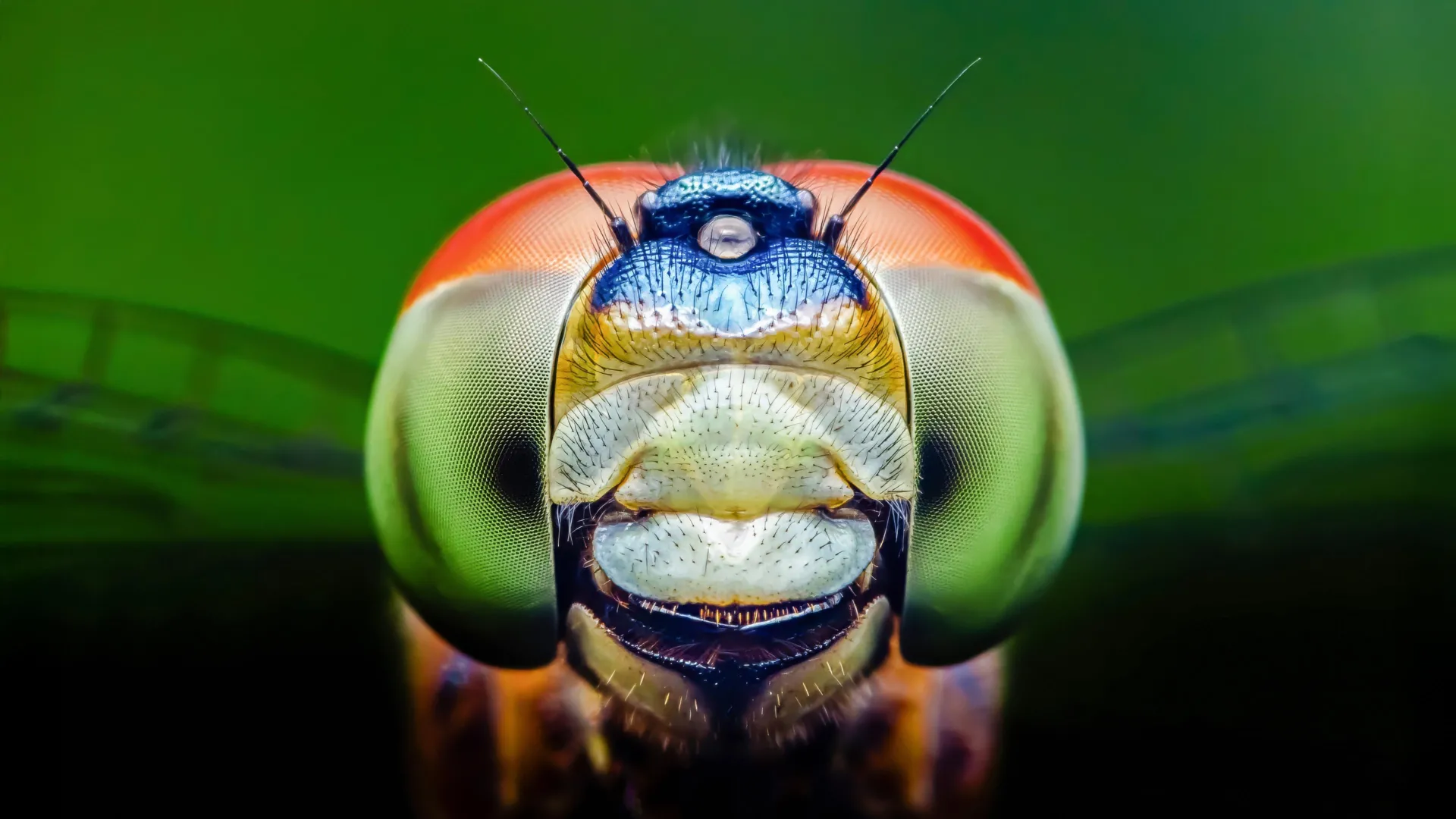
In the intricate tapestry of biological history, nature occasionally finds itself repeating a successful design. This phenomenon, known as parallel evolution, occurs when distantly related species independently develop similar traits to solve identical environmental challenges. A groundbreaking study from Osaka Metropolitan University (OMU) has now unveiled a striking example of this: dragonflies, the ancient masters of aerial agility, have evolved a mechanism for detecting red light that mirrors the visual systems of mammals, including humans.
This discovery, recently published in the journal Cellular and Molecular Life Sciences, does more than satisfy academic curiosity about insect behavior. By identifying the molecular mechanics behind this "deep-red" vision, researchers have unlocked a new toolkit for the burgeoning field of optogenetics, promising to revolutionize how we study and manipulate cells deep within living tissue.
The Biological Foundation: How We See
To understand the significance of this discovery, one must first look at the human eye. Our visual experience is governed by opsins—specialized light-sensitive proteins embedded in the photoreceptor cells of our retinas. Humans typically possess three distinct types of cone opsins, each tuned to different segments of the visible light spectrum: blue, green, and red. By integrating these inputs, our brains construct the vibrant, full-color world we inhabit.
For decades, the scientific consensus held that insects, while possessing sophisticated compound eyes, generally operated on a different visual wavelength, often sensitive to ultraviolet (UV), blue, and green light. Red vision is rare in the insect world, as it requires specific protein configurations to capture longer wavelengths of light. The discovery that dragonflies—predatory insects that have thrived for millions of years—have evolved an opsin tuned to approximately 720 nanometers (nm) places them in an elite category. This wavelength sits comfortably beyond the deepest red visible to the human eye, bordering on the near-infrared.
Chronology of the Discovery
The path to this finding was a meticulous process of biochemical detective work led by Professors Mitsumasa Koyanagi and Akihisa Terakita at the OMU Graduate School of Science.
The Initial Inquiry
The research began with a fundamental question: Why do dragonflies, unlike the vast majority of their insect cousins, display such an acute sensitivity to red? The team suspected that this was not merely a random mutation, but an adaptation driven by ecological necessity.
Molecular Identification
Using advanced genomic sequencing and protein analysis, the team isolated the opsin responsible for long-wavelength sensitivity in Gomphidae (clubtail) dragonflies. Their analysis revealed a protein uniquely optimized for capturing photons in the 720 nm range. As Professor Terakita noted, "This is one of the most red-sensitive visual pigments ever found."
The Behavioral Hypothesis
With the mechanism identified, the team shifted their focus to the field. They hypothesized that this sensitivity was sexually dimorphic, serving as a biological beacon for mating. By measuring the reflectance of dragonfly wings and bodies, the team confirmed that males and females reflect light differently in the red to near-infrared spectrum. This suggests that during high-speed aerial flight, males utilize this specialized visual channel to identify and track potential mates against the complex backdrop of a natural landscape—a feat that would be impossible with standard insect vision.
Supporting Data: The Case for Parallel Evolution
Perhaps the most startling aspect of the study is the molecular blueprint. When the OMU team compared the dragonfly’s red-sensitive opsin to the red-sensing opsins found in humans, they discovered an identical functional mechanism.
"Surprisingly, the mechanism by which dragonfly red opsin detects red light is identical to that of red opsin in mammals," said Ryu Sato, the study’s first author. "This is an unexpected result, suggesting that the same evolutionary process occurred independently in distantly related lineages."
This finding serves as a profound reminder of evolutionary constraints. While the common ancestor of insects and mammals lived hundreds of millions of years ago, the laws of physics and chemistry governing photon absorption remain constant. When faced with the evolutionary pressure to see deeper into the red spectrum, both lineages arrived at the same molecular solution. The proteins utilize the same specific amino acid arrangements to "tune" their sensitivity, providing a masterclass in nature’s efficiency.
Implications for Optogenetics and Medical Technology
The excitement surrounding this discovery extends far beyond evolutionary biology. In the high-tech world of optogenetics—a field where scientists use light to control the activity of neurons and other cells—the primary limitation has always been light penetration.
The Problem of Depth
Most optogenetic tools currently in use are activated by blue or green light. While effective for surface-level work, these wavelengths cannot penetrate deep into biological tissue; they are quickly scattered or absorbed by blood and skin. Researchers studying deep-brain structures or internal organs often struggle to use light without invasive fiber-optic implants.
The Dragonfly Solution
The OMU team realized that the dragonfly’s red-sensitive opsin was the perfect candidate for an upgrade. By identifying a single key position in the protein structure, they were able to engineer a variant that could be "tuned" even further toward the infrared spectrum.
"In this study, we succeeded in shifting the sensitivity of a modified near-infrared opsin from Gomphidae dragonflies even further toward longer wavelengths," Professor Koyanagi explained.
By successfully inducing cellular responses using near-infrared light, the team has created a "red-shifted" tool that can reach significantly deeper into living organisms. Because near-infrared light passes through biological tissue with minimal scattering, this protein could allow for non-invasive, high-precision control of deep-tissue cells.
Official Responses and Expert Commentary
The scientific community has reacted with significant interest to the OMU study. The ability to manipulate cells at depth has long been the "holy grail" of neuroscience and regenerative medicine.
Professor Terakita emphasized the dual nature of the work: "These findings demonstrate this opsin as a promising optogenetic tool capable of detecting light even deep within living organisms. It is a rare case where a fundamental discovery in insect biology directly informs the engineering of new medical diagnostic and therapeutic tools."
Industry observers note that if this opsin can be successfully adapted for clinical research, it could lead to non-invasive treatments for conditions ranging from chronic pain management to the stimulation of specific heart cells or the mapping of deep-seated neural circuits in the brain. The translation of this "dragonfly logic" into human medicine represents a new frontier in bio-inspired engineering.
The Road Ahead: Future Research
While the initial results are promising, the team at OMU acknowledges that there is still much to explore. The next phase of research will likely focus on the stability of these modified proteins and their compatibility with various mammalian cell types.
Furthermore, the team intends to conduct further behavioral studies to confirm the extent to which other dragonfly species rely on this near-infrared channel. Does this visual ability contribute to their legendary hunting prowess, or is it strictly reserved for the dance of courtship?
The research stands as a testament to the importance of "blue-sky" research. By looking closely at the eyes of an insect, researchers have not only clarified a chapter of evolutionary history but have also provided a vital component for the future of biomedical technology. As we continue to decode the biological strategies of the natural world, it becomes increasingly clear that the solutions to our most complex technological challenges may have been flying right in front of us all along.
Summary of Technical Insights
- Opsin Sensitivity: Dragonflies utilize a specialized protein tuned to 720 nm, the deepest red-sensitivity found in the insect kingdom.
- Parallel Mechanism: The molecular mechanism for red-shifting in dragonflies is structurally analogous to that found in human red-cone cells.
- Engineering Potential: A single point mutation in the opsin protein allows for further shifting into the near-infrared range, facilitating deeper tissue penetration.
- Clinical Utility: The modified opsin offers a non-invasive, light-driven mechanism to control cellular activity in deep-seated human tissues, bypassing the scattering issues associated with blue/green light-based optogenetics.
As the scientific community digests these findings, one thing is certain: the dragonfly has provided more than just a lesson in adaptation. It has provided a roadmap for the next generation of optogenetic research, proving that even the smallest creatures can hold the keys to significant medical breakthroughs.