










For the millions of individuals living with Ehlers-Danlos Syndrome (EDS), the professional world can often feel like an obstacle course. As a complex, multisystemic genetic connective tissue disorder, EDS frequently manifests with hypermobility, chronic pain, and a host of debilitating comorbidities—most notably dysautonomia and Mast Cell Activation Syndrome (MCAS). Because the spectrum of EDS is vast—encompassing 13 distinct types—symptoms are highly individualized, rendering a "one-size-fits-all" approach to workplace wellness ineffective.
Under the Americans with Disabilities Act (ADA), qualified employees with disabilities are legally entitled to reasonable accommodations that allow them to perform the essential functions of their roles. However, the gap between legal rights and practical implementation remains significant. For many with EDS, the challenge lies not only in managing fluctuating health but in navigating the professional bureaucracy required to secure the tools they need to thrive.
The Reality of EDS in the Modern Workplace: Main Facts
Ehlers-Danlos Syndrome is characterized by structural weakness in connective tissues, leading to joint instability, skin fragility, and systemic vascular issues. When brought into the office environment, these physiological realities translate into specific, often invisible, workplace challenges.
An employee with EDS might face subluxations from repetitive tasks, chronic fatigue that makes a traditional 9-to-5 schedule unsustainable, or neurological symptoms triggered by fluorescent lighting and office temperature. Unlike a temporary injury, these are chronic conditions that require long-term, systemic adjustments. The primary objective of workplace accommodation is to mitigate these physiological stressors so that the employee’s output is determined by their skill and talent, rather than the limitations imposed by their environment.
A Chronology of Advocacy and Evolution
The conversation surrounding workplace accommodations for invisible disabilities has undergone a profound shift over the last decade. Historically, workplace design was centered on "universal" standards—often ignoring the needs of those with chronic, fluctuating health conditions.
- Pre-2015: The "Medical Model" of disability dominated, where the burden was placed on the individual to "fix" their health to fit the workplace.
- 2015–2020: The rise of digital communication and the recognition of "invisible disabilities" began to gain traction. Disability advocates began pushing for accommodations that moved beyond physical ramps and into the realms of flexible scheduling and sensory-friendly workspaces.
- 2020–2024: The COVID-19 pandemic served as a massive, unplanned trial for remote work. For many with EDS, this period proved that high-level productivity does not require physical presence in a traditional office, effectively shattering many of the myths employers held regarding "essential" on-site requirements.
- 2026 and Beyond: We are currently in an era of intentional design. Employers are increasingly recognizing that the "Great Resignation" and the fight for talent necessitate a more inclusive approach. Reasonable accommodations are no longer viewed as "special treatment," but as essential infrastructure for a diverse and capable workforce.
Supporting Data: The Impact of Accommodations
Data from the Job Accommodation Network (JAN) consistently demonstrates that the cost of providing workplace accommodations is remarkably low, while the return on investment is exceptionally high.
According to various studies, most employers report that the cost of an accommodation is either zero or less than $500. Furthermore, the benefits extend far beyond the individual:
- Retention: Providing accommodations significantly increases employee loyalty and reduces turnover costs.
- Productivity: When physical pain or environmental triggers are managed, an employee’s cognitive load is freed up, allowing for higher-quality work.
- Morale: An inclusive environment fosters a culture of trust, which improves overall team dynamics.
For an employee with POTS (a common EDS comorbidity), a simple investment in a sit-stand desk or a cooling fan can be the difference between a high-performing employee and one forced into early disability retirement.
Official Responses and Legal Frameworks
The legal landscape is designed to protect employees, yet it requires active participation. Under the ADA, the "interactive process" is the core of the accommodation request. Employers are required to engage in a good-faith dialogue with the employee to determine which accommodations will enable them to perform their duties.
Official guidance from the Equal Employment Opportunity Commission (EEOC) suggests that employers should not view a request for accommodation as a sign of weakness, but as a standard business process. However, many employers remain under-educated regarding rare conditions like EDS. The onus often falls on the employee to provide medical documentation that bridges the gap between their diagnosis and their specific workplace needs. This requires a professional, documented approach: detailing exactly how a specific symptom limits a specific job task, and proposing a reasonable solution.
Creating an EDS-Friendly Environment: Practical Accommodations
To create a sustainable work life, accommodations must be categorized by the specific barrier they remove.
1. Physical Safety and Joint Protection
For those prone to dislocations and subluxations, the physical workstation must be optimized.
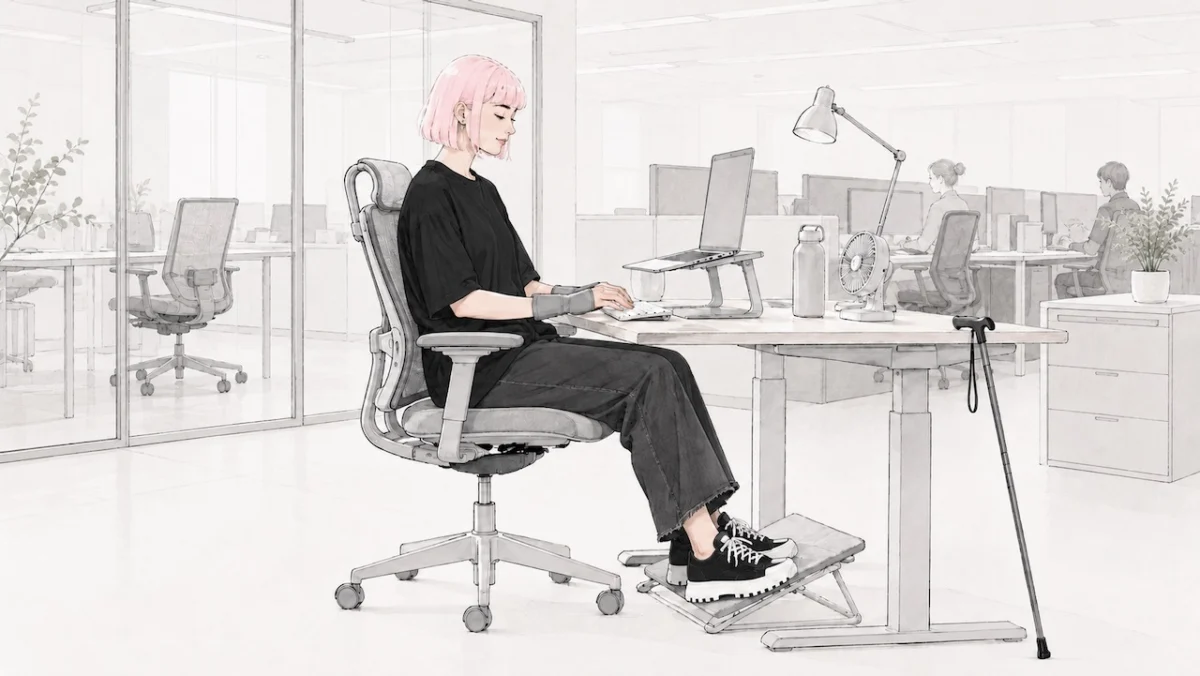
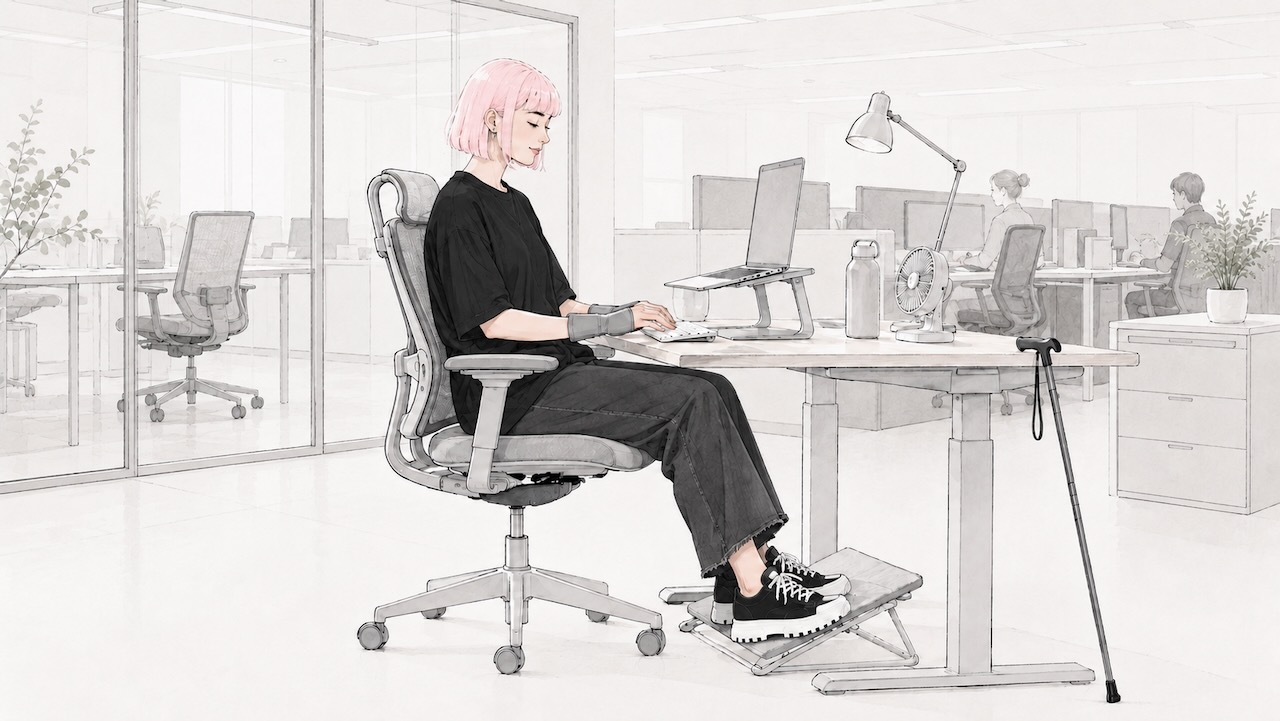
- Ergonomic Furniture: Chairs with adjustable lumbar support, armrests that allow for neutral positioning, and split-key keyboards.
- Peripheral Support: Using vertical mice to prevent wrist strain and footrests to ensure proper posture.
- Mobility Aids: Ensuring that office layouts are free of trip hazards and that paths of travel are clear for those using canes or rollators.
2. Flexibility as a Medical Necessity
EDS symptoms are often episodic. A "flare" can occur without warning, making a rigid 9-to-5 schedule counterproductive.
- Flexible Hours: Allowing the employee to start earlier or later depending on their morning fatigue levels or symptom severity.
- Remote/Hybrid Work: Eliminating the physical and cognitive toll of a daily commute.
- Asynchronous Tasks: Prioritizing output over time-in-seat, allowing employees to work when they are at their most functional.
3. Environmental Control
Conditions like MCAS and POTS make an individual hyper-sensitive to their surroundings.
- Climate Control: Access to personal fans or heaters to manage temperature-sensitive dysautonomia.
- Lighting: Replacing flickering or harsh fluorescent bulbs with soft, natural-spectrum lighting or task lamps.
- Fragrance-Free Policies: Essential for employees with chemical sensitivities often linked to MCAS.
Implications for the Future of Work
The rise of the "neurodiverse and physically diverse" workforce is not a trend; it is a permanent evolution of the labor market. As EDS awareness grows, the standard for a "good employer" will increasingly be defined by their ability to provide flexible, inclusive environments.
The implication for employers is clear: the cost of inaction—losing skilled, experienced, and loyal employees—is far greater than the cost of a desk adjustment or a flexible schedule. For the employee, the implication is one of empowerment. By understanding the legal frameworks and clearly articulating their needs, those with EDS can transition from merely "surviving" the workday to thriving in their chosen careers.
Key Takeaways for Employees and Employers
- Document Everything: Keep a clear paper trail of your health limitations and your accommodation requests.
- Educate the Employer: Don’t assume your boss understands the systemic nature of EDS. Provide literature from reputable organizations like The Ehlers-Danlos Society.
- The Interactive Process is Key: If an initial request is denied, don’t stop. Propose alternatives and continue the dialogue.
- Focus on Function: Always frame your requests around how they help you complete your job tasks more effectively.
Helpful Resources
- United States: The Job Accommodation Network (JAN) provides an A-to-Z list of disabilities and corresponding accommodations. The EEOC website offers guidance on the ADA.
- United Kingdom: The "Access to Work" program is a critical resource for government-funded support and equipment.
- Canada: Employment and Social Development Canada (ESDC) offers various programs for workplace accessibility and disability support.
The journey toward a more accessible workplace is ongoing. By advocating for ourselves and educating our employers, we are not just helping ourselves—we are paving the way for a more equitable, inclusive, and productive future for everyone living with chronic, invisible conditions. Success in the workplace is not just about physical presence; it is about providing the right support to allow every individual’s talent to shine.