











For many adults over the age of 65, the key to maintaining independence lies not in expensive gym memberships or high-impact athletics, but in the simple, sturdy chair already sitting in their living room. While traditional squats are often heralded as the "king of exercises," they can be intimidating—or even inaccessible—for those dealing with joint sensitivity or balance concerns.
However, recent shifts in physical therapy and geriatric fitness have highlighted that hip strength does not require heavy barbells. By utilizing a chair as a stabilization tool, individuals can perform targeted, low-impact movements that rebuild the outer glutes, hip flexors, and stabilizing muscles essential for walking, climbing stairs, and preventing falls.
The Core Facts: Why Hip Strength Matters
As we age, the muscles surrounding the hip joint—the primary engine of the lower body—naturally undergo physiological changes. Sarcopenia, or the age-related loss of muscle mass, often hits these stabilizing muscles hardest. Weakness in this region is a primary contributor to gait instability, which increases the risk of falls—a leading cause of injury in older adults.
The hip complex is responsible for more than just movement; it is the center of gravity for the human body. When the outer hips (abductors) and hip flexors are strong, the body can shift weight effectively during daily tasks without compromising posture or balance. A 10-minute, chair-based routine provides a low-risk, high-reward environment to retrain these muscles, allowing for "clear feedback"—a state where the exerciser can physically feel the muscle working rather than relying on momentum or compensating with the lower back.
A Chronological Guide: The 10-Minute Routine
To maximize the benefits of this session, consistency is key. The following routine is designed to be performed for 10 minutes, three to five times per week.
The Setup
- Equipment: A sturdy, armless chair (ensure it is placed against a wall to prevent sliding).
- Optional: A light mini-resistance band.
- The Cadence: Set a timer for 10 minutes. Perform each of the four exercises for 45 seconds, followed by 15 seconds of transition time. Complete the full circuit, then repeat the sequence once more.
Exercise 1: Seated Band Abduction
This movement targets the abductors—the outer hip muscles that prevent the "wobble" when walking.

- Sit toward the edge of the chair with feet hip-width apart.
- If using a band, place it just above the knees.
- Press your knees outward against the resistance of the band, pause, and return to center.
- Why it works: It forces the outer glutes to fire in a position where the lower back is fully supported.
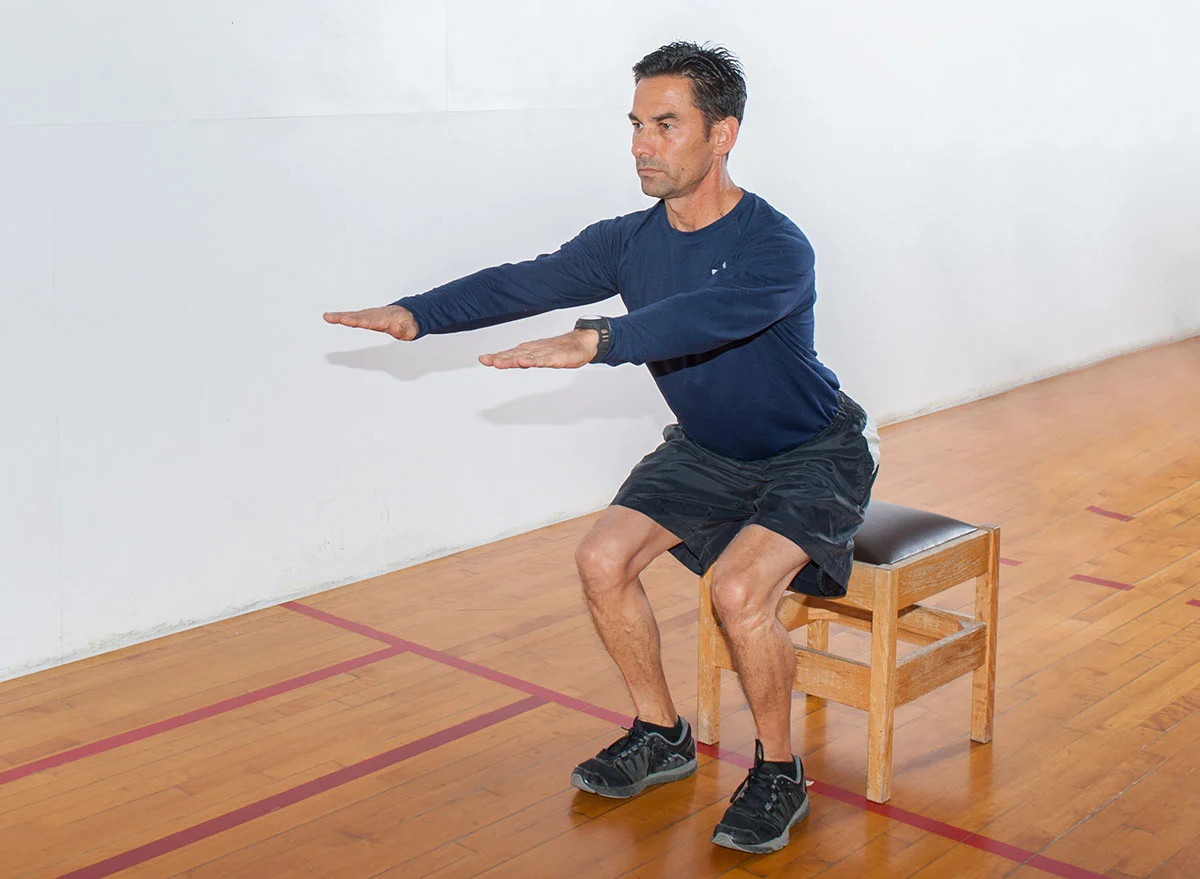
Exercise 2: Chair Box Squat
This is the "foundation" move for functional independence.
- Stand in front of the chair, feet shoulder-width apart.
- Slowly hinge at the hips, lowering your glutes until they lightly tap the seat.
- Do not fully sit; engage your core and drive through your heels to return to a standing position.
- Why it works: The chair provides a tactile target, ensuring you reach the same depth every time without the fear of falling backward.
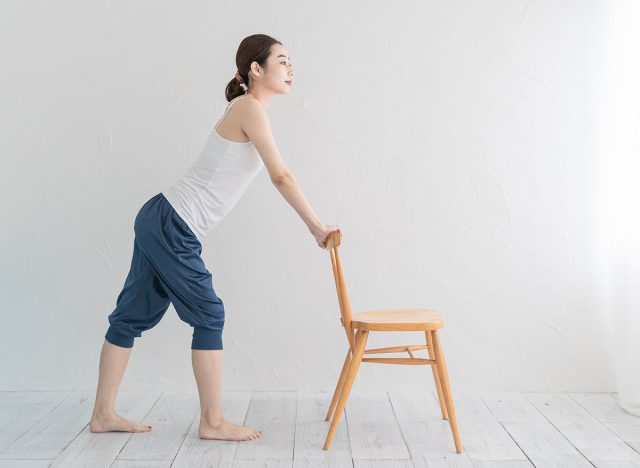
Exercise 3: Chair-Supported Hip Extension
This exercise isolates the posterior chain, specifically the gluteus maximus.
- Stand behind the chair, holding the backrest for balance.
- Keep your torso tall and core engaged.
- Extend one leg straight back—avoiding a large "swing"—and squeeze the glute at the top of the motion.
- Why it works: It prevents the lumbar spine from taking over, ensuring the effort remains localized in the hip and glute.
Exercise 4: Seated March
The hip flexors are often neglected, yet they are vital for lifting the foot to clear obstacles like curbs or stairs.
- Sit tall with your core engaged.
- Slowly lift one knee toward the ceiling, holding for a second at the peak of the movement.
- Lower the foot with control and repeat on the opposite side.
- Why it works: It builds endurance in the front of the hip, directly translating to a more confident, purposeful gait.
Supporting Data and Clinical Evidence
Scientific literature increasingly supports the move toward seated and supported exercises for older populations. According to research published in journals such as the National Center for Biotechnology Information (NCBI), resistance training in a supported position significantly improves physical function in older adults by reducing the "fear of falling" factor.
When a participant feels secure, they are more likely to exert maximum effort. Studies on hip-strengthening protocols indicate that even low-intensity, high-frequency movements can induce hypertrophy in the gluteal muscles, which in turn reduces the burden on the knee and ankle joints. By removing the balance challenge of a free-standing squat, the central nervous system can focus entirely on the motor unit recruitment of the hip muscles.
Official Perspectives: The Role of Targeted Programming
Physical therapists and certified personal trainers specializing in geriatric care emphasize that "intensity" does not always mean "weight." For those over 65, intensity is defined by intent—the focus on the specific muscle group being used.
"Many of my clients come to me expecting that if they aren’t sweating through a heavy lifting session, they aren’t making progress," says one leading fitness consultant. "However, the goal after 65 is durability. If you can move through a full range of motion with control, you are effectively bulletproofing your hips against the atrophy that leads to mobility loss."
The consensus among health professionals is that the chair acts as a "safety net." When the risk of injury is removed, the frequency of exercise increases. This creates a positive feedback loop: the more often you train, the stronger you become, and the more capable you feel in your daily life.
Implications for Longevity and Independence
The implications of adopting this 10-minute routine are profound. Mobility is the currency of independence. When hip strength is maintained, the necessity for mobility aids, the reliance on caregivers, and the risks associated with sedentary behavior all decrease.
Key Takeaways for Long-Term Success:
- Progressive Loading: Once the movements feel easy, don’t just add more repetitions. Consider adding a slightly stronger band or slowing the tempo down (a 3-second count to lower, a 3-second count to rise).
- Mind-Muscle Connection: The most effective part of this routine is the mental focus. Avoid "checking out" during the 45-second intervals. Focus on the squeeze of the glute or the stability of the core.
- Lifestyle Integration: Treat this 10-minute window as a non-negotiable appointment. Because it requires no travel and minimal equipment, it eliminates the common excuses of time and access.
In conclusion, maintaining a strong, functional body after 65 is not about mimicking the gym routines of youth. It is about honoring the biomechanical needs of the body in the present. By leveraging the humble chair, older adults can reclaim their hip health, ensuring that they remain mobile, steady, and independent for years to come. The effort is minimal, but the dividends—a life lived on one’s own terms—are immeasurable.