America has long positioned itself as the "land of possibility"—a beacon of relentless optimism, scientific advancement, and boundless economic growth. It is a nation built on the frontier spirit, where the impossible is merely a challenge waiting to be overcome. Yet, this very optimism creates a glaring, often tragic paradox: the same cultural engine that drives the world’s greatest discoveries also serves as the perfect incubator for hucksters, charlatans, and snake-oil salesmen.
In the United States, belief is a commodity, and it is frequently weaponized. From the patent medicine wagons of the 19th century to the viral "wellness" influencers of the TikTok era, Americans have consistently fallen head-over-heels for schemes promising eternal youth, instant wealth, or perfect health. As we navigate an era of unprecedented access to information, the question remains: Why, in an age of science, are we still so susceptible to the irrational?
A History of Hype: From Rattlesnakes to Ponzi Schemes
The American appetite for a "shortcut" is as old as the republic itself. This history is littered with figures who understood that if you tell an American that anything is possible, they will eventually believe that everything is for sale.
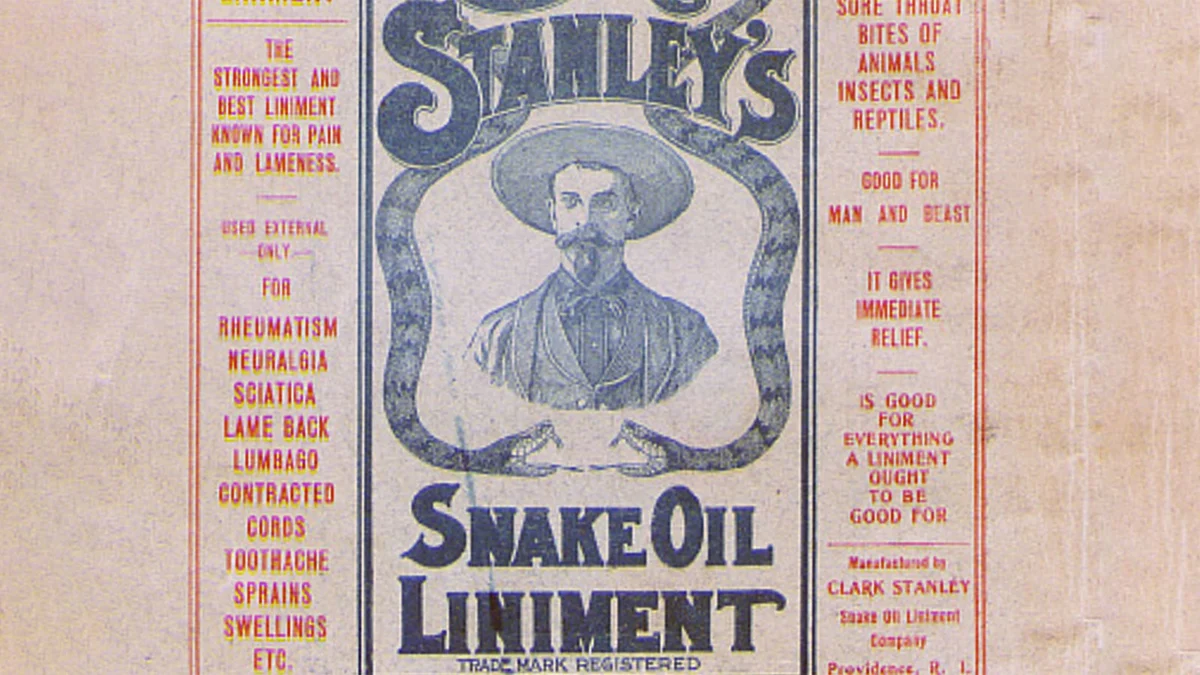
Consider the archetype of the "Rattlesnake King," Clark Stanley. In the early 20th century, Stanley traversed the country selling "snake oil liniment," promising miraculous relief for everything from lameness and sprains to the reduction of joints. While the public viewed it as a panacea, a 1916 investigation by the U.S. Bureau of Chemistry revealed the truth: Stanley’s elixir contained almost no snake-derived components. Instead, it was a mixture of mineral oil, beef fat, capsicum, and traces of camphor or turpentine. Stanley had effectively monetized a misunderstanding of genuine anti-inflammatory traditions used by Chinese laborers, turning a grain of truth into a flood of fraud.
Decades later, the same psychological mechanics were harnessed by Charles Ponzi. By promising a 50% profit in just 45 days through the manipulation of international postal reply coupons, Ponzi didn’t just steal money; he exploited the American dream of "getting ahead." Ponzi proved that if you provide a thin veneer of financial sophistication, the desire for wealth will override the alarm bells of common sense.
These historical figures are not mere relics of a more gullible past. They are the forefathers of a modern industry that continues to thrive by peddling raw milk as a "superfood," marketing peptides as fountains of youth, and selling expensive IV vitamin drips to "cure" hangovers.
The Neurology of Belief: Why We Cling to the Impossible
If these claims appear ludicrous to a rational observer, why do they persist? The answer is not found in a lack of intelligence, but in the fundamental architecture of the human brain.
Dr. Tali Sharot, a neuroscientist at University College London, argues that our beliefs are not merely tools to map the world accurately; they are tools to maximize reward and minimize harm. "People really don’t want to die," notes Dr. Lydia Kang, an associate professor of internal medicine at the University of Nebraska Medical Center and author of Quackery. "Everybody has a deep wish to have a long and fruitful life, without disability or pain and with your brain intact."
This creates a psychological vulnerability. When faced with a terminal diagnosis or the creeping decay of aging, a person is not looking for a peer-reviewed meta-analysis; they are looking for hope. If a supplement, a technique, or a "wellness" protocol offers the promise of a better future, the brain is biologically wired to favor that hope over the cold, hard reality of medical limitations.
"Believing that your future will be better than the past and the present—even if your future will not be better—many times can be optimal," Dr. Sharot explains. Even if the product is a sham, the act of trying provides a temporary boost in mood, a sense of agency, and the "positive anticipation" of a cure. In this sense, the victim is not just buying a pill; they are buying a psychological defense mechanism.
The Exploitation of the "Gray Area"
The most dangerous scams are those that exist in the "gray areas" of science—cases where a genuine scientific discovery is stretched, distorted, or completely fabricated to suit a commercial agenda.
Historically, this has led to some of the most horrific outcomes in medical history. Dr. Benjamin Rush, a signer of the Declaration of Independence and a respected physician, was so desperate to save patients during the 1793 yellow fever epidemic that he turned to aggressive bloodletting and purging. Based on misinterpreted autopsy reports, Rush’s procedures were so extreme that they likely hastened the deaths of his patients. The site of his practice reportedly became malodorous, buzzing with flies—a physical manifestation of what happens when desperation is allowed to override rigorous scientific method.
Today, this pattern is replicated by corporations that "capture the desperation" of those who are hurting. Companies will identify a kernel of emerging research—perhaps a study on the anti-inflammatory properties of a specific protein—and then "stick it in a bottle" with a massive markup, marketing it as a cure-all. Because it is often impossible to definitively prove that a supplement doesn’t work for a specific individual, regulators are left struggling to keep pace, while the companies continue to rake in profits.
The Double-Edged Sword of American Progress
The reason Americans are uniquely prone to these schemes is, ironically, because of our actual successes. The United States has fundamentally altered the human experience through technology and medicine. We have gone from an average life expectancy of 47 in 1900 to nearly 80 today. We have eliminated diseases that once claimed half of all children before their fifth birthday. We can access the sum of human knowledge on a device that fits in our pockets.
Because we have witnessed so many "miracles" in the last century, the line between "difficult" and "impossible" has blurred. If we can fly across the country in a metal tube, why shouldn’t we be able to reverse aging? If we can map the human genome, why shouldn’t there be a supplement that grants us endless energy?
This success creates a cultural bias: the belief that there is no limit to what can be achieved, provided you have the right technology or the right secret. This is where the "influencer" economy flourishes. Social media has democratized the spread of information, but it has also stripped away the gatekeepers of credibility.
The Current Crisis: A Collapse of Trust
The situation has reached a critical juncture. The rise of social media has allowed "wellness influencers" to bypass traditional medical oversight, reaching millions with claims that are often unsupported or dangerous.
More concerning is the shift in the political landscape. When public figures—including high-level health officials—publicly advocate for unproven treatments or cast doubt on established medical science, they erode the "guard rails" that society relies upon.
"It’s actually worse than it has been before," says Dr. Kang. "Because of social media, because of what’s on the internet, and because the so-called trusted people we’re supposed to be getting advice from are not trustworthy. And I think that puts the American public in far greater danger."
Implications: Navigating the Future
The implication of this trend is a potential public health crisis fueled by misinformation. When the public can no longer distinguish between a legitimate medical breakthrough and a sophisticated marketing campaign, the consequences are measured in more than just wasted money. They are measured in delayed treatments, harmful side effects, and the loss of faith in the institutions that provide the only real protection against the hazards of existence.
To combat this, the burden falls on both policy and individual skepticism. While regulators must work to close the loopholes that allow companies to peddle unproven health claims, the public must cultivate a higher degree of intellectual rigor. We must learn to distinguish between the optimism that fuels progress and the exploitation that fuels profit.
America will always be the land of possibility. It is a nation that thrives on the belief that tomorrow can be better than today. But as we look toward the future, we must ensure that our pursuit of happiness is not hijacked by those who profit from our deepest fears and our most desperate hopes. True progress requires us to embrace the truth, even when it isn’t as comforting as a bottle of snake oil.