









As the climate shifts and fire seasons grow longer and more intense, the impact of wildfires has transcended the immediate vicinity of the burn zones. Smoke, a complex mixture of gases and fine particulate matter, is now a transcontinental health hazard. It travels hundreds, sometimes thousands, of miles, turning once-clear skies into hazy, hazardous environments. From the dense forests of Canada to the urban centers of the American Midwest and the Eastern Seaboard, wildfire smoke has become a recurring public health crisis that demands a new level of vigilance.
Understanding the Invisible Enemy: What Constitutes "Bad Air"?
To navigate these periods of degraded air quality, it is essential to understand the metric used by the Environmental Protection Agency (EPA): the Air Quality Index (AQI). The AQI acts as a thermometer for the atmosphere, condensing complex pollutant data into a single, accessible number.
The scale is linear: the lower the number, the cleaner the air. An AQI reading below 50 is classified as "healthy." As the index climbs into the 50–100 range, air quality is considered "moderate," posing a limited risk to exceptionally sensitive individuals. However, once the index crosses the 100 threshold, the air becomes unhealthy for "sensitive groups," and once it surpasses 150, the environment is deemed hazardous for the general population.
Dr. Sanjay Sethi, chief of the division of pulmonary, critical care, and sleep medicine at the University at Buffalo, emphasizes that "sensitive groups" is not a narrow category. It encompasses anyone with pre-existing respiratory or cardiovascular conditions, including asthma, chronic obstructive pulmonary disease (COPD), and heart disease. "If you have heart or lung problems, then you’ve got to be definitely more careful," Dr. Sethi warns. "I would either avoid going outside or wear an N95 or at least a dust mask."
Recent scientific inquiries have further underscored the danger. Beyond the immediate respiratory distress, emerging research suggests that wildfire smoke may pose a greater threat to neurological health than other forms of urban air pollution, with potential links to an increased risk of dementia.
The Chronology of a Crisis: How Smoke Moves Across Borders
The phenomenon of long-range smoke transport is a relatively modern concern in terms of frequency and scale. Historically, wildfires were localized events. Today, climate change-driven droughts and rising temperatures have created "megafires" capable of generating massive pyrocumulonimbus clouds—fire-induced thunderstorms that inject smoke high into the upper atmosphere.
Once in the upper atmosphere, these particles can be caught in jet streams and carried across the continent. In recent years, we have seen a recurring pattern: massive blazes in the Western United States or the Canadian boreal forests send thick plumes of particulate matter (PM2.5) sweeping across the Midwest, eventually blanketing the East Coast.
This creates a paradox of perception: residents in a city experiencing a "code red" air quality day may be hundreds of miles from the nearest active flame. Because the smoke is often high-altitude, it may be invisible or smell faint, leading many to underestimate the danger. However, as the air settles, the fine particulate matter—which is small enough to enter the bloodstream—descends to breathing level, creating significant health risks for those outdoors.
Supporting Data: Monitoring and Assessing Risks
The primary challenge for public health officials is communicating risk when the threat is invisible. While the EPA maintains a robust network of monitoring stations, these are often geographically sparse.
To bridge this gap, private initiatives like PurpleAir have emerged. By utilizing a network of low-cost, citizen-operated sensors, PurpleAir provides a granular, street-by-street view of air quality that official government stations sometimes lack.
However, experts caution that even with sophisticated tracking, the most reliable data is that which is closest to the individual. Joseph Allen, director of Harvard University’s Healthy Buildings Program, strongly advocates for the democratization of air monitoring. "You can find these low-cost, indoor air quality monitors just about everywhere online now," Allen says. "They don’t cost all that much anymore." By installing monitors inside the home, residents can distinguish between the air they are breathing indoors and the hazardous conditions reported by the EPA for the broader region.
Official Responses and Protective Measures
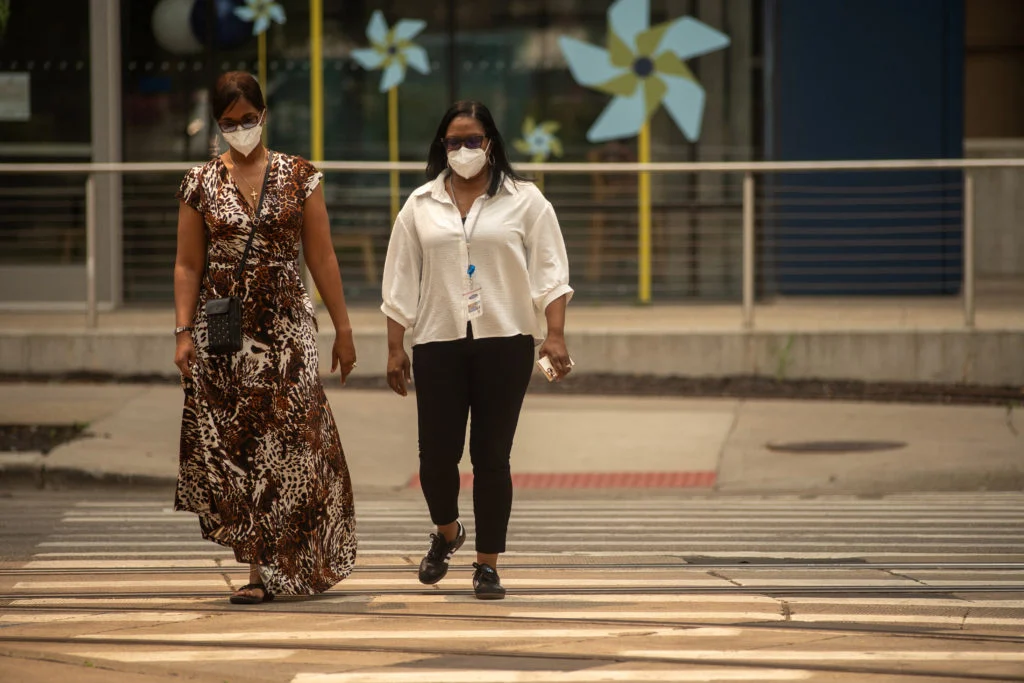
When air quality reaches hazardous levels, official guidance is often uniform: stay inside, close the windows, and avoid strenuous activity. But for many, total isolation is not possible. For those who must venture outside, the lessons learned during the COVID-19 pandemic remain the gold standard for personal protection.
The N95 respirator is the most effective tool for filtering out the microscopic particles associated with smoke. Jennifer Stowell, a research scientist at Boston University’s Center for Climate and Health, notes the efficacy of these masks: "An N95 is going to get rid of 90-95% of the particles. If you have access to a mask that has a respirator-type attachment to it, then that’s the very best."
It is important to note that surgical masks or cloth face coverings offer little protection against the ultra-fine particulates found in smoke. When selecting a mask, the seal is as important as the filter; air must pass through the material, not around the edges.
If you find yourself outdoors and begin to experience symptoms—such as a persistent cough, stinging eyes, or chest tightness—experts advise immediate evacuation to an indoor environment. "If you start wheezing, which is like this whistling sound of the chest, or if you’re feeling short of breath, that’s definitely more concerning," Dr. Sethi explains.
Implications for Indoor Life: Creating a Sanctuary
When the air outside becomes toxic, the home must serve as a filter. Managing indoor air quality is a multi-step process that involves both physical sealing and active filtration.
- Seal the Envelope: The simplest step is to close all windows and doors. For those living in older homes with drafts, use towels or weather stripping to seal gaps under doors and around window frames where smoke can seep in.
- Optimize HVAC Systems: If you have central air conditioning, ensure the system is set to "recirculate" mode. This prevents the intake of outside air. Upgrading your HVAC filter to a MERV 13 rating—which is capable of trapping finer particles—can significantly improve the air quality within your home.
- Deploy Air Purifiers: Portable HEPA air purifiers are the most effective way to clean indoor air. If you only have one unit, keep it in the room where you spend the most time, such as the bedroom or a home office.
- Avoid Indoor Pollutants: During high-smoke events, the indoor environment is already stressed. Avoid activities that add further particulate matter to the air, such as burning candles, using incense, frying foods on the stovetop, or vacuuming, which can kick up settled dust.
The Future of Living with Smoke
The recurring nature of these events suggests that wildfire smoke is shifting from an "emergency" to a "seasonal reality." As cities across North America grapple with this, urban planning and public policy will need to evolve. This includes the development of "clean air centers"—public buildings equipped with industrial-grade filtration systems where vulnerable populations can seek refuge—and more robust public health messaging that treats air quality with the same urgency as extreme weather warnings.
While the individual steps mentioned above are effective, they are reactive. Protecting public health in the long term will require a broader societal commitment to fire management, land stewardship, and a serious address of the climate drivers that make these fire seasons increasingly volatile.
Until then, vigilance remains the most effective defense. By monitoring the air, understanding the risks, and preparing the home environment, the public can better navigate the hazy, dangerous days that have become the new norm in our changing climate. When in doubt, rely on trusted, real-time data, and prioritize your respiratory health over convenience. The smoke may be invisible, but the long-term impact on our collective health is not.