





For decades, the standard narrative of cancer treatment has been reactive. A patient feels a symptom, undergoes a scan, receives a life-altering diagnosis, and begins a battle against an established, often aggressive tumor. But beneath this clinical timeline lies a hidden history. Cancer does not emerge in a vacuum; it is the culmination of a decade or more of cellular errors, genetic mutations, and environmental interactions.
Today, oncology is undergoing a fundamental paradigm shift. Scientists are no longer merely looking for ways to kill tumors; they are learning to identify the "pre-cancerous" state, treating the disease as a process rather than a static event. By drawing parallels to the long-term management of cardiovascular health—where physicians mitigate risks like high blood pressure and cholesterol years before a cardiac event—researchers are opening a new window of opportunity: cancer interception.
The Three Windows of Intervention
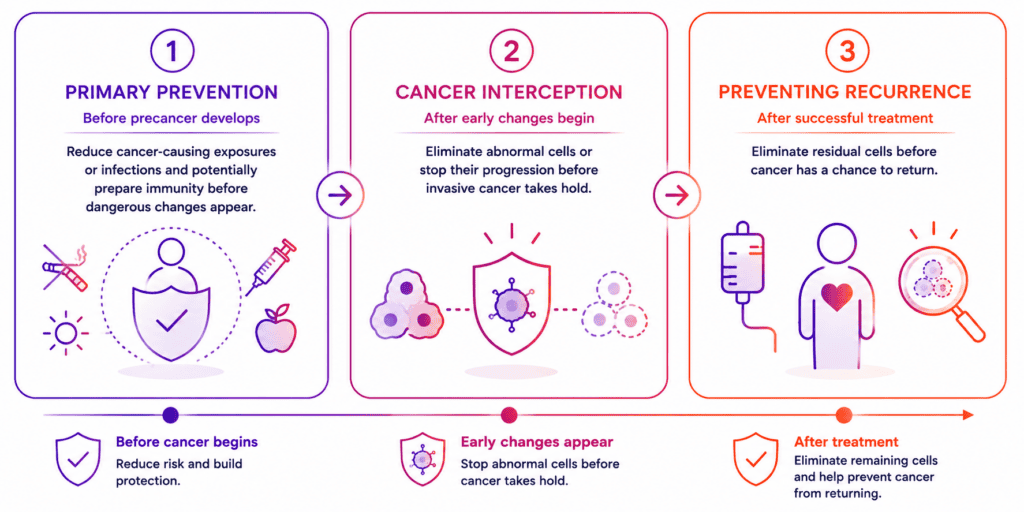
To prevent cancer from developing or returning, the medical community has categorized intervention efforts into three distinct chronological windows. Each presents unique biological advantages and challenges.
1. Primary Prevention: The Shield
Primary prevention operates before any precancerous changes occur. This is the most traditional form of defense, focusing on reducing carcinogen exposure, promoting healthy lifestyle choices, and utilizing prophylactic measures such as vaccines. By stopping the initial damage to cellular DNA, this strategy aims to keep the immune system in a state of readiness without ever needing to confront an established malignant lesion.
2. Cancer Interception: The Preemptive Strike
Interception occurs after dangerous genetic mutations have begun but before the disease has become invasive. This is the most complex frontier. Here, the goal is to identify microscopic clusters of abnormal cells and neutralize them. Because the tumor burden is minimal, the immune system often retains an advantage, yet clinicians must navigate the difficulty of identifying these "stealth" cells without causing unnecessary harm to the patient.
3. Preventing Recurrence: The Cleanup
This window begins after a primary tumor has been surgically removed or otherwise treated. The objective is to eliminate residual, microscopic disease—often called "minimal residual disease"—that remains hidden in the body, serving as a seed for future relapses. By training the immune system to recognize these lingering cells, doctors hope to achieve long-term remission.
A Chronology of Discovery: From Viruses to mRNA
The concept of "intercepting" cancer is not entirely new, but its application has evolved rapidly through scientific milestones.
- 1999: The Cancer Research Institute (CRI) began supporting the pioneering work of Dr. Ian H. Frazer. His research into virus-like particles provided the foundation for the HPV vaccine, a landmark achievement in primary prevention.
- The Early 2000s: Clinical adoption of colonoscopies for polyp removal demonstrated that identifying and removing precancerous lesions significantly reduced mortality rates. Similarly, prophylactic surgeries for those carrying BRCA mutations highlighted the power of high-risk screening.
- 2020–2025: Advancements in immune monitoring and "precancer mapping" allowed researchers to view the earliest biological signals of malignancy. This period saw the launch of numerous clinical trials targeting specific mutations, such as the KRAS gene in pancreatic cancer.
- August 2026: A pivotal moment occurred when pharmaceutical giants Merck and Moderna reported that a personalized mRNA vaccine, used in conjunction with immunotherapy, significantly reduced the risk of melanoma recurrence. This provided the first large-scale, phase III evidence that the immune system could be "trained" to prevent cancer from returning.
Supporting Data: Lessons from the Laboratory
The transition from theory to practice has been marked by both exhilarating breakthroughs and humbling lessons.
In a study involving an MUC1 vaccine—designed to target a protein common in precancerous colon growths—researchers found that only one in four participants generated a robust immune response. Intriguingly, those who did respond saw a 38 percentage point reduction in recurrence compared to those who received a placebo. Analysis revealed that the "non-responders" already possessed a suppressed immune microenvironment, suggesting that future trials must first assess a patient’s "immune baseline" to determine if they need preparatory therapy before vaccination.
Similarly, trials with nivolumab for mouth lesions showed that while one-third of participants saw their lesions shrink, the treatment carried risks of severe immune-related side effects. This underscored a vital ethical mandate: interventions intended for prevention must be exceptionally safe, as they are being administered to people who do not yet have a life-threatening malignancy.
The KRAS-targeted vaccine trials offer a more optimistic outlook. In a study of 20 high-risk participants, 90% generated a durable immune response that lasted up to two years. While these studies have yet to prove that they can prevent the onset of pancreatic cancer, they have successfully answered two fundamental questions: the vaccine is safe, and it can successfully prime the human immune system against precancerous targets.
Official Perspectives: The Path Forward
Dr. Jill O’Donnell-Tormey, CEO of the Cancer Research Institute, has frequently emphasized that "the window before cancer is real." The consensus among top oncologists is that the field must move toward "team science"—a collaborative framework that bridges the gap between fundamental immunology, advanced genomics, and clinical trial design.
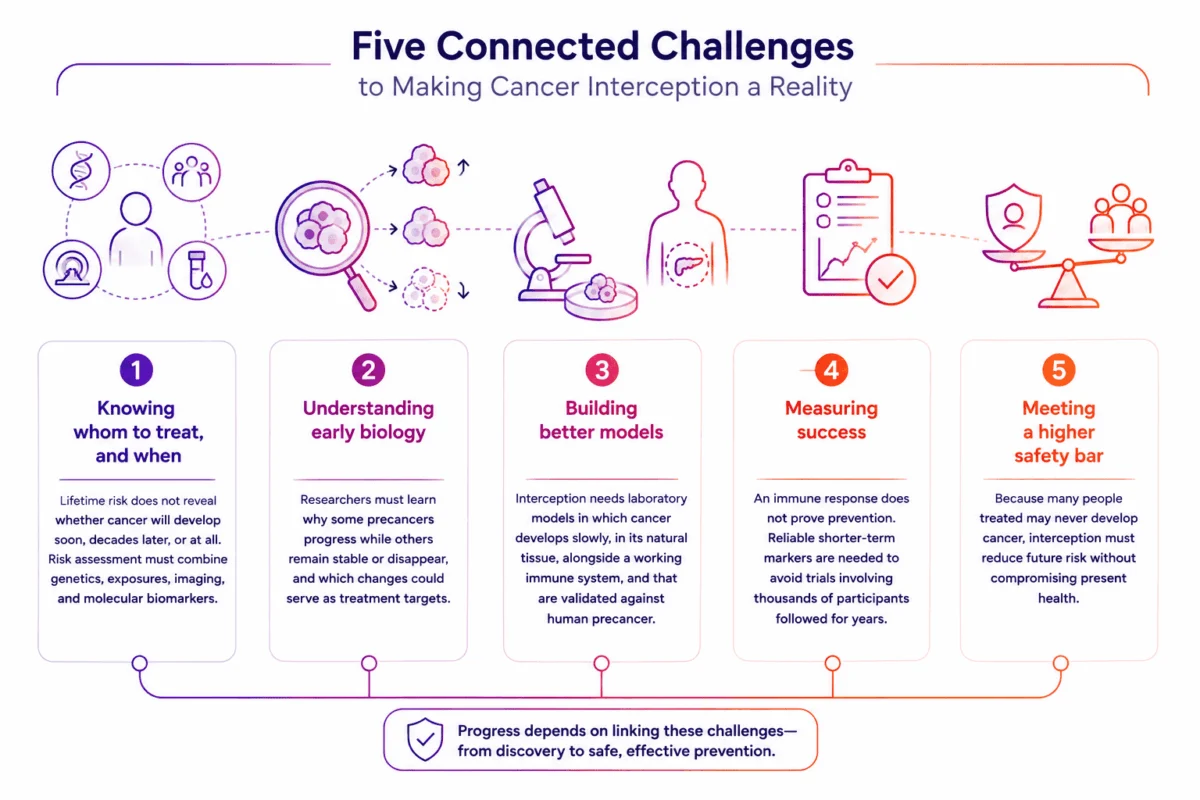
The current challenges are formidable. Researchers are working to:
- Define Biomarkers: Identifying which specific mutations signal an imminent threat.
- Model Precancer: Developing laboratory models that accurately replicate the transition from a benign lesion to invasive cancer.
- Optimize Delivery: Ensuring that vaccine-induced immune cells can physically reach and penetrate precancerous tissues.
- Standardize Monitoring: Creating non-invasive ways to track the effectiveness of preventative treatments.
These challenges are deeply intertwined. A biomarker is only useful if it can be acted upon, and a vaccine is only effective if it reaches its destination. The future of oncology depends on the integration of these disparate elements into a cohesive clinical strategy.
Implications for Global Health
The implications of successful cancer interception are profound. If we can treat cancer like heart disease—managing it through early detection and preventative "vaccines" or therapies—we could fundamentally reshape the human experience of the disease.

The success of HPV vaccination programs globally provides a blueprint. Supported by organizations like Gavi, the Vaccine Alliance, HPV vaccination has already reached 86 million girls in lower-income nations, with projections suggesting the prevention of 1.4 million cervical cancer deaths. If similar programs can be developed for non-viral cancers—through mRNA technology or targeted immunotherapies—we could see a massive reduction in the global cancer burden over the next century.
However, the transition requires a cultural shift in medicine. We must move away from the "wait-and-see" approach that characterizes current cancer screening. Instead, the focus must shift to "active interception"—intervening at the first sign of molecular instability.
Conclusion: A New Era of Prevention
The vision for the next decade is clear: to stop cancer before it ever takes hold, or to ensure that if it does, it is caught at a stage so early that it poses little threat to the patient’s long-term health.
While the science is still maturing, the evidence from recent trials in melanoma and pancreatic cancer suggests that we are at an inflection point. The immune system, once thought to be a passive bystander in the early stages of cancer development, is now viewed as a powerful tool that can be harnessed, educated, and directed. With sustained investment, rigorous clinical trials, and a commitment to understanding the earliest biological precursors of disease, we are entering an era where cancer will no longer be a sudden diagnosis, but a manageable—and perhaps even preventable—condition.