











As we cross the threshold into our 50s, the physiological landscape of our bodies begins to shift. One of the most common, yet often overlooked, markers of healthy aging is the gradual decline in upper-body strength. While many focus on cardiovascular health or lower-body mobility, the chest, shoulders, arms, and core form the kinetic chain that powers our independence—from hoisting heavy grocery bags to maintaining the postural integrity required to avoid chronic back pain.
According to Certified Personal Trainer (CPT) Tyler Read, who has spent 15 years in the fitness industry, the humble push-up remains the gold standard for measuring this functional capacity. It is not merely a "gym exercise"; it is a comprehensive diagnostic tool that reveals how your body coordinates multiple muscle groups under the strain of your own body weight.
The Science of Functional Strength After 50
Upper-body strength often fades in midlife due to a phenomenon known as "movement atrophy." As daily routines become more sedentary, the muscles in the chest (pectoralis major), shoulders (deltoids), and arms (triceps) lose the consistent stimulus required to maintain density and power. Furthermore, the core—the stabilizer for every movement—often weakens, leading to a "slumped" posture that further inhibits the ability to generate force.

Unlike isolation exercises, such as bicep curls or machine chest presses, the push-up requires a "closed kinetic chain" effort. This means your hands are fixed against a surface while your body moves, forcing the brain to recruit the chest, shoulders, core, and even the glutes to stabilize the frame. If you lack strength in any one of these segments, the chain breaks, and your performance suffers.
Chronology of Decline and Restoration
The decline of muscle mass, or sarcopenia, typically begins to accelerate in our late 40s and early 50s. Without intervention, this leads to a reduction in the "functional reserve"—the extra strength we need to handle physical stressors like lifting a suitcase into an overhead bin or catching ourselves if we stumble.
The Phases of Improvement:
- The Foundation Phase (Weeks 1–4): Beginners often start with wall or incline push-ups. This period is dedicated to retraining the nervous system to engage the core and maintain a neutral spine.
- The Integration Phase (Weeks 5–8): As proficiency increases, practitioners move to knee-assisted push-ups. Here, the focus shifts to full range of motion—touching the chest near the floor while keeping the elbows at a 45-degree angle.
- The Performance Phase (Weeks 9+): Once the individual can perform a set of 5 strict push-ups, they enter the realm of building muscular endurance, gradually pushing toward the "above average" benchmarks.
Data-Driven Benchmarks: What Your Numbers Mean
How many push-ups should an active 50-year-old be able to perform? While fitness levels vary based on medical history and activity background, experts have categorized performance to help individuals track their progress toward functional longevity.

Below 5 Push-Ups: The Warning Zone
Performing fewer than five repetitions indicates that your current muscular endurance may be insufficient for optimal daily function. This is not a cause for alarm, but rather a diagnostic indicator that your body is currently under-supported. It often points to a disconnect between the core and the extremities. The primary goal here is to prioritize stability exercises, such as planks and bird-dogs, to "wake up" the stabilizers before increasing the volume of pushing movements.
5 to 12 Push-Ups: The Baseline of Functionality
Achieving 5 to 12 reps is considered a respectable baseline. At this stage, your body is capable of handling standard daily stressors, though you may feel the onset of fatigue relatively quickly during sustained efforts. Individuals in this bracket have a solid foundation; by focusing on progressive overload—adding just one or two reps per week—significant gains in muscle tone and joint health are highly achievable.
13 to 20 Push-Ups: The Above-Average Performer
Crossing into the double digits puts you firmly ahead of the curve for the over-50 demographic. This range reflects efficient recruitment of the chest, shoulders, and triceps, as well as high-level core engagement. People in this category generally report better posture, reduced neck and shoulder tension, and a greater sense of physical confidence in their daily lives.

More Than 20 Push-Ups: The Elite Standard
Completing 20 or more strict, high-quality push-ups is considered elite for those over 50. This indicates not just raw strength, but high-level muscular endurance and cardiovascular efficiency. It suggests that your musculoskeletal system is resilient, your connective tissues are well-conditioned, and your risk of injury during physical tasks is significantly lower than that of your sedentary peers.
The "Proper Form" Imperative
The most critical factor in this test is not the number on the counter, but the quality of the repetition. "Many people shorten the range of motion, lift the hips too high, or rush through sloppy repetitions once fatigue appears," says Read.
For a repetition to count, the following criteria must be met:
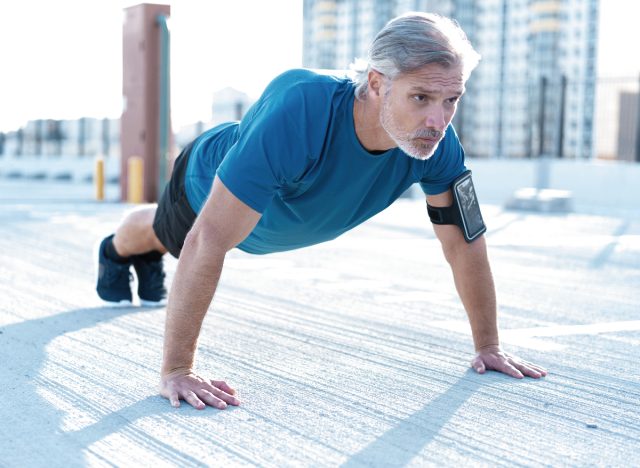
- The Plank Line: Your body must remain in a straight line from your head to your heels. If your lower back arches or your hips sag, you are compromising your spine to compensate for a weak core.
- Range of Motion: Your chest should descend to within a few inches of the floor. Partial reps build partial strength.
- The Pivot Point: Keep your elbows tucked at a 45-degree angle rather than flared out at 90 degrees. This protects the rotator cuff and maximizes pectoral engagement.
Implications for Longevity and Quality of Life
The push-up is a proxy for something much larger: your biological age. Studies have shown that individuals who can perform 40 or more push-ups (in a general population study) have a significantly lower risk of cardiovascular disease. While those numbers are aspirational for many, the trend of the data remains clear: the stronger your upper body, the more resilient your heart and metabolic health.
Building this strength has immediate implications:
- Independence: The ability to push yourself up from the floor is a primary marker for long-term independent living.
- Bone Density: Like all weight-bearing exercises, push-ups encourage osteoblast activity, helping to maintain bone density in the wrists and forearms.
- Metabolic Health: By engaging the largest muscle groups in the upper body, you increase your resting metabolic rate, making it easier to manage body composition in the later decades of life.
How to Effectively Increase Your Score
If you are currently struggling, do not be discouraged. The path to 20 push-ups is built through consistency, not intensity.

- Regress to Progress: If you cannot do a full floor push-up, use an elevated surface like a countertop or a sturdy table. The incline reduces the percentage of your body weight you have to lift, allowing you to build the necessary muscle fiber density without risking form breakdown.
- Focus on Supporting Muscles: Incorporate shoulder blade squeezes (scapular retractions) to stabilize the back, and plank holds to build the isometric endurance of your core.
- Frequency and Recovery: Do not test your max daily. Muscles grow during the recovery phase, not the training phase. Aim for three sessions per week, allowing at least one day of rest between workouts.
- The "Slow-Down" Technique: Perform the eccentric (lowering) portion of the push-up slowly—taking three full seconds to go down. This time-under-tension approach is one of the most effective ways to build the strength needed for the explosive push-up phase.
In summary, the push-up is more than a fitness test; it is an investment in your future. By dedicating time to mastering this movement, you are ensuring that your body remains a capable, powerful vehicle for the experiences you have yet to enjoy. Start where you are, honor your form, and keep pushing.




