










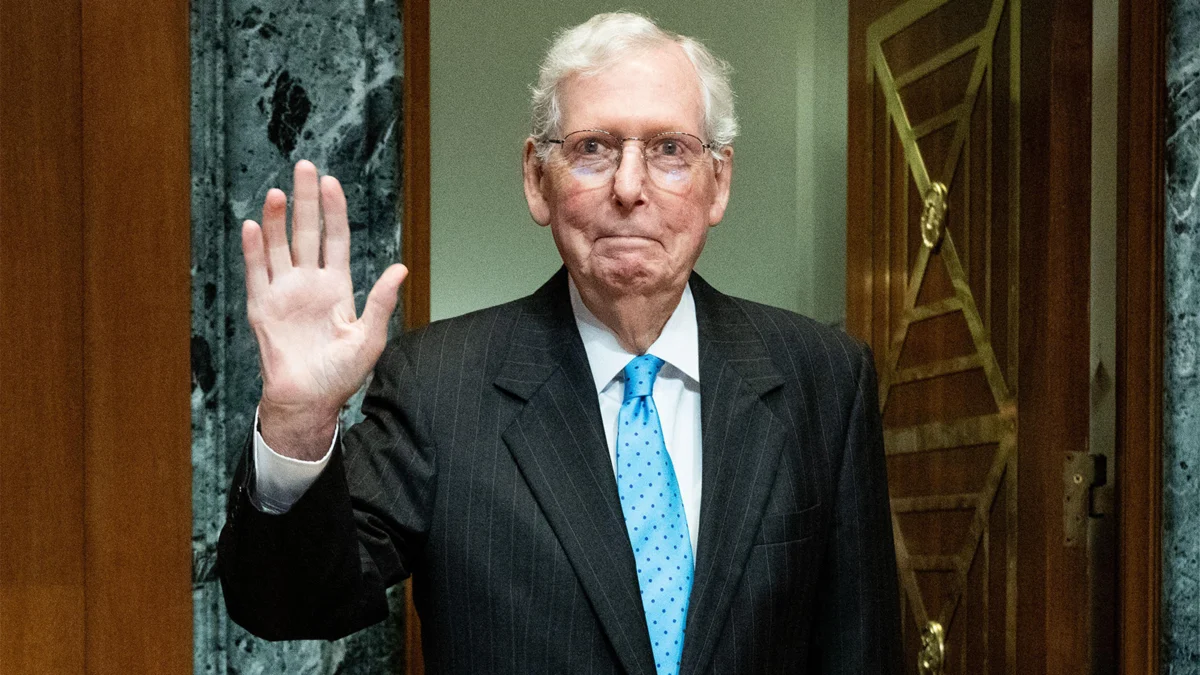
As August draws to a close, the halls of the U.S. Senate remain marked by the conspicuous absence of one of its most powerful and long-serving figures: Sen. Mitch McConnell (R-Ky.). It has been nearly a month since the Senate Minority Leader provided a direct update regarding his health, and as the mid-September deadline for the Senate to reconvene approaches, speculation continues to mount regarding the 84-year-old’s physical capacity to return to his high-stakes role.
For nearly three months, McConnell has been almost entirely absent from the public eye. While official channels maintain that he is engaged in "important Senate business" from home, the lack of visual evidence or detailed medical disclosure has created a vacuum of information that is being filled by growing concern among his constituents and his peers.
The Chronology of a Health Crisis
The current period of uncertainty began in mid-June, setting off a chain of events that has left the political establishment in a state of watchful waiting.
- June 14: Reports emerged that Sen. McConnell had been hospitalized. Initial details were sparse, but subsequent investigations revealed that emergency services had responded to a call at the senator’s home regarding a person in "cardiac arrest" who was unconscious, necessitating CPR. This report sparked immediate, rampant speculation regarding the severity of the senator’s condition.
- July 12: After nearly a month of silence, McConnell released a formal statement to quell rumors. He clarified that he had suffered a fall, which led to a brief loss of consciousness, and subsequently developed a "mild bout" of pneumonia. He explicitly denied suffering a heart attack, stroke, tumor, or hemorrhage.
- July 27: A follow-up statement indicated that McConnell was undergoing "intense" physical therapy at a rehabilitation facility. The Office of the Attending Physician noted that he had not yet been medically cleared to return to work, emphasizing that his childhood struggle with polio had complicated his recovery and mobility.
- August 6: In his most recent official update, the senator announced he had been discharged from the rehabilitation center to continue his recovery at home. The statement emphasized that he was following an intensive regimen of physical therapy while engaging with staff on legislative matters.
Since the August 6 update, no new photographs or video appearances have been released, and the senator has not made any public appearances, leading to questions about the true state of his recovery.
Medical Context: The Complexity of Pneumonia in the Elderly
To understand why a "mild" case of pneumonia might keep a high-ranking official out of the public sphere for three months, one must look at the physiological realities of aging. Dr. John Rowe, a professor of health policy and aging at Columbia University, notes that pneumonia is not a monolith; it is a serious respiratory threat, particularly for octogenarians.
"Pneumonia can range from mild cases where patients bounce back quickly with antibiotics to severe cases complicated by systemic issues like sepsis," Dr. Rowe explained in an interview with MedPage Today. "Lung and immune system functions naturally weaken with age, which puts older patients like Senator McConnell at a significant disadvantage."
Dr. Rowe highlights that McConnell’s history of childhood polio is a critical, often overlooked variable. Polio survivors often experience the "late effects" of the disease, which can include muscle atrophy and decreased strength. "All these risks are magnified if the patient has a pre-existing condition—in this case, the residua of polio—which may cause loss of muscle mass and strength," Rowe noted.
While full recovery is common, the speed of that recovery varies wildly based on the patient’s baseline health. For a patient in their mid-80s, the process of regaining full strength can be a marathon, not a sprint. "It can be very debilitating," Dr. Rowe added. "Recovery to full strength and activity can realistically require as much as six months."
The Transparency Debate: Politicians vs. Private Citizens
The extended absence of the Minority Leader has reignited a long-standing, contentious debate in Washington: What level of medical transparency does the public have a right to demand from its elected representatives?
Historically, the medical records of U.S. politicians have been treated with a high degree of privacy, often guarded by the individual and their staff. However, the stakes of the positions held by figures like McConnell are uniquely high. S. Jay Olshansky, PhD, of the University of Illinois Chicago School of Public Health, argues that the professional comparison should be to high-responsibility roles in the private sector rather than the standard expectations for private citizens.
"I used to believe that politicians deserved the same medical privacy as regular civilians," Olshansky told MedPage Today. "But I now view it as an issue of fundamental transparency. We require airline pilots to have their health and cognitive functioning measured and evaluated because their jobs put other people’s lives on the line. I now believe politicians fall into this same category, since they make daily decisions that can result in life-and-death outcomes for millions of people."
Olshansky advocates for a systemic change: "It is time that all politicians or political candidates have their physicians reveal their full, unredacted medical records annually as a prerequisite for entering or remaining in office."
Implications for the Senate and Public Trust
The lack of clarity regarding McConnell’s health has created a political ripple effect. While Rep. James Comer (R-Ky.) has publicly suggested that the senator may return when the Senate reconvenes on September 14, McConnell’s own press team has remained tight-lipped regarding a firm return date.
This silence has frustrated colleagues and the public alike. Calls for more granular details—beyond the periodic, heavily curated press releases—have grown louder. Without transparency, the "information vacuum" allows for the circulation of misinformation and heightens the anxiety surrounding the Senate’s legislative agenda, particularly as the body approaches critical deadlines on budget negotiations and judicial confirmations.
Furthermore, McConnell’s history of health-related incidents—most notably the 2023 incident where he froze mid-speech for roughly 20 seconds during a press conference—has left many wondering if the current absence is a culmination of long-term health challenges rather than a singular, isolated event.
Conclusion: A Critical Juncture
As September 14 approaches, the nation will be watching closely to see if Senator McConnell returns to the floor of the Senate. His return would likely serve as a visual confirmation of his recovery, yet the broader questions regarding his long-term capacity and the necessity of medical transparency for public officials will likely persist.
For now, the senator remains in the recovery phase, attempting to regain the strength necessary for one of the most demanding jobs in the world. Whether this period of rest will be sufficient, and whether the political establishment will be forced to adopt more rigorous standards for medical disclosure, remain two of the most significant questions facing the U.S. Senate as it prepares for the autumn session.
The balance between the personal dignity of a public servant and the public’s need to know is a delicate one, but as the tenure of Senator McConnell continues to be defined by his absence, the call for a new standard of accountability is becoming increasingly difficult for leadership to ignore.