











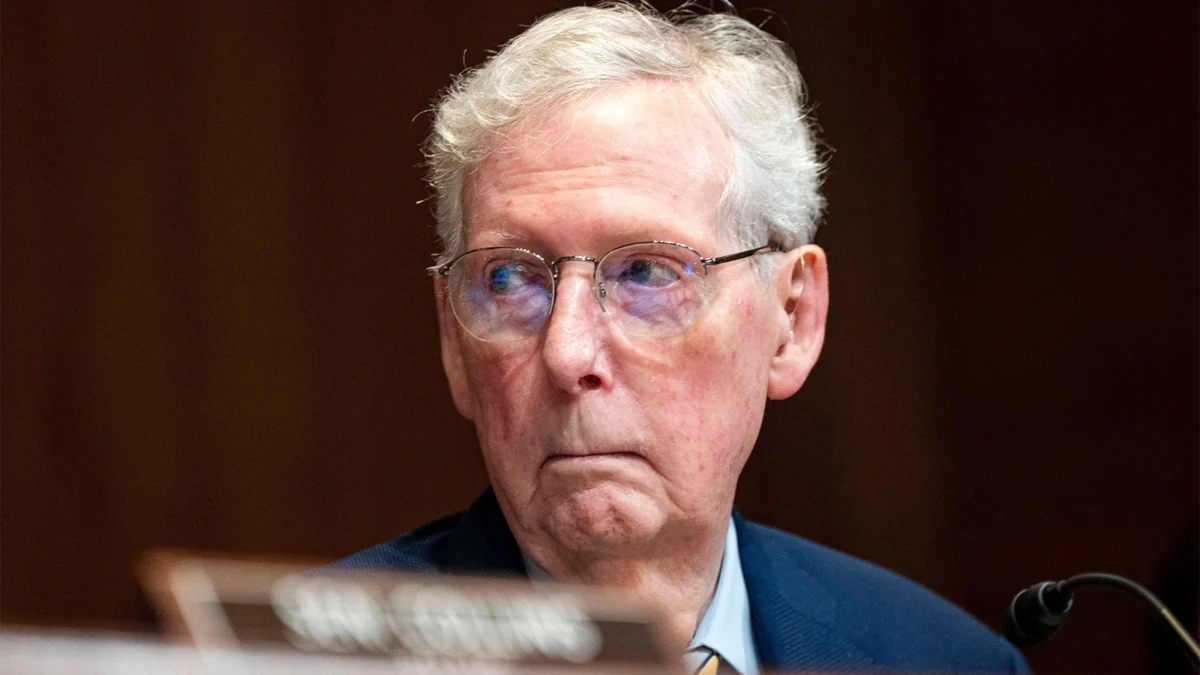
For over five weeks, the halls of the United States Senate have been marked by a conspicuous and growing absence. Senator Mitch McConnell (R-Ky.), the long-serving power broker and former Senate leader, has remained away from his post for 40 days, triggering a cascade of speculation, political anxiety, and intense scrutiny regarding the true state of his health. While his office maintains that the Senator is on a path to recovery, the lack of direct public communication has left a vacuum filled by rumor, leaving constituents and colleagues alike questioning the transparency of his medical status.
The Chronology of Silence: A Timeline of Medical Uncertainty
The current crisis of information began in mid-June, though the public remained largely in the dark until early July. On June 14, emergency services were dispatched to the McConnell residence following reports of an unconscious individual. According to police scanner audio obtained by NBC News, responders were alerted to a situation categorized as a "cardiac arrest," a life-threatening medical emergency requiring immediate intervention.
For weeks, the Senator’s office offered little beyond a vague acknowledgement that he had been hospitalized. It was not until July 12—nearly a month after the incident—that his office issued a formal statement accompanied by a photograph of the Senator sitting upright alongside his wife.
The statement, designed to quell mounting rumors, explicitly denied that the Senator had suffered a heart attack or a stroke. It further asserted that he had not sustained a concussion or broken bones. Instead, the office characterized the event as a fall that resulted in a brief loss of consciousness, followed by a "mild case of pneumonia" contracted during his hospital stay. The statement concluded that he had moved to a rehabilitation facility to regain his strength.
Despite this, medical experts and political observers have noted a glaring omission: while the statement denies a heart attack, it conspicuously fails to address the reports of cardiac arrest. This semantic distinction has fueled skepticism, as the term "cardiac arrest" refers to an electrical malfunction of the heart, whereas a "heart attack" is a circulation problem.
The Medical Reality: Risks of Elderly Recovery
The medical community has been quick to point out that even if the Senator’s own account of a fall and pneumonia is accurate, the recovery process for an 84-year-old is fraught with peril.
Dr. Jeremy Faust, Editor-in-Chief of MedPage Today, has been among the most vocal in emphasizing the gravity of the situation. "When you have a person who is elderly and has other underlying medical conditions, it is really concerning," Faust noted in a recent interview. He highlighted that if the incident was indeed an out-of-hospital cardiac arrest, the statistics for a full recovery are sobering. Of the small percentage of individuals who survive such an event to reach a hospital, only a fraction emerge with their cognitive and neurological functions entirely intact.
Dr. Ashish Panchal, volunteer chair of the American Heart Association Emergency Cardiovascular Care Committee, corroborated this, noting that for patients in their 80s, the recovery timeline is rarely measured in days or weeks, but often in months. Factors such as the duration of oxygen deprivation to the brain, the underlying cause of the arrest, and the patient’s overall physiological resilience dictate whether a return to the high-stress environment of the U.S. Senate is even feasible.
A History of Health Concerns
The current 40-day absence does not exist in a vacuum; it is the latest chapter in a series of health-related episodes that have plagued Senator McConnell in recent years. In March 2023, the Senator was hospitalized after a fall that resulted in a concussion. Shortly thereafter, he experienced a high-profile, viral moment during a press conference where he froze mid-sentence, leading to widespread speculation about a potential neurological impairment.
The pattern continued through the winter, with a week-long hospitalization for flu-like symptoms. In 2025, the Senator was photographed utilizing a wheelchair following yet another fall in a Capitol Hill hallway. For a man who has held the reins of Senate power for decades, these recurring incidents have raised legitimate questions about the intersection of aging, public office, and the capacity to serve.
The Political Fallout: Growing Demands for Transparency
The silence from the Senator’s office has reached a breaking point, drawing criticism from across the political aisle. Kentucky Governor Andy Beshear (D), who would be responsible for appointing a successor should a vacancy occur, expressed his frustration during a recent television interview.
"If he can make a call to his political operatives and spend 15 or 20 minutes, call into a news station and spend 4 or 5—just let people know you’re okay," Governor Beshear stated. "This rampant speculation is so wild, he has a chance to end it."
The sentiment is echoed by members of Congress who feel that the Senator’s continued silence is an affront to his constituents. Representative Alexandria Ocasio-Cortez (D-N.Y.) was particularly pointed in her critique, arguing that the need for medical privacy must be balanced against the duties of a public servant.
"I understand that people have a right to medical privacy to deal with their issues, but we do not have the right to disappear from our jobs without explanation," Ocasio-Cortez said. "I don’t think any American has ever experienced the ability to just leave your job for over a month with no explanation to your employer."
Even within his own party, voices are beginning to murmur. Representative Thomas Massie (R-Ky.) has publicly called for more transparency, suggesting that the current strategy of silence is harming both the Senator’s legacy and the party’s operations.
Implications for the Senate and the Nation
The implications of this 40-day absence are profound. The Senate is a deliberative body that relies on the physical presence and active engagement of its members to function effectively. When a senior leader is missing, the ripple effects are felt in committee assignments, vote counts, and the overall legislative agenda.
Beyond the legislative mechanics, there is a fundamental question of democratic accountability. Elected officials operate under a social contract where, in exchange for the power vested in them by the voters, they provide a degree of transparency regarding their fitness to serve. When an official becomes essentially invisible, that contract is strained.
The public’s right to know—or at least to receive a candid assessment from medical professionals appointed by the Senator—is becoming a central issue. As the days tick by without a direct address from McConnell, the rumors will likely continue to intensify. In the age of social media and rapid-fire news cycles, the refusal to engage directly with the public is rarely a sustainable strategy.
For now, the status of Senator Mitch McConnell remains a mystery wrapped in a statement of carefully curated omissions. As the legislative calendar moves forward and the political pressure mounts, the question is no longer just about the state of the Senator’s health, but about how much longer the American public will be expected to accept silence as an answer. The "Silent Sentinel" of the Senate now faces a test of accountability that may define the final chapter of his long and influential career.