










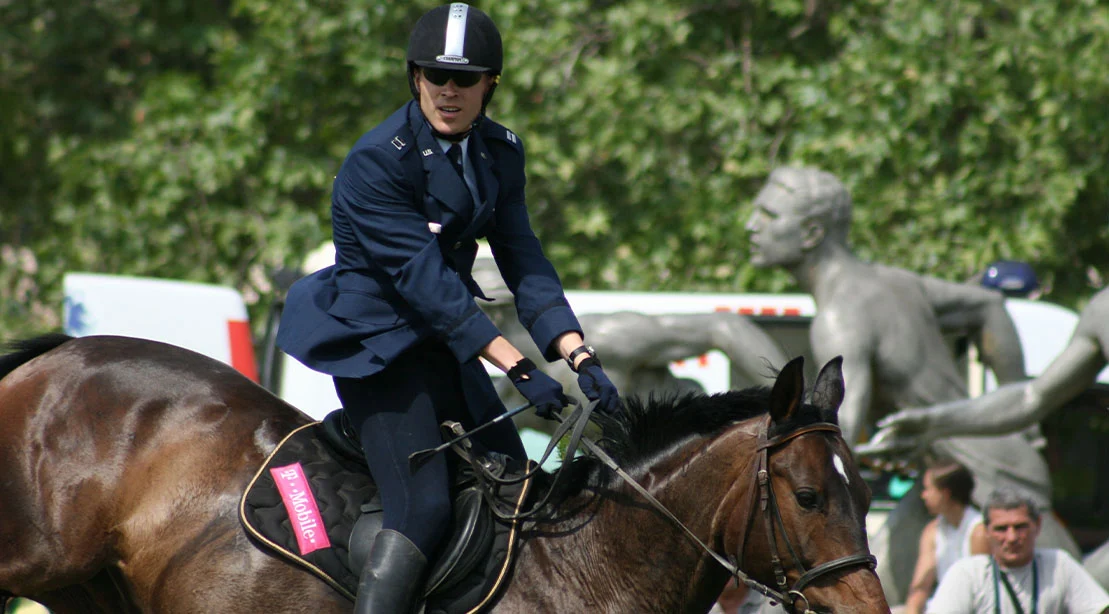
For most, the aspirations of childhood are bifurcated: one path leads to the disciplined, uniform-clad ranks of the military, while the other leads to the podiums and international spotlights of the Olympic Games. Society often pressures individuals to choose between the structure of duty and the singular focus of athletic excellence. For Major Eli Bremer of the Air Force Reserve Command, such a choice was never a necessity. To him, the two paths were not mutually exclusive; they were symbiotic.
“There was never an ‘or’ question in my mind,” Bremer reflects. “It was always ‘and.’”
This philosophy—that one can serve the nation in uniform while simultaneously competing for it on the global stage—has defined Bremer’s life and continues to influence the future of military-athletic policy in the United States.
The Genesis of a Dual Legacy: Chronology of an Olympian
Growing up in the shadow of the Air Force Academy in Colorado Springs, Colorado, Bremer was immersed in a culture of high achievement. His surroundings were saturated with the ethos of the military, and he found himself surrounded by mentors who lived the values of service daily.
“All my childhood mentors were cadets at the Academy,” he recalls. This early exposure provided the blueprint for his future. While he was deeply committed to the idea of military service, he harbored a secondary, equally burning ambition: the modern pentathlon.
From Freshman Vision to Beijing 2008
Bremer’s journey was not one of chance, but of deliberate design. During his freshman year at the Academy, he penned a letter to his future self—a document that explicitly outlined his intent to join the Air Force’s World Class Athlete Program (WCAP) and represent the United States in the Olympics.
His ambition materialized in 2008. Standing on the world stage in Beijing, China, Major Bremer wore the nation’s colors, competing in the modern pentathlon. While he finished 22nd in a highly competitive field, the experience solidified his belief in the WCAP model. He realized that the program did not merely support an athlete’s training; it integrated their athletic career into a broader professional trajectory.
Supporting Data: The Value of the WCAP Model
The World Class Athlete Program is often misunderstood by the public as a simple sponsorship for military personnel. In reality, it is a sophisticated human capital development tool.
Bremer, who now serves as the chair of the Advisory Board for the Air Force’s WCAP, emphasizes the long-term utility of the program. “The military and the individuals get a great outcome from it,” Bremer explains. “The athletes we bring into the Air Force really like it because they understand the three years of job training they get in a skill outside of their sport. That’s a huge benefit.”
The "And" Advantage
Data suggests that the dual-track approach—balancing elite training with military job certification—creates a more resilient veteran. By providing professional skills training alongside athletic development, the Air Force ensures that when the "uniform" of the athlete is retired, the individual is not left without a transition path. This is a critical component in modern military retention and veteran reintegration, as it allows athletes to cultivate a secondary identity that is not solely reliant on their physical performance.
Governance and Advocacy: The Nassar Crisis and Beyond
While his athletic accomplishments are a source of pride, Bremer views his contributions to governance and ethics as his most significant legacy. The transition from active competitor to advocate was catalyzed by one of the darkest chapters in American sports history: the Larry Nassar sexual abuse scandal.
Bremer emerged as a vocal critic of the governing structures within the U.S. Olympic and Paralympic Committee (USOPC). He argued that the existing governance model was not just flawed—it was complicit. “I had been a vocal critic of the governance model because it predisposed ways to cover up issues like abuse,” Bremer recalls.
The Architect of Reform
When the scandal broke, those who had previously dismissed Bremer’s concerns were forced to confront the systemic failures he had been highlighting for years. “People thought I was Nostradamus, but I wasn’t; I just know governance,” he says.
Following the fallout, Bremer did not retreat. He leveraged his position to lead an athlete coalition, working alongside bipartisan lawmakers to push for comprehensive legislation aimed at restructuring the USOPC. His efforts were instrumental in creating more transparency and accountability, proving that his service was not limited to the field of play or the military base, but extended to the very halls of legislative change.
International Diplomacy: The 2027 Military World Games
Bremer’s influence has extended into the international arena through his long-standing relationship with the International Military Sports Council (CISM). His journey with CISM began in 2000 in Switzerland, where he shared a moment of camaraderie with a Brazilian lieutenant named Nilton Rolim.
Twenty-four years later, that friendship has blossomed into a monumental achievement for U.S. military sports. Colonel Rolim, now the President of CISM, collaborated with Bremer to explore the possibility of the United States hosting the Military World Games.
Bringing the Games to Charlotte
As co-chair of the bid committee, Bremer was a driving force in securing the 2027 Military World Games for Charlotte, North Carolina. The event, scheduled for June 25th to July 4th, 2027, represents a significant investment in military diplomacy. For Bremer, this is the culmination of decades of advocacy for the value of military sports as a bridge between nations. “I’m super proud of what we’ve done there,” he notes, acknowledging the collective effort required to bring such a prestigious event to American soil.
Implications for Future Generations: Fitness as a Lifetime Mission
Today, Major Bremer’s life is defined by a different kind of intensity. As the owner of the consulting firm Pure Performance and the CEO of Mytikas Industries, his professional life is as demanding as his athletic one. However, his approach to fitness has undergone a profound evolution.
Shifting the Goalposts
"My thinking now is not on how fast I can run but if I can keep up with my son and be there for my 83-year-old father,” he admits. This transition from high-impact, elite-level training to longevity-focused movement is a lesson he imparts to veterans and civilians alike.
Bremer suggests that the "goalposts" of life must inevitably shift, but the commitment to physical and mental health should never wane. He views fitness as a foundational element of veteran success. “It’s okay to move the goalposts a little bit, and you have to, but you must forgive yourself and do the best you can now. You don’t want to wake up 10 years from now and realize you sold yourself short.”
The Transformative Power of Service
As he continues to advocate for younger Americans to consider the military, Bremer highlights the WCAP as a path to personal growth. He remains a staunch believer that service is a transformative experience, regardless of whether one is an Olympian or a support specialist.
“It makes you a better person,” Bremer concludes. “Your time in service will fundamentally transform you.”
Through his dual career as an Olympian and a Major, and his subsequent work as a reformer and business leader, Eli Bremer has proven that the "and" in his life was not a compromise, but a catalyst. By refusing to limit himself to a single lane, he has successfully demonstrated how an individual can weave together the disparate threads of patriotism, personal ambition, and systemic reform into a single, cohesive, and impactful legacy.
As we look toward the 2027 Military World Games in Charlotte, the impact of his life’s work serves as a reminder to all: greatness is rarely found in choosing one path, but in the courage to walk two at once.