











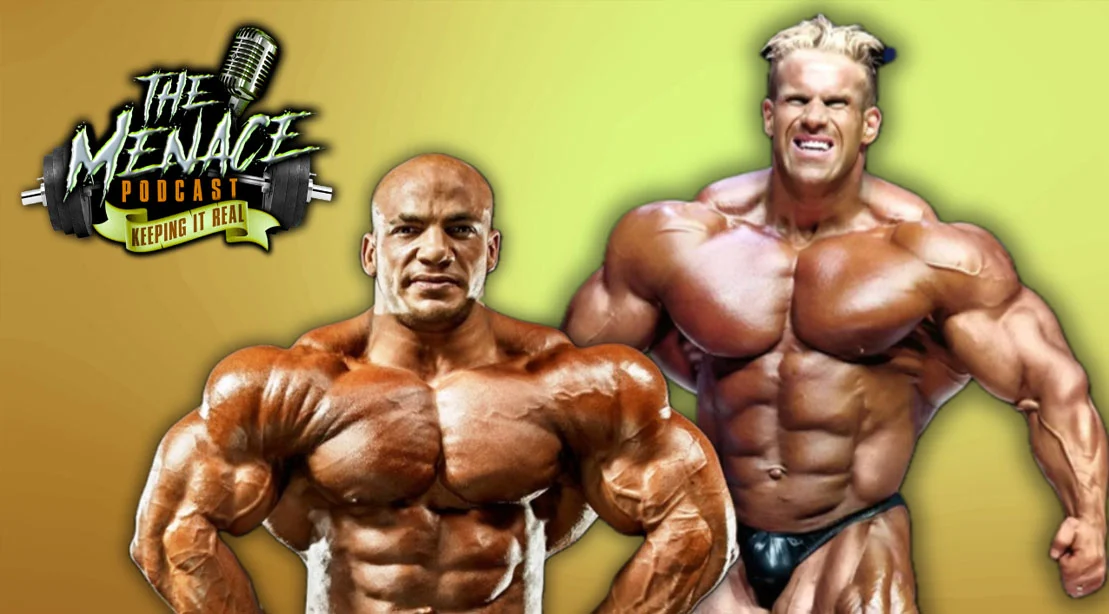
In the high-stakes world of professional bodybuilding, comparisons between eras are as inevitable as they are contentious. On Episode 295 of The Menace Podcast, host and bodybuilding legend Dennis James, alongside veteran panelists Milos Sarcev and Jose Raymond, reignited one of the sport’s most fascinating hypothetical debates: Who reigns supreme when size, conditioning, and aesthetics are weighed in the balance—the four-time Mr. Olympia Jay Cutler or the two-time champion Mamdouh "Big Ramy" Elssbiay?
The discussion, which has sent ripples through the fitness community, goes beyond simple nostalgia. It touches on the fundamental evolution of the sport, the shifting standards of mass, and the subjective nature of judging the world’s most elite physiques.
The Legacy of the Titans: Main Facts
To understand the weight of this debate, one must look at the distinct legacies of both men. Jay "The Quad Stomper" Cutler is widely regarded as one of the most resilient and tactical competitors in the history of the IFBB Pro League. His career was defined by his ability to dethrone the invincible Ronnie Coleman in 2006, reclaiming the title in 2007, 2009, and 2010. Cutler’s physique was characterized by extreme density, a balanced structure, and an industrial-grade work ethic that redefined how bodybuilders approached their offseason.
Conversely, Mamdouh "Big Ramy" Elssbiay represented a new epoch in bodybuilding. Bursting onto the scene after a dominant victory at the 2012 Amateur Mr. Olympia, the Egyptian powerhouse brought a level of mass that was previously thought to be impossible to maintain without sacrificing structural integrity. His back-to-back Mr. Olympia victories in 2020 and 2021 proved that he was not merely a "freak of nature" but a champion capable of refining his conditioning to meet the sport’s highest standards.
A Chronological Collision: The 2013 Mr. Olympia
The pivot point for the Menace Podcast discussion was the 2013 Mr. Olympia—a year that serves as a bridge between two distinct generations. By 2013, Jay Cutler was in the twilight of his storied career. Having taken a year off in 2012 due to injury, he returned to the stage looking to secure a fifth title.
In that same lineup stood a young, hungry Big Ramy, making his presence felt on the sport’s biggest stage. The results placed Cutler in sixth and Ramy in eighth. However, in hindsight, the panelists argued that the scorecards may have been influenced by reputation rather than the reality of the stage.
"Jay was gifted that spot," Jose Raymond remarked during the podcast. "Ramy was significantly bigger and in better shape on that stage."
This sentiment underscores a recurring theme in professional judging: the "politicized" nature of the sport, where established legends often receive the benefit of the doubt against rising challengers. Dennis James corroborated this, noting that in direct comparison, Ramy’s physique made the iconic Cutler look "bad in a lot of poses."
Size, Conditioning, and Symmetry: The Technical Breakdown
The core of the Menace Podcast debate centers on the technical metrics of bodybuilding: width, waist-to-shoulder ratio, and quad flare.
The Case for Big Ramy
Dennis James, who has been instrumental in the development of many top-tier pros, didn’t mince words. He identified Ramy as the most impressive physique he had ever witnessed in terms of raw, overwhelming width. "Just because of the width, then the waist, and then the f***ing flare in the quads," James said. He famously described Ramy in his prime as a "cartoon character"—a testament to the fact that his muscular development often defied the anatomical limits of a normal human being.
The Case for Jay Cutler
While Ramy possessed superior "freak factor" dimensions, Cutler’s strength was in his consistency and his "3D" density. Cutler was never the widest man on stage, but his ability to carry massive amounts of muscle while maintaining a level of dryness and muscle maturity was his signature. Cutler’s success was built on a foundation of structural balance, whereas Ramy’s success was built on the sheer awe of his frame.
Supporting Data: By the Numbers
To quantify the comparison, one must look at their professional trajectories:
- Jay Cutler:
- Mr. Olympia Wins: 4 (2006, 2007, 2009, 2010)
- Peak Era: 2001–2010
- Defining Feature: Extreme muscle maturity, balanced aesthetics, and an unparalleled ability to peak for major shows.
- Big Ramy:
- Mr. Olympia Wins: 2 (2020, 2021)
- Peak Era: 2017–2021
- Defining Feature: Unprecedented mass-to-frame ratio and the ability to maintain aesthetic proportions despite extreme weight.
When looking at the data, Cutler has the longevity and the historical dominance. However, if the argument is strictly about who possessed the most "monstrous" physique at their absolute peak, the metrics lean toward Ramy.
Official Responses and Expert Opinions
The debate has elicited strong responses from the bodybuilding community, primarily because it touches on the philosophical divide between "classic" bodybuilding and the "mass monster" era.
Milos Sarcev, known as the "Mind of Bodybuilding," has often weighed in on the nuance of Ramy’s development. During the podcast, the consensus shifted toward acknowledging that Ramy’s peak physique—specifically his ability to display massive quads that tapered into a relatively controlled midsection—was arguably more impressive than anything seen in the mid-2000s.
However, observers of the sport often point out that bodybuilding is not just about the size of the muscle; it is about the "flow." Cutler’s physique flowed better, whereas Ramy’s physique was a collection of individual, oversized parts. This distinction is where the subjective nature of the judges becomes the deciding factor.
The Broader Implications: Where Does the Sport Go From Here?
The discussion on The Menace Podcast serves as a mirror for the current state of the IFBB. If the industry continues to prioritize the "cartoonish" mass of a prime Big Ramy, it risks alienating fans who crave the artistic balance of previous eras. Conversely, if judges revert to rewarding the "Cutler-style" aesthetic, they may inadvertently stifle the evolution of human muscularity.
The implication for future athletes is clear: the modern bodybuilder must now possess both the gargantuan size of a Ramy and the structural precision of a Cutler.
Furthermore, this debate highlights the importance of the "Eye Test." Regardless of what the scorecards say, the history of bodybuilding is written in the memories of the fans. Whether it was the roar of the crowd for Cutler in 2006 or the shock at the sheer volume of Ramy in 2020, both men have permanently altered the trajectory of the sport.
Conclusion: A Debate Without End
Can a prime Jay Cutler beat a peak Big Ramy? According to the experts at The Menace Podcast, the answer is a complicated "no" when judged purely on the physical impact of the physique. While Cutler remains a superior champion in terms of career longevity and tactical maneuvering, Ramy’s peak represents the outer limits of human development.
As the sport moves forward, these discussions remain vital. They remind us that bodybuilding is not merely a contest of numbers or weight; it is a display of human potential. Whether you prefer the industrial, granite-like conditioning of Jay Cutler or the ethereal, super-human proportions of Big Ramy, both legends have left an indelible mark on the history of the Sandow trophy.
To delve deeper into the technical analysis provided by Dennis James, Milos Sarcev, and Jose Raymond, viewers are encouraged to watch the full episode of The Menace Podcast on the official Muscle & Fitness YouTube channel. As the sport continues to evolve, the ghost of this debate will undoubtedly haunt the halls of every future Olympia, reminding us all that in the world of iron, there is always another level to reach.