










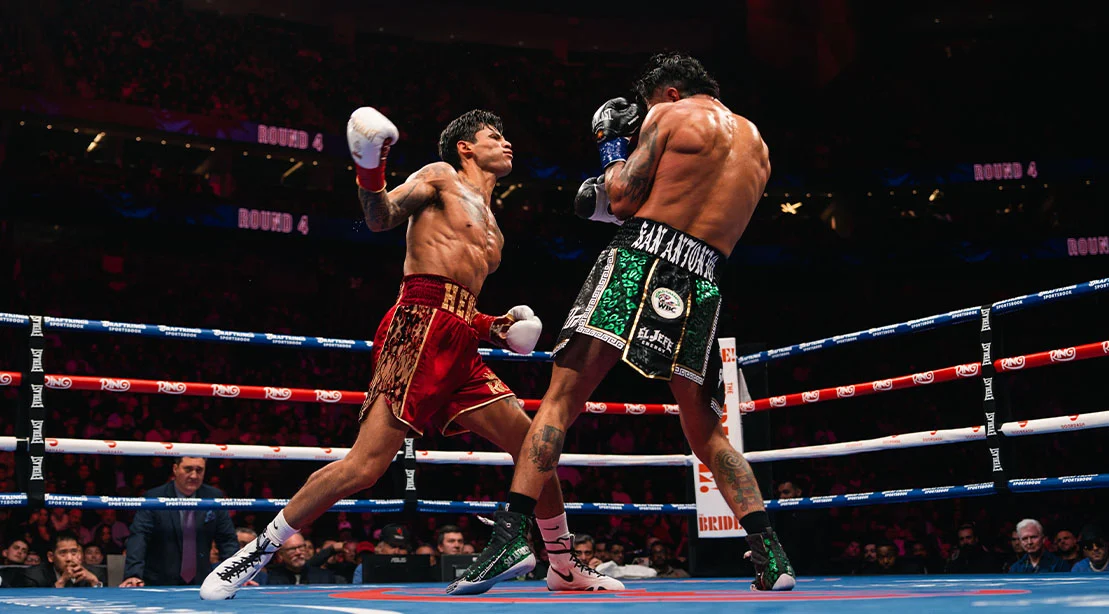
Ryan Garcia is a fighter who has never been shy about his ambitions or his voice. Throughout his ascent in the volatile world of professional boxing, he has been a lightning rod for attention, both for his blistering hand speed and the intense scrutiny that follows his every move. Yet, as he stands on the precipice of his September 12th title defense against Conor Benn, the 27-year-old looks and sounds like a man reborn.
The brash confidence remains, but it is now tempered by a newfound sense of tactical efficiency. Following his February victory over Mario Barrios—a performance that saw him secure the WBC welterweight title—Garcia has eschewed the traditional, grueling "rebuild" phase of a training camp. Instead, he has opted for a path of continuous refinement, signaling that the most dangerous version of Ryan Garcia is not the one who works the hardest, but the one who works the smartest.
The New Philosophy: Efficiency Over Exhaustion
In the brutal calculus of championship boxing, fighters often fall into the trap of believing that more is always better. More rounds, more miles, more weight, more intensity. However, after years of navigating the extreme physical and psychological demands of the sport, Garcia (24-2-1) has pivoted toward a philosophy of "intentional recovery."
The decision to jump back into camp shortly after capturing the WBC title was not born of necessity, but of strategy. By keeping his body in a state of high-level readiness, Garcia has avoided the "yo-yo" effect of extreme weight fluctuations and the physical trauma of trying to regain elite conditioning from a sedentary baseline.
"My body is feeling great," Garcia shared with Muscle and Fitness. "Didn’t have much time off from the last fight, so everything’s just a little bit smoother this camp. There’s less stress on the body, so it feels good."
This shift underscores a broader evolution in his professional identity. Garcia has learned that the "grind" is only as valuable as the recovery that follows it. By balancing his training load, he is ensuring that his body arrives at the ring on fight night not just prepared, but preserved.
A Day in the Life: The Anatomy of a Camp
While Garcia is moving toward efficiency, his daily routine remains the envy of endurance athletes. A typical day for the champion is a grueling masterclass in high-volume, multi-disciplinary preparation.
His mornings are dedicated to the structural integrity of his frame, beginning with 90 to 120 minutes of strength and conditioning. This isn’t vanity training; it is functional, explosive, and rotational. Following this, he transitions to road work, logging five to seven miles to solidify his aerobic base. By the time he steps into the gym for boxing-specific drills—another 90 to 120 minutes of pad work, technical sparring, and strategy—the average athlete would be looking for the exit. He finishes the day with sprints, a final test of his anaerobic threshold.
"Every day varies," Garcia explains. "You have to make adjustments. It’s not just go, go, go. You’ve got to find your spots and the time to pull it back a little bit or push it or take a day off."
This willingness to adapt—to listen to his body rather than bully it—is perhaps the greatest indicator of his maturity. He is no longer fighting his own physiology; he is working in tandem with it.
The Physical Foundation: Strength as a Catalyst for Speed
For years, Garcia’s calling card was raw, natural speed. Critics often wondered if his frame could sustain the power required to compete at the championship level. With the help of targeted strength training, he has silenced those doubts.
Garcia views the weight room not as a place to bulk up, but as a laboratory for mechanical optimization. By strengthening his core, shoulders, and posterior chain, he has unlocked a new layer of punching power that complements his legendary hand speed.
"I’ve been mastering myself and the way I punch for years and years," he says. "As I grow older and wiser, things have definitely been getting much better."
When asked about his favorite aspects of training, his answer is telling: core work. "I like doing ab routines—bicycles, scissors, anything that has to do with abs." This focus on the "powerhouse" of the body ensures that when he throws a combination, the force generated from his lower body is transferred seamlessly through his core and into his hands.
Recovery: From Afterthought to Essential Pillar
The most striking departure from his younger self is Garcia’s commitment to recovery. Where he once viewed ice baths and physical therapy as minor concessions, he now views them as the engine of his performance. His current regimen includes red-light therapy, cryotherapy, sauna sessions, and dedicated physical therapy.
"Adding that into my regimen at times has been beneficial and helped me perform much better," Garcia notes. "I definitely have taken up more of a liking to it lately."
This extends to his nutrition, where he has traded rigid, restrictive dieting for a sophisticated understanding of macro-fueling. He maintains a consistent intake of high-quality proteins and carbohydrates, allowing for the occasional "treat" without derailment. "I train so hard that it would be hard for me to mess up my diet," he says. "Once you understand food, it doesn’t control you at all."
Managing the Noise: Mental Fortitude and the Pressure of the Crown
If there is one thing Ryan Garcia has learned in the public eye, it is that external noise is a constant, unavoidable variable. From his well-documented struggles with anxiety to his year-long suspension in 2024, Garcia has been forced to confront his demons in front of a global audience.
His strategy for dealing with this? Discipline and detachment. "Let the noise be the noise," he says. "Just address something if it really irritates you, but most of the time, stay busy. It’s not going to help if you dwell on it."
His faith remains his bedrock, but his preparation is his shield. He believes that pressure is simply a symptom of under-preparedness. When he is in the gym, putting in the work, the pressure evaporates.
"I love to entertain, so it’s almost second nature when I get in there," he notes.
Now, with the WBC belt around his waist, he feels a different kind of pressure—the pressure of the hunted. Rather than making him complacent, the title has made him ravenous. "Now that I have it, I’m even more inclined to be hungrier, more ferocious, and more defensive of not losing my title."
Implications for the Benn Fight
As he prepares for Conor Benn, Garcia is not looking for a "win"—he is looking for a statement. He describes his current state as "complete," suggesting that the various facets of his development—speed, power, conditioning, and mental clarity—are finally converging.
"They’ll see somebody so complete and at the top of his game," he promises. "I think they’re going to be like, ‘Damn, he’s gotten to his prime.’"
Garcia’s final thoughts on the upcoming bout are characteristically brief, yet confident. He is not just expecting to defend his title; he is expecting to put on a clinical display. "I’m going to beat him very easy," he says, before pausing to adjust his phrasing. "Well, make it look easy."
For the audience, the fight will be a litmus test. If the new, efficient, and mentally centered Ryan Garcia shows up on September 12th, the boxing world may be witnessing the birth of a dominant, long-reigning champion.
Appendix: The "Garcia-Inspired" High-Performance Routine
Designed to mirror the champion’s focus on explosive power and sustainable conditioning, this 45-to-55-minute protocol should be performed 1–2 times per week.
The Warmup (6 Minutes)
- Shadow Boxing: 3 minutes (focus on movement and rhythm).
- Dynamic Stretching: 3 minutes (leg swings, arm circles, hip openers).
Block 1: Strength and Explosiveness (3 Rounds)
- Jump Squats: 12 reps (focus on vertical lift).
- Medicine Ball Slams: 12 reps (focus on core engagement).
- Push-Ups: 20 reps (explosive upward phase).
- Rest 60-90 seconds between rounds.
Block 2: Fight Conditioning (6 Rounds)
- Heavy Bag Work: 3 minutes of high-speed combinations.
- Jump Rope: 1 minute.
- Focus on staying relaxed; speed and precision are the goals.
Block 3: The Core Finisher (3 Rounds)
- Bicycle Crunches: 30 seconds.
- Scissor Kicks: 30 seconds.
- Plank Holds: 45 seconds.
- Minimal rest between exercises; 45 seconds between rounds.
Optional Sprint Finisher
- Sprints: 4 to 6 rounds of 50-yard bursts.
- Maintain form; terminate if mechanics break down.