







By Karina Sturm | January 2026
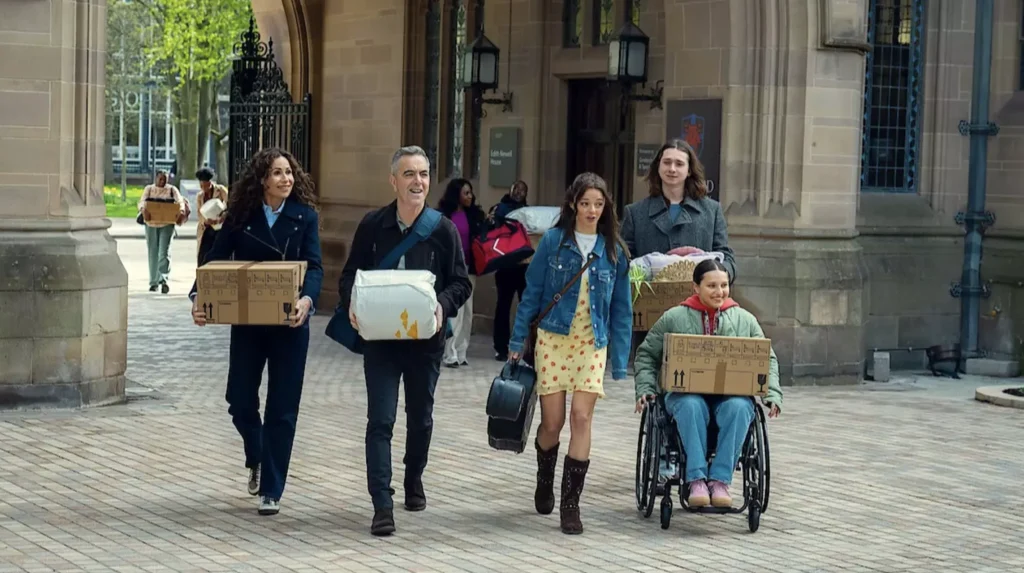
Netflix’s latest adaptation of Harlan Coben’s thriller Run Away has captivated audiences with its labyrinthine plot, centering on Simon Greene’s desperate search for his runaway daughter, Paige. As Simon peels back the layers of his family’s fractured history, the narrative builds toward explosive revelations. Yet, for a significant portion of the viewership—specifically those within the Ehlers-Danlos Syndrome (EDS) and chronic illness communities—the most profound revelation of the series is not a plot twist at all. It is a quiet, radical act of authenticity: the depiction of Anya Greene, the family’s youngest daughter, as an ambulatory wheelchair user.
Played by Ellie Henry, Anya’s character exists in a state of fluid physical ability. In some scenes, she navigates the world from her wheelchair; in others, she stands or walks unaided. There is no expository dialogue explaining this reality, no "medical moment" to satisfy the curiosity of the audience, and no apology for her changing needs. This deliberate creative choice has sparked a nationwide conversation, highlighting a persistent gap in how mainstream media perceives and portrays disability.
A Chronology of Confusion: The "Continuity Error" Myth
When Run Away premiered, social media forums and comment sections were immediately flooded with inquiries regarding Anya’s mobility. Many viewers, accustomed to the rigid, binary stereotypes of disability—the "wheelchair-bound" versus the "fully able-bodied"—perceived the character’s fluctuating mobility as a production oversight.
"Is this a continuity error?" asked one viewer on a popular subreddit. Another speculated that the director had "forgotten" which scenes were supposed to feature the chair.
This reaction is a quintessential example of the "gaze" applied to disabled individuals. In the public imagination, the wheelchair is often viewed as a permanent prison for the paralyzed, rather than a tool for accessibility and energy conservation. For those living with dynamic disabilities, this is a familiar, often exhausting, reality. When an ambulatory wheelchair user stands up to reach a high shelf in a grocery store or walks a few steps at a park, they are frequently met with skepticism, harassment, or the infamous "miracle" comments from strangers who believe they have witnessed a sudden cure.
By refusing to provide a "reason" for Anya’s mobility, Run Away forced viewers to confront their own biases. The show did not offer an explanation because, in the life of a person with a dynamic disability, there is nothing that requires explaining.
The Reality of Dynamic Disabilities
To understand the significance of Anya’s portrayal, one must understand the medical reality of dynamic disabilities. Conditions like Ehlers-Danlos Syndrome (EDS), Postural Orthostatic Tachycardia Syndrome (POTS), and various autoimmune disorders are characterized by fluctuating symptoms. A patient may wake up with the ability to walk, only to find that by midday, their joints have subluxated, their heart rate is spiking, or their fatigue has reached a debilitating threshold.
For these individuals, a wheelchair is not a symbol of total paralysis; it is a mobility aid used to manage pain, prevent injury, and preserve the energy required to participate in daily life. It is an instrument of autonomy, not a marker of absolute incapacity.
However, television history has rarely reflected this. When disability is depicted, it is almost exclusively portrayed as a static state. If a character is in a chair, they are in a chair for the entirety of the narrative. By deviating from this, Run Away mirrors the true, non-linear nature of life with a chronic condition, effectively challenging the "static disability" trope that has dominated Hollywood for decades.
Casting Against the Grain: A Paradigm Shift
Perhaps the most revolutionary aspect of Ellie Henry’s involvement is not just the character’s mobility, but the process of her casting. In the typical entertainment industry workflow, characters are written with a "disability script"—a list of requirements that often force actors to perform a caricature of a medical condition.
In the case of Run Away, the character of Anya was not initially written as disabled. It was only after Henry—who lives with EDS and is an ambulatory wheelchair user in real life—was cast that the production team made the proactive decision to integrate her lived experience into the character.
This is a monumental shift. Historically, the industry has operated by either excluding disabled characters entirely or casting non-disabled actors to "play" at disability, often relying on offensive stereotypes. By allowing Henry to define the character through her own identity, the producers of Run Away broke the mold. They didn’t write a "disability story"; they cast a person, and let that person’s reality exist as a natural facet of the character’s life.
Official Responses and Creative Intent
In an interview with RadioTimes.com, Ellie Henry addressed the online discourse surrounding her character’s mobility. Henry revealed that she had anticipated the confusion from the public and had discussed the matter with the production team early in the filming process.
Her stance was firm: she specifically opted against providing an on-screen explanation for her wheelchair use. By choosing silence, Henry and the production team sent a powerful message: her disability does not require a justification, a medical diagnosis, or a "narrative arc" to be valid. It simply is.
This decision effectively silenced the urge for the show to turn her disability into a "plot device." In many dramas, a character’s disability is used as a tool to generate sympathy or to provide a "teachable moment" for the non-disabled protagonist. Run Away refuses this. Anya is a member of the Greene family, dealing with the central mystery of the show, and her mobility aids are as unremarkable as wearing a pair of glasses. This normalization is, for many, the most accurate form of representation possible.
Implications for the Industry and the EDS Community
The impact of this portrayal on the Ehlers-Danlos Syndrome community cannot be overstated. For years, the EDS community has struggled with the "invisible" nature of their condition. Because patients often look "fine" on the surface, they are frequently told they are "faking it" or "exaggerating" their pain.
By seeing a character like Anya on a major, global platform like Netflix, the EDS community finds a rare sense of validation. It provides a visual shorthand that patients can point to when explaining their lives to friends, family, or even medical professionals.
However, we must also acknowledge the limitations of this representation. Anya is not the lead character. She is a supporting figure in a larger thriller. While her presence is a massive step forward, the industry still has a long way to go in terms of centering disabled voices in lead, complex roles. The fact that we are still analyzing the "accuracy" of a supporting character shows just how starved the screen is for authentic disabled narratives.
Furthermore, the "continuity error" discourse highlights a broader failure in public education. If a mainstream audience—consuming thousands of hours of content annually—is still shocked by the existence of an ambulatory wheelchair user, it points to a systemic failure in media literacy regarding disability.
A Future of Normalization
Run Away has provided a masterclass in how to integrate disability without fetishizing or medicalizing it. By leaving the wheelchair use unexplained, the show has generated more discourse—and more awareness—than any heavy-handed, scripted monologue ever could.
The momentum created by this choice suggests a turning point. If audiences can learn to accept that a character’s mobility is fluid, perhaps they will begin to extend that same grace to the real-life people they encounter in their daily lives.
As we look toward the future of television, the challenge for creators is clear: stop treating disability as an "issue" to be solved or a "tragedy" to be explored. Start treating it as a natural, un-dramatic, and essential part of the human experience. As Run Away has proven, the most impactful way to represent a community is not to talk about them, but to simply let them be part of the story.
What the public perceived as a continuity error was, in truth, a long-overdue correction of the screen’s representation gap. The era of the "static" disabled character is fading, and in its place, we are finally beginning to see the full, dynamic spectrum of the human experience.