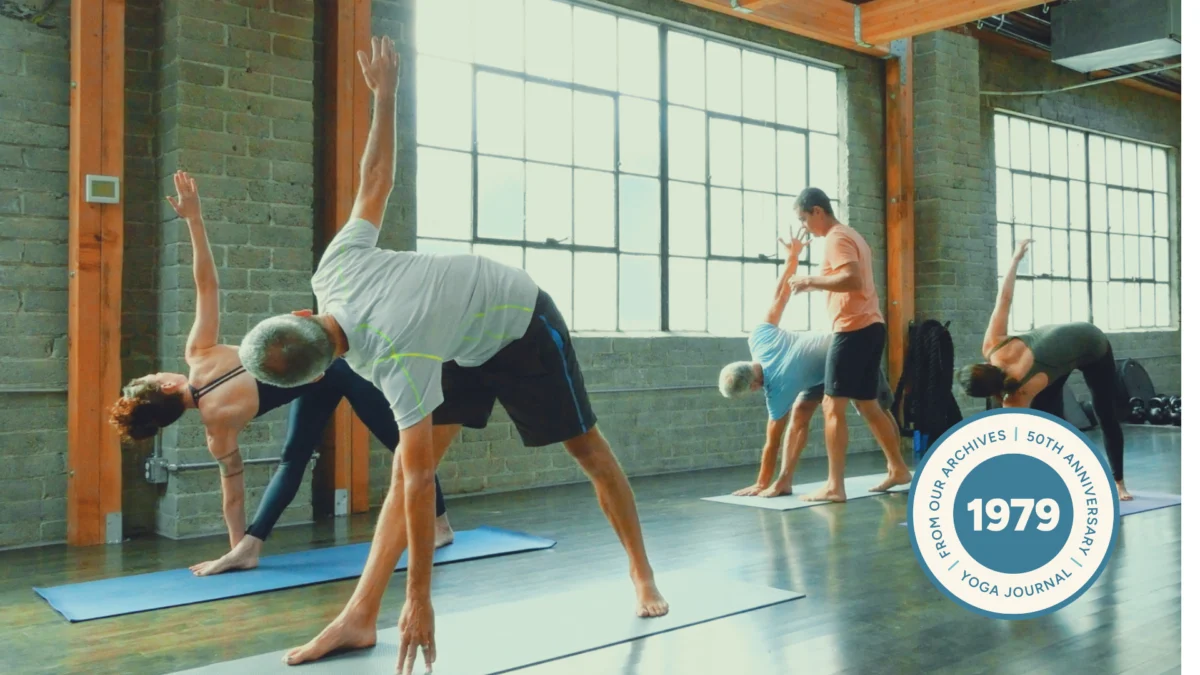
Originally published in the July-August 1979 issue of Yoga Journal, this deep dive into Parivrtta Trikonasana remains a cornerstone of instructional literature. As part of our ongoing archival series, we revisit these foundational insights, which continue to guide practitioners toward precision, mindfulness, and structural integrity.
The Core Mechanics of Parivrtta Trikonasana
Revolved Triangle Pose, or Parivrtta Trikonasana, is frequently cited by yoga instructors as one of the most transformative yet challenging standing postures in the repertoire. It is a pose that demands more than mere flexibility; it requires a sophisticated coordination of the skeletal system, a keen awareness of the kinetic chain, and a disciplined approach to mental focus.
At its essence, the pose involves a deep spinal rotation while maintaining a stable, grounded base. The difficulty many practitioners encounter—that distinct feeling of being on the verge of toppling—is not merely a physical limitation but a manifestation of divided attention. When the body enters a state of rotation, the mind naturally gravitates toward the point of movement: the reaching hand, the gaze, or the effort of the twist. In doing so, the practitioner often abandons the "past"—the grounded, firm foundation of the back leg.
The challenge, therefore, is to reconcile these two opposing forces. By maintaining a firm, unwavering awareness in the back heel and foot, the practitioner creates a structural counterweight to the reach of the arms. When the base is secure, the "future" (the upper body) can expand with stability rather than strain.
Chronology: A Legacy of Precise Instruction
The history of yoga instruction in the West is inextricably linked to the rigorous methodology of B.K.S. Iyengar. This article, originally penned in 1979, serves as a testament to the enduring influence of his teachings, specifically those found in his seminal work, Light on Yoga.
Throughout the late 1970s, Yoga Journal played a pivotal role in translating these complex, ancient techniques into accessible English-language pedagogy. By the time this article was published, the global yoga community was moving away from loose, interpretive styles toward a more refined, alignment-based approach. The instructions provided in the 1979 text—emphasizing the specific placement of the pelvis, the engagement of the quadriceps, and the use of props—set the standard for what we now recognize as "alignment-based yoga."
The chronology of this practice shows a clear progression: from the initial, often shaky attempts of the novice, through the use of assistive props like benches and walls, to the eventual realization of the pose as a "gift" of structural harmony.
Supporting Data: Anatomy and Structural Integrity
To understand Parivrtta Trikonasana, one must analyze the interplay between the lower and upper body. The pose is not merely a "twist"; it is a complex alignment puzzle.
The Quadriceps and Knee Stability
A common error in the practice is the inward collapse of the back knee. When the knee turns inward, the integrity of the pelvic girdle is compromised, making a safe rotation impossible. By tightening the quadriceps—the large muscles of the front thigh—the practitioner locks the knee in a stable, extended position. This action serves two purposes:
- Structural Foundation: It prevents the knee from absorbing the torque of the twist, thereby protecting the joint.
- Facilitation of Rotation: By creating a rigid, resistant base in the legs, the spinal column encounters a fixed point against which it can lengthen. It is a principle of physics: tension in the base allows for greater elongation in the spine, which in turn facilitates a deeper, safer rotation.
Pelvic Alignment and the Sacroiliac Joint
Perhaps the most technical aspect of the pose involves the position of the buttocks. The common mistake is to attempt to keep both buttocks at the exact same level. In reality, the trailing buttock must drop slightly to allow the lumbar and thoracic spine to rotate fully.
If the pelvis remains square to the floor, the twist is restricted to the waist, which often leads to compensatory strain on the sacroiliac (SI) joint. The SI joint is a delicate structure; over-rotation without proper pelvic positioning is a primary cause of lower back pain in practitioners. By dropping the buttock on the side of the back leg, the practitioner ensures the rotation originates from the entire length of the spine rather than placing undue stress on the lumbar region.
Professional Perspectives on Modification
In the modern era, the use of props is often viewed as a "shortcut," but the 1979 archives remind us that props are, in fact, instruments of precision. For the student who cannot maintain a grounded back heel, two specific modifications are recommended:
- The Wall-Heel Wedge: Placing the back heel against the wall provides immediate feedback. If the heel lifts, the student knows they have lost their foundation. This helps the practitioner aim the front foot toward the center of the room, ensuring the front heel aligns with the mid-arch of the back foot.
- The Bench Lever: For those with tight hamstrings or limited mobility in the lateral hip (specifically the gluteus medius), the use of a small bench allows the student to reach the floor without compromising spinal length. The bench serves as an extension of the arm, allowing the practitioner to focus on the rotation of the chest rather than the struggle to reach the ground.
Implications: The Mind-Body Connection
The practice of Parivrtta Trikonasana transcends physical exercise; it acts as a diagnostic tool for the mind. Because movement inherently captures our focus, we often become "future-oriented" in our yoga practice—rushing to reach the final expression of the pose.
The implication for the practitioner is clear: the precision of the pose is not the goal, but the medium. When we center our attention on the grounding of the foot, the firming of the quadriceps, and the alignment of the pelvis, the range of the twist arrives naturally. It is, as the text suggests, a "gift."
Clinical Observations
Modern physical therapy in yoga confirms the observations made decades ago. The "looseness" required in the calves, hamstrings, and hip muscles is essential for preventing nerve impingement and muscular tears during rotational movements. When practiced with the meticulous attention described in the 1979 archives, Parivrtta Trikonasana serves as an excellent preparatory sequence for deeper seated twists, which require even greater spinal flexibility and pelvic awareness.
Conclusion
As we look back at this archival piece, the message remains pertinent: the beauty of yoga lies not in the perfection of the form, but in the intelligence of the approach. By treating the body as a holistic system—where the stability of the feet informs the freedom of the spine—the practitioner avoids the pitfalls of ego-driven movement. Whether one is a novice or a seasoned veteran, returning to the fundamentals of Parivrtta Trikonasana serves as a vital reminder that balance is found in the stillness of the foundation, not in the reach of the hand.
This article is dedicated to the legacy of B.K.S. Iyengar, whose commitment to the science of yoga continues to illuminate the path for practitioners across the globe.