










Published May 28, 2026
Yoga Journal’s archives series is a curated collection of articles originally published in past issues beginning in 1975. This guide to Parsvottanasana (Pyramid Pose) first appeared in the November 2008 issue, offering timeless insights into the mechanics of one of yoga’s most transformative, yet often misunderstood, postures.
The Core Mechanics of Pyramid Pose
Parsvottanasana, known in English as the Intense Side Stretch or Pyramid Pose, is a foundational yet complex asana that demands a sophisticated integration of physical alignment. It is uniquely challenging because it asks the practitioner to simultaneously lengthen the hamstrings and open the shoulders—two anatomical actions that, for many, feel inherently contradictory.
The struggle often arises from an over-enthusiastic approach to the forward bend. When a student prioritizes the depth of the fold at the expense of structural integrity, the shoulders tend to round forward, the chest collapses, and the spine loses its extension. This common error misses the true purpose of the pose: to counteract the postural stagnation created by modern, sedentary, computer- and car-driven lifestyles.
The secret to mastering Parsvottanasana lies not in the depth of the fold, but in the infusion of a subtle backbend. By maintaining length along the front of the body, the practitioner transforms a simple stretch into a dynamic exercise in energetic and physical equilibrium.
A Chronology of Practice: From Wall to Mat
To truly understand the geometry of Pyramid Pose, one must progress through stages of support. The following sequence, derived from traditional hatha methodology, allows the body to learn the necessary alignment before moving to the center of the room.
Stage 1: Establishing the Foundation with Wall Support
Begin by standing facing a wall. Place your hands on the surface, shoulder-distance apart and at hipbone height. Step your right foot back approximately four feet, with the left foot positioned about 1.5 feet from the wall. Reach your hips back until your torso and arms form a line parallel to the floor.
Ensure your alignment creates a straight trajectory from your hands through your shoulders to your hips. Your ears should be in line with your upper arms, and your gaze should remain steady on the floor. Maintain a heel-to-heel alignment, with the front toes pointing forward and the back foot angled at 45 degrees.
The goal here is to "square" the hips. Pull the front hip back while shifting the rear hip forward. This is achieved by pressing through the ball of the big toe and engaging the quadriceps, drawing the front outer hip back and into the midline. Simultaneously, release your back inner thigh toward the wall behind you. Be wary of the back foot’s inner arch; if it collapses, the structural integrity of the entire leg is compromised. Lift the arch and keep the outer edge of the foot firmly grounded.
Stage 2: Creating Space in the Upper Body
Once the base is stable, face the center of the room, using a wall only for heel support if needed. In this variation, we introduce the "scissoring" of the inner thighs—an energetic drawing together of the legs that creates immense stability.
Inhale, taking the arms out to the sides. Internally rotate the upper arm bones (humeri) so the palms face the wall behind you. As you exhale, form gentle fists and bring your knuckles together behind your back, just below the shoulder blades.
The common pitfall here is the collapse of the shoulder heads. To correct this, draw the shoulders up and back, externally rotating the upper arms by spinning the inner arm toward the outer arm. This is a subtle, internal motion, but it is critical for developing shoulder mobility. Ensure there is no sharp pain; if discomfort arises, ease the intensity of the rotation. Lift the sternum away from the navel, spread the collarbones, and extend over the front leg while keeping the hips square.
Stage 3: The Classical Expression
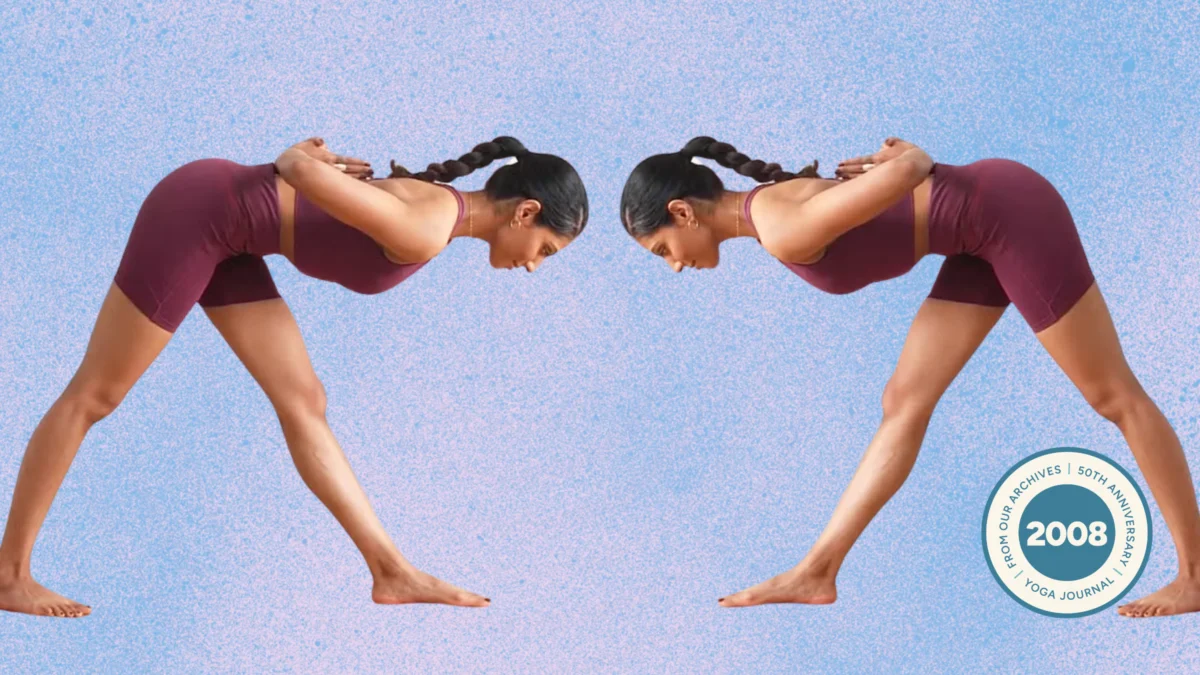
For the full expression of the pose, move to the center of the mat. Stand in Tadasana (Mountain Pose) and place your hands on your hips to ensure your frontal hipbones point forward like headlights.
Step the right leg back 3.5 to 4 feet, maintaining the heel-to-heel alignment. A longer stance is generally preferred for maximum spinal extension. If your back foot angle is too wide, the knee may be subjected to torque as you square the hips; if the toes point too far forward, the heel will lift, destroying your stability.
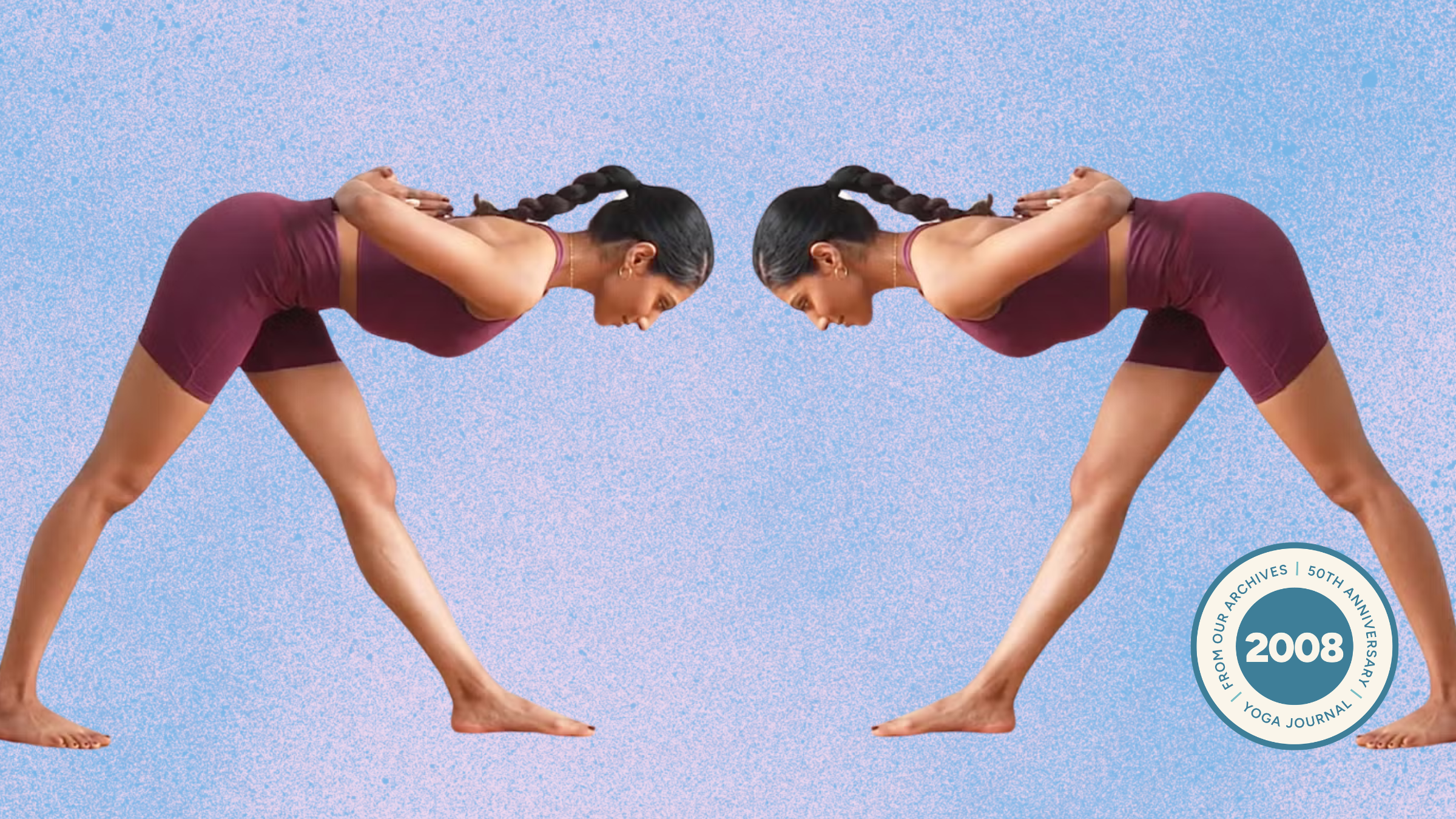
Rotate your arms behind your back, pressing the palms together in Anjali Mudra (prayer position) if mobility allows. If the palms do not touch, focus on keeping the chest open. As you extend forward, resist the pull of gravity. Use your core engagement and the strength of your quadriceps to anchor the pose. The crown of the head should act as a natural extension of the spine, with the gaze soft but fixed on the front big toe.
Supporting Data: The Anatomy of Tension and Release
Scientific and yogic analysis of the human body highlights why Parsvottanasana is essential for longevity. The hamstrings—the primary muscles in the back of the thighs—are frequently shortened by prolonged sitting. When these muscles are tight, they pull on the pelvis, creating a posterior tilt that rounds the lower back.
Simultaneously, the chest muscles (pectorals) tighten due to the forward-reaching nature of desk work, leading to rounded shoulders and a restricted thoracic spine. By integrating the "backbending" element (lifting the sternum) while in a "forward bend" (the hinge at the hip), the practitioner is essentially performing a corrective physical therapy maneuver.
Key alignment metrics:
- Stance Width: 3.5 to 4 feet for optimal extension.
- Back Foot Angle: 45 degrees to protect the knee joint.
- Hold Time: 8 to 10 deep, conscious breaths per side.
- Primary Engagement: Quadriceps (active) and core (stabilizing).
Expert Perspectives on Energetic Alignment
In the tradition of Hatha yoga, the word Hatha is often interpreted as the union of Ha (sun) and Tha (moon), representing the balance of opposing energies. Parsvottanasana is the physical manifestation of this philosophy.
Teachers often emphasize that the stability of the foundation is not merely a physical requirement, but an energetic one. "The freedom you find in your upper body is facilitated by the stability of your base," notes the archival wisdom. Without a grounded base, the upper body becomes frantic and unstable. By rooting through the feet and legs, the practitioner creates a "container" that allows the spine to lengthen and the heart to open.
This is the definition of yuj—the yoke. By holding the pose, one learns to inhabit the tension between two opposing forces: the downward pull of the earth (stability) and the upward reach of the spirit (freedom).
Implications for Daily Practice
The implications of mastering Pyramid Pose extend far beyond the yoga mat. The physical habits developed in this asana—shoulders back, chest open, core engaged, and foundation stable—are the exact postural corrections needed for a healthier life.
- Postural Awareness: Regular practice encourages a vertical stacking of the spine, reducing the strain on the lumbar and cervical vertebrae caused by "tech neck."
- Emotional Resilience: The act of staying present in a challenging, asymmetrical pose fosters mental focus and emotional regulation.
- Increased Mobility: By systematically addressing the tension in the hamstrings and shoulders, practitioners report a greater ease of movement in everyday activities such as walking, lifting, and reaching.
In conclusion, Parsvottanasana is a masterclass in duality. It teaches us that we do not have to choose between extremes. By marrying the stability of the earth with the expansiveness of the breath, we find a middle path—one where the body is strong, the heart is open, and the mind is perfectly aligned. Whether you are a beginner or a long-time practitioner, returning to the fundamentals of this pose provides a consistent benchmark for your ongoing development in yoga.