







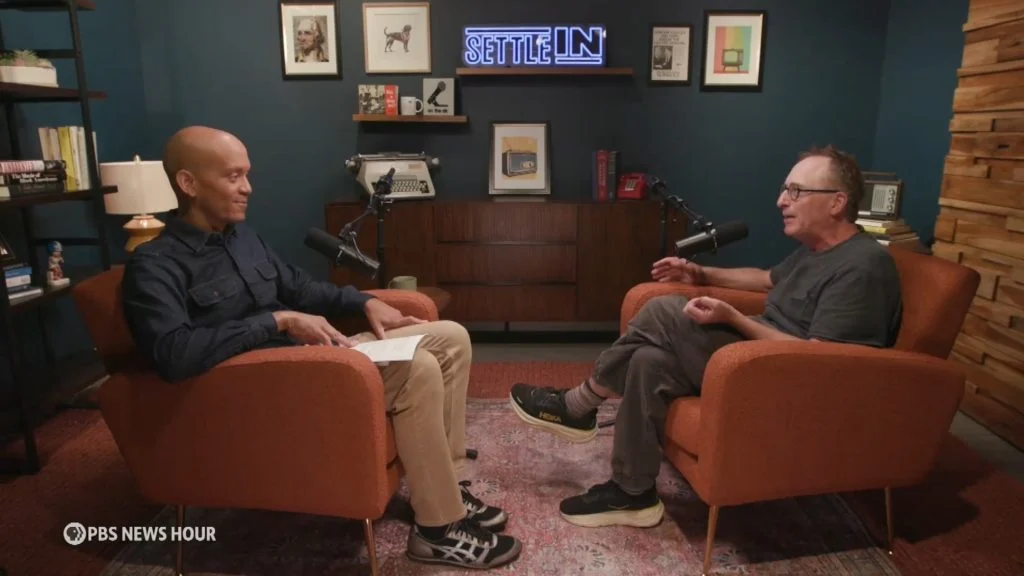
In an era defined by rapid cultural shifts, the erosion of traditional community structures, and the volatile influence of the "manosphere," author and investigative journalist Jon Ronson has turned his lens toward a pressing, often uncomfortable question: What are young men being taught about what it means to be a man today?
In his latest work, The Castle, Ronson explores the intersection of personal obsession and societal malaise. The book, which originated from a surreal, real-life encounter involving his son, serves as a gateway into a broader investigation of why certain rigid, archaic, and often destructive visions of masculinity are gaining such potent traction in the 21st century. Ronson recently discussed these themes with Geoff Bennett on the PBS News podcast Settle In, offering a profound critique of the modern male psyche.
The Genesis of an Investigation: From Tinder to Turrets
The narrative of The Castle begins not in a think-tank or a sociology lecture, but in the dense forests of Connecticut. Ronson’s son and three friends received an invitation to a party from a stranger met on the dating app Tinder. Expecting a social gathering, the young men embarked on a three-and-a-half-hour drive from New York, only to arrive at a bizarre, ostentatiously Gothic castle featuring an array of turrets and a functional drawbridge.
Upon entering the grand banqueting hall, they found no party, but rather a collection of bewildered strangers. The owner of the castle, rather than offering hospitality, presented them with a bizarre proposition: they were to participate in his personal reality show, titled 101 Princesses. The "lord" of the castle demanded that they descend into a basement costume room, don princess attire, and return to serve his vision of a royal court.
When the young men refused to play along, the castle owner grew increasingly agitated, eventually ejecting them from the property. While the anecdote serves as a compelling hook, Ronson saw something deeper. "This was a story that crashed unannounced into my life," Ronson noted. "I leapt into this without any preconceptions." What started as a family curiosity transformed into a rigorous journalistic inquiry into the fragile, performative nature of modern power dynamics.
Chronology: A Journey Through the Manosphere
Ronson’s investigation into the "castle owner" became a mirror for his own vulnerabilities. At the time, Ronson was recovering from a major surgery—a colon resection due to diverticulitis. During his convalescence, he found himself sitting on a park bench, grappling with a profound sense of purposelessness.
"I was feeling a little fragile, like life was passing me by," Ronson admitted. "I noticed in myself this kind of desperate need to want to investigate the castle… coming from some broken thing inside of me that I can’t be purposeless."
The Evolution of the Study
- The Trigger (The Castle Incident): Ronson identifies the castle owner’s attempt to replicate a Hugh Hefner-style "Playboy Mansion" lifestyle as a relic of a bygone era. He posits that in the current climate, attempting to "lord it over" women is not only regressive but increasingly impossible for anyone outside the absolute pinnacle of "manosphere" influence.
- The Cultural Context: Ronson links these individual stories to larger macroeconomic trends. He argues that the "unraveling" of the modern man is tied to the death of traditional institutions and the fallout of deindustrialization. These structures once provided men with a sense of self-esteem, utility, and a defined role in society.
- The White House Cage Match: To conclude his research, Ronson attended a UFC cage fight held on the South Lawn of the White House. This visit served as a capstone to his study of "total disinhibition," where men have created isolated bubbles of influence where they believe they are immune to social consequences.
Supporting Data: The Collapse of Old Structures
Ronson’s thesis hinges on the idea that when societal structures fail, men are left to seek purpose in increasingly erratic and isolated ways. The "death of institutions" is not just a political talking point for Ronson; it is a psychological crisis.
When men lose their jobs in traditional industries, or when the social contracts that once governed domestic and public life are rewritten, the resulting vacuum is often filled by influencers who promise a return to a perceived "golden age" of dominance. Ronson suggests that the current fascination with figures like Andrew Tate or the bravado of UFC culture is a symptom of this displacement.
The "manosphere" creates a feedback loop of validation. By claiming status—often through the exploitation of women or the aggressive assertion of physical superiority—these men attempt to manufacture the purpose they can no longer find in the traditional workplace or the community.
Official Perspectives: The Reality Check
Perhaps the most poignant moment in Ronson’s research occurred at the White House, where he interviewed UFC fighter Sean O’Malley. O’Malley, known for his prowess in the cage and his outspoken views on his one-sided open marriage, offered a stark example of the "bubble" mentality.
O’Malley had long maintained that he possessed the "status" to dictate the terms of his relationship, allowing himself sexual freedom while restricting his wife, Danya. However, when Ronson pressed him on the viability of this arrangement, O’Malley’s response revealed the cracks in the facade.
"It worked until it didn’t," O’Malley admitted, revealing that his wife had finally set boundaries, effectively ending the one-sided dynamic. Ronson observed a visible bafflement in O’Malley—a man who had constructed a lifestyle based on the assumption that he was the architect of his own reality, only to find that "real life was snapping back."
Ronson uses this anecdote to suggest that the pendulum may finally be swinging. While the era of total disinhibition—born in the wake of the "cancel culture" wars—encouraged men to act without fear of reprisal, the reality of human relationships and social accountability is beginning to reassert itself.
Implications: The Future of Masculinity
The implications of The Castle are significant. Ronson does not present these men as mere caricatures, but as individuals grappling with a profound sense of loss. He asks us to consider what happens when the "old ways" of being a man are rendered obsolete, but no constructive, healthy alternative is provided.
The Consequences of Disinhibition
The culture of "my way or the highway" that Ronson highlights has led to a society where individuals are increasingly siloed. Whether it is a man in a Connecticut castle demanding princess costumes or a cage fighter assuming his wife will adhere to a one-sided contract, the core issue is an inability to engage with the world on terms of equality and mutual respect.
The Pendulum Swing
Ronson’s observation that "real life is snapping back" suggests that the hyper-individualistic, narcissistic phase of modern masculinity may be reaching a breaking point. As these men encounter the limits of their control, they are forced to confront the reality that status, when untethered from empathy and reality, is a hollow pursuit.
In conclusion, The Castle is more than a book about a strange encounter in the woods; it is an autopsy of the modern male ego. By examining both the absurd (the castle owner) and the hyper-masculine (the cage fighter), Ronson provides a necessary exploration of the hunger for purpose in an age of uncertainty. As he suggests, the path forward requires moving beyond these performative, isolated bubbles and re-engaging with a world that demands accountability, connection, and the abandonment of the "lord-and-subject" mentality.
For the reader, the question remains: if the old castle walls are crumbling, what will be built in their place? Ronson’s work serves as both a warning and an invitation to find a new, more sustainable definition of what it means to be a man.