









The cable rope crunch stands as perhaps the most ubiquitous resistance exercise in the modern gym. From high-performance training facilities to local community centers, it is the go-to movement for those seeking to carve out a defined, muscular midsection. Yet, despite its prevalence, it remains one of the most frequently butchered movements in the fitness industry.
For many, the exercise is a simple game of pulling a weight stack toward the floor. In reality, that misconception is exactly why so many trainees fail to see the results they crave. If you aren’t feeling the fire in your rectus abdominis, you aren’t training your abs—you’re likely just taxing your hip flexors.
The Anatomy of the Misconception: Hip Flexors vs. Rectus Abdominis
The primary error most gym-goers make during the rope crunch stems from a failure to understand the biomechanics of the core. When performing the movement while kneeling—the gold standard for stability and focus—there are two distinct ways to execute the pull.
The first, and most common, is the "hip-hinge" method. In this version, the athlete pulls the weight down by bending primarily at the waist, moving the entire torso as a rigid unit. This effectively turns the movement into a test of the hip flexors (specifically the psoas). Because the psoas is a deep muscle hidden behind the organs, you will never see the "washboard" definition you desire by over-relying on it.
The second, and only correct method, involves locking the hips in place. In this execution, the movement is driven by the rotation of the spine. You must actively crunch your sternum toward your pubic bone, driving your elbows down toward your thighs. By eliminating the hip hinge, you force the rectus abdominis to do the heavy lifting.
Anatomy and Physiology: Understanding the "Six-Pack"
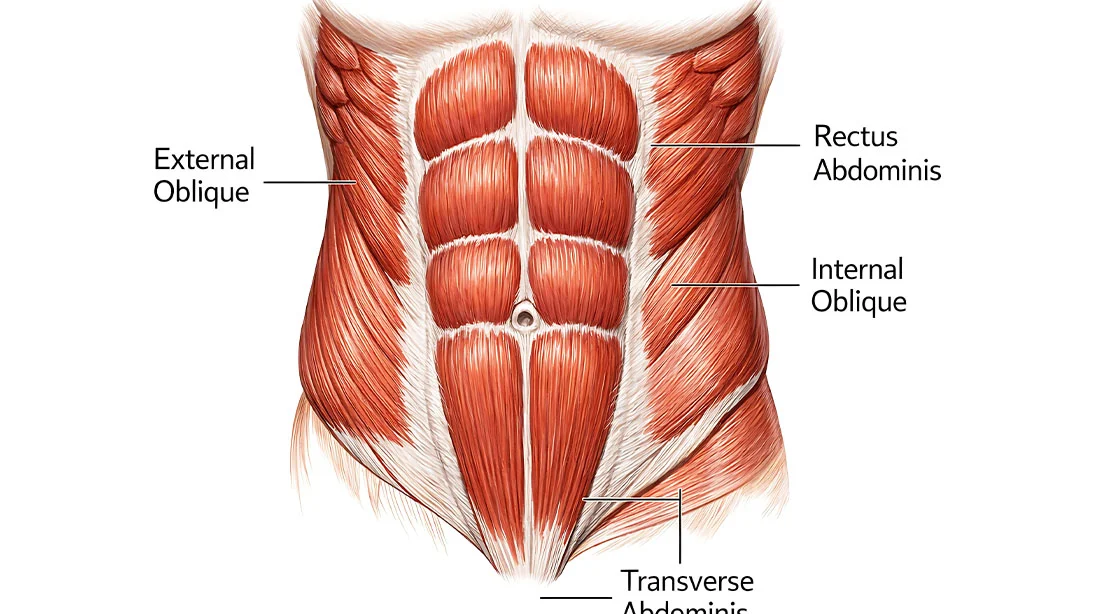
To build an elite set of abs, you must understand the muscle you are targeting. The rectus abdominis is the primary muscle of the anterior trunk. It is a long, flat, sheath-like muscle that extends vertically from the sternum to the pubic bone. Its sole function is to flex the spinal column.
The Myth of Upper and Lower Abs
A common fallacy in fitness is the idea that you can "isolate" the upper or lower abs. Anatomically, this is impossible. The rectus abdominis is a single, continuous muscle divided vertically by the linea alba and horizontally by tendinous inscriptions. These inscriptions are the connective tissues that create the "blocks" of a six-pack. While you can emphasize different regions of the muscle through varying ranges of motion, you cannot target one section while leaving the other dormant. It is a unified structure; when it fires, the entire muscle contracts.
Tendinous Inscriptions
These inscriptions are not individual muscles, nor can they be grown like biceps. They are fixed points of attachment. As you build mass in the rectus abdominis, the muscle belly expands between these points, creating the depth and definition that gives the appearance of a hard-earned six-pack.
The Chronology of Proper Execution: A Step-by-Step Guide
If you are serious about transforming your midsection, you must treat the rope crunch with the same technical rigor as a heavy barbell squat or a deadlift.
Phase 1: The Setup
- Attachment: Secure a rope attachment to the high pulley of a cable station.
- Positioning: Kneel on the floor, facing the cable stack. Your knees should be roughly hip-width apart.
- The Grip: Grab the ends of the rope and pull them down so that your hands are positioned on either side of your face or neck. Keep your hands locked in this position throughout the entire movement. Do not pull with your arms; your arms are merely hooks for the weight.
Phase 2: The Initiation
- Bracing: Take a deep breath and brace your core as if you are about to take a punch to the stomach.
- The Crunch: Initiate the movement by exhaling and curling your ribcage toward your pelvis. Focus on shortening the distance between your sternum and your pubic bone.
- The Pivot: Imagine you are trying to touch your elbows to your knees. Your hips must remain perfectly stationary. If your butt moves backward, you have defaulted to a hip-hinge, and you have lost the tension on your abs.
Phase 3: The Peak Contraction
- Squeeze: At the bottom of the movement, hold the contraction for a full second. This is where the "searing pain" occurs. Do not skip this.
- Control: Return to the starting position slowly. Do not let the weight stack slam. The eccentric portion (the lengthening phase) is just as critical for hypertrophy as the concentric contraction.
Supporting Data: Why "Pain" is a Metric of Progress
In the world of hypertrophy, we often hear that "pain is weakness leaving the body," but in the context of abdominal training, pain is a diagnostic tool. The rectus abdominis is uniquely dense with nerve endings. When you push this muscle to true failure, the sensation is distinct from the fatigue felt in the chest or quads. It is an intense, localized burning sensation.
For an athlete, this pain indicates that you have breached the threshold of muscular endurance and are entering the zone of metabolic stress—a key driver of muscle growth. If your abs don’t feel like they are tearing at the end of your set, you likely haven’t reached true failure.
Implications for Your Training Program
Integrating the rope crunch correctly has massive implications for your overall physique and functional strength.
1. Metabolic Demand
Because the rectus abdominis is a large, energy-demanding muscle, intense sets of rope crunches can significantly increase the thermic effect of your workout. By performing four sets to absolute failure, you are not just working on aesthetics; you are increasing the metabolic cost of your training session.
2. Spinal Health
While the crunch involves spinal flexion, when performed under controlled conditions, it strengthens the musculature that supports the lumbar spine. A strong anterior core acts as a stabilizer for heavy compound movements like overhead presses and squats, protecting the lower back from injury.
3. The "Mind-Muscle" Connection
The rope crunch is a masterclass in the mind-muscle connection. Because the movement is so subtle, it forces you to think about the muscle fibers contracting. This heightened awareness carries over into every other exercise in your repertoire, allowing for better form and higher-quality training across the board.
Conclusion: Reaching the Limit
The rope crunch is not meant to be an easy exercise. It is a grueling, repetitive grind that demands focus and intensity. If you are looking for a quick fix, you will be disappointed. However, if you are willing to embrace the discomfort, lock your hips, and push your rectus abdominis to its absolute limit, the results will be undeniable.
Use enough weight to achieve a target of 20 strict repetitions, followed by a "burnout" set of 5 to 10 more to satisfy the demands of true hypertrophy. Manage the pain, maintain your form, and keep your hips locked. Your six-pack isn’t waiting for a new, "revolutionary" exercise—it’s waiting for you to master the one you’ve been ignoring.
Crush them. Find your limit. Killer abs await.