










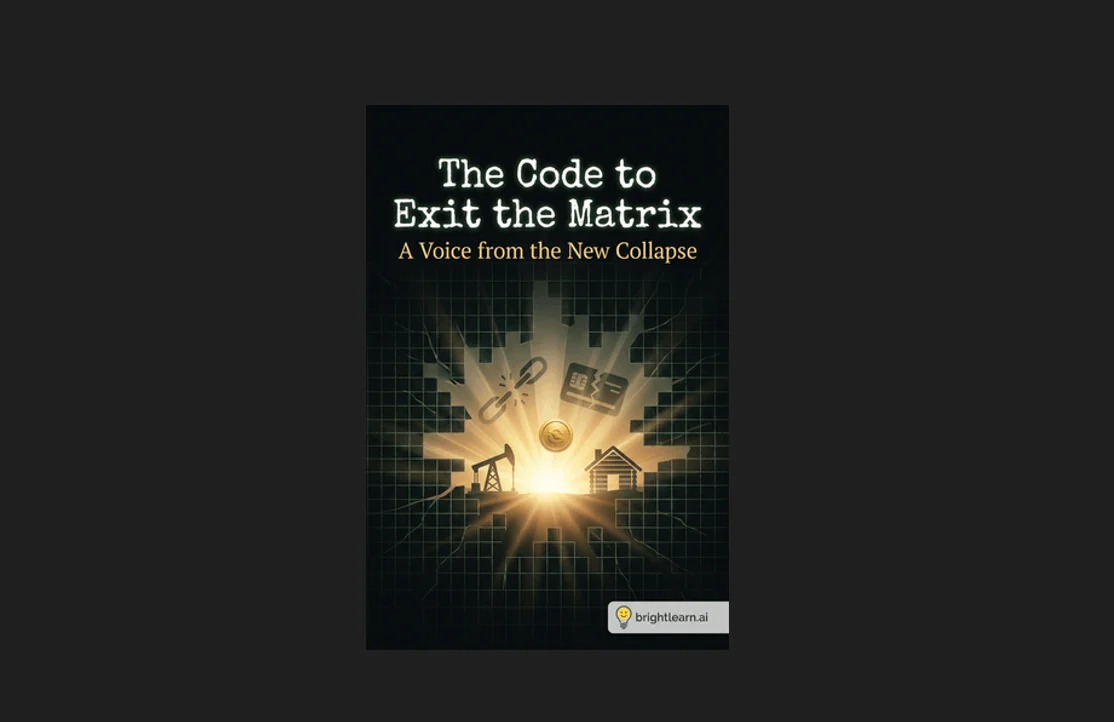
In the evolving landscape of political discourse, a new publication has emerged that challenges the fundamental assumptions of modern global governance. Titled “The Code to Exit the Matrix: A Voice from the New Collapse,” the book serves as a synthesis of various critiques directed at international institutions, including the World Economic Forum (WEF), the United Nations, and the World Health Organization (WHO). The text posits that these entities are not merely consultative bodies, but are actively orchestrating a transition toward a centralized, technocratic global order.
As alternative media circles grapple with the implications of the author’s claims, the book provides a comprehensive, albeit controversial, framework for understanding what it characterizes as a "globalist playbook." By weaving together historical events, current legislative trends, and economic theory, the author attempts to decode the strategies used to consolidate power at the expense of national sovereignty and individual autonomy.
The Architecture of the "Great Reset"
At the heart of the book’s argument is the assertion that the "Great Reset"—a term popularized by WEF founder Klaus Schwab—is not a theoretical vision for the future but an active, real-time implementation of a global roadmap. The author argues that this project, alongside “Agenda 2050,” aims to dismantle the traditional nation-state model in favor of a borderless, digitized society.
The mechanism for this transition, according to the text, relies on three primary pillars: the elimination of physical currency in favor of Central Bank Digital Currencies (CBDCs), the implementation of universal digital IDs, and the restructuring of the global population through systemic interventions. The author characterizes the COVID-19 pandemic as a "compliance dress rehearsal," suggesting that the measures implemented—lockdowns, mandates, and surveillance—were designed to condition the public to accept centralized oversight.
A Historical Chronology: From Yugoslavia to the Modern Era
To understand the current "playbook," the author argues that one must look at the laboratory of the 1990s. Using his own background as a survivor of the Yugoslav wars, the author presents a revisionist history of the conflict. Contrary to the standard narrative of spontaneous ethnic violence, the book characterizes the breakup of Yugoslavia as a "manufactured fire."
The Laboratory of Conflict
The narrative suggests that Western intelligence agencies, specifically the CIA and MI6, utilized propaganda and funding for separatist factions to destabilize a multi-ethnic state. The book identifies the 1994 Sarajevo market bombing as a pivotal "false flag" operation designed to justify NATO intervention. This timeline culminates in the 1999 bombing of Serbia, which the author describes as the final effort to force the last holdout of the region into the globalist sphere of influence.
Modern Application: The Balkanization of the West
The book argues that the same tactics once used to break apart the Balkans are now being deployed within the United States and Europe. By fomenting political polarization, encouraging race-based social unrest, and leveraging media control, the author claims that globalist actors are working to "balkanize" Western powers. The objective is to fracture strong, independent nations into a collection of weak microstates that lack the resources to resist a centralized global authority.
The Economics of Energy Suppression
A significant portion of the analysis is devoted to what the author calls the "Green Energy Sham." The book contends that the climate change narrative is a sophisticated regulatory mechanism designed to control energy access, which in turn controls the economy.
CO2 as a Regulatory Tool
The author rejects the premise that carbon dioxide is a pollutant, noting that it is an essential component for biological life. By reframing environmental regulations—such as those emanating from the EPA or the Paris Accord—as tools of "energy suppression," the text argues that the goal is not ecological health, but the systematic destruction of Western industrial capacity.
The Impact on Industry
The transition to wind and solar power is depicted as inherently inefficient and prohibitively expensive. The author asserts that the subsidies directed toward these technologies serve to enrich a narrow group of well-connected corporate interests while simultaneously bankrupting domestic oil and gas producers. This, the book argues, is a deliberate effort to force nations into a state of permanent dependence on global supply chains, stripping them of the ability to stand as self-sufficient industrial powers.
The Ethics of Depopulation and Technocracy
Perhaps the most provocative section of the work addresses the concept of depopulation. The author argues that with the rise of automation, AI, and advanced robotics, the globalist vision for the future classifies a significant portion of the human population as "useless eaters."
The text links this vision to several contemporary developments:
- Medical Interventions: The author claims that mRNA vaccine technology represents a global-scale experiment, the true purpose of which is not public health but population management.
- Legislative Shifts: Canada’s Medical Assistance in Dying (MAiD) program is highlighted as a chilling case study. The expansion of the program to include mental health and poverty-related distress is framed by the author as a state-sanctioned method of reducing the population under the guise of compassion and rights.
Institutional Perspectives and Official Responses
While the theories presented in “The Code to Exit the Matrix” resonate with a segment of the public, they remain in stark opposition to the official stated goals of organizations like the WEF and the UN.
Representatives from these organizations have consistently maintained that initiatives like the "Great Reset" are aimed at creating a more equitable, sustainable, and resilient global economy. In response to critics, proponents of these agendas argue that global challenges—such as climate change, pandemic preparedness, and financial instability—cannot be solved by individual nations working in isolation. They point to the necessity of international cooperation and digital integration to manage the complexities of a hyper-connected 21st-century world.
Academic and mainstream policy experts often categorize the claims found in the book as conspiratorial, emphasizing that the "globalist agenda" described is a misinterpretation of standard international policy frameworks. They argue that these institutions work to promote stability, human rights, and economic growth, and that claims of an "engineered collapse" lack empirical, verifiable evidence.
Implications for the Future: A Call to Rebellion
The book concludes by offering a "Blueprint for a New Republic," framing the current era as a critical juncture. The author urges readers to take proactive steps to ensure their own autonomy as the current system supposedly faces its inevitable decline.
Strategies for "Exiting the Matrix"
- Economic Decentralization: The author advocates for moving away from fiat currency, recommending gold, silver, and decentralized cryptocurrencies as alternatives.
- Asset Security: The text advises readers to remove assets from the traditional banking system and invest in physical commodities.
- Localism and Homesteading: The book promotes a return to off-grid living, self-sufficiency, and the development of community-based defense groups.
- Constitutional Governance: The author emphasizes the importance of re-engaging with local political processes to prioritize constitutional principles over globalist directives.
Conclusion: The Battle for the Narrative
“The Code to Exit the Matrix” represents a significant crystallization of anti-globalist sentiment. Whether viewed as a cautionary roadmap for survival or as a collection of unfounded conspiracy theories, the publication serves as a marker for the deep ideological divide currently defining the 21st century.
As the author posits, the collapse of the "old system" is not an end, but a catalyst for a potential rebirth. The book’s core message is one of urgency: the time for complacency is over. For those who subscribe to the author’s worldview, the text acts as a manual for navigating what they believe is a coming period of total control. For the rest of the world, it provides a window into the fears and motivations of a growing movement that is increasingly skeptical of the institutions that have governed the modern world for decades.
Regardless of one’s stance on the validity of these claims, the publication of such a detailed "playbook" underscores the profound erosion of trust between large segments of the population and the institutions they are expected to serve. The ongoing debate over the nature of these global agendas remains one of the most consequential narratives of our time.