The era of human-centric labor is not ending with a bang, but with the quiet, relentless hum of local workstations. While the general public remains preoccupied with the novelty of chatbots, a seismic shift in cognitive labor is already well underway. Last week, without a studio, an animation team, or a budget beyond the cost of a few kilowatt-hours of electricity, a fully rendered, 27-shot music video was produced on a single home workstation. The shots possessed spatial consistency, the characters maintained integrity, and the project was completed before the traditional Hollywood establishment even acknowledged the possibility of such a feat.
The public reaction to this milestone was a masterclass in psychological denial. Observers labeled it "impressive" while simultaneously insisting that it did not signify an impending wave of job displacement. This refusal to confront the reality of machine cognition is, paradoxically, the most significant risk factor for the workforce. The individuals most likely to be displaced are those who fail to recognize the quantum leap in goal-oriented machine intelligence currently unfolding.
The Chronology of Cognitive Obsolescence
To understand the speed of this transition, one must look at the timeline of the last 18 months. Only a year ago, the consensus among industry experts was that local, high-fidelity AI video generation was years away. Today, it is a tool available to any individual with a mid-range graphics card. This compression of time—from science fiction to experimental cloud demo, to a local utility—is the hallmark of the current AI revolution.
Phase 1: The Invisible Automation (2023–2024)
The initial wave of displacement was characterized by the silent erosion of "invisible" desk roles. Accountants, paralegals, and customer service representatives began to see their workloads diminished by Large Language Models (LLMs). Because this displacement occurred via software, it left no visual footprint. There were no picket lines or dark factories; there was simply a cessation of task assignments.
Phase 2: The Feedback Loop (2024–2025)
We have now entered the phase of recursive development. AI is no longer just a tool; it is an architect. Models are now being utilized to write code for future iterations of themselves, accelerating reinforcement learning at an exponential rate. Startups like Ricursive Intelligence are already demonstrating the ability to compress chip design cycles from years to months by letting machines handle the foundational engineering. When the machine begins to design the machine, the curve of progress ceases to be linear.
Phase 3: The Robotics Breakthrough (2026 and Beyond)
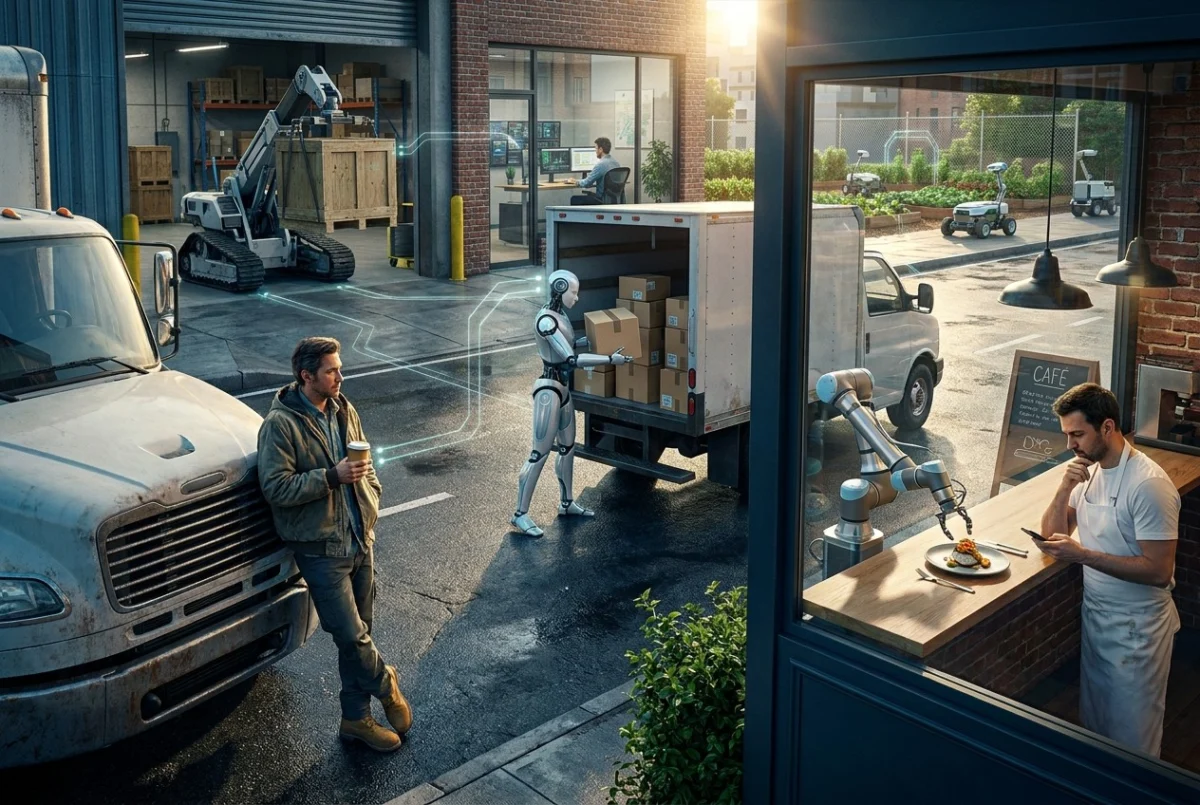
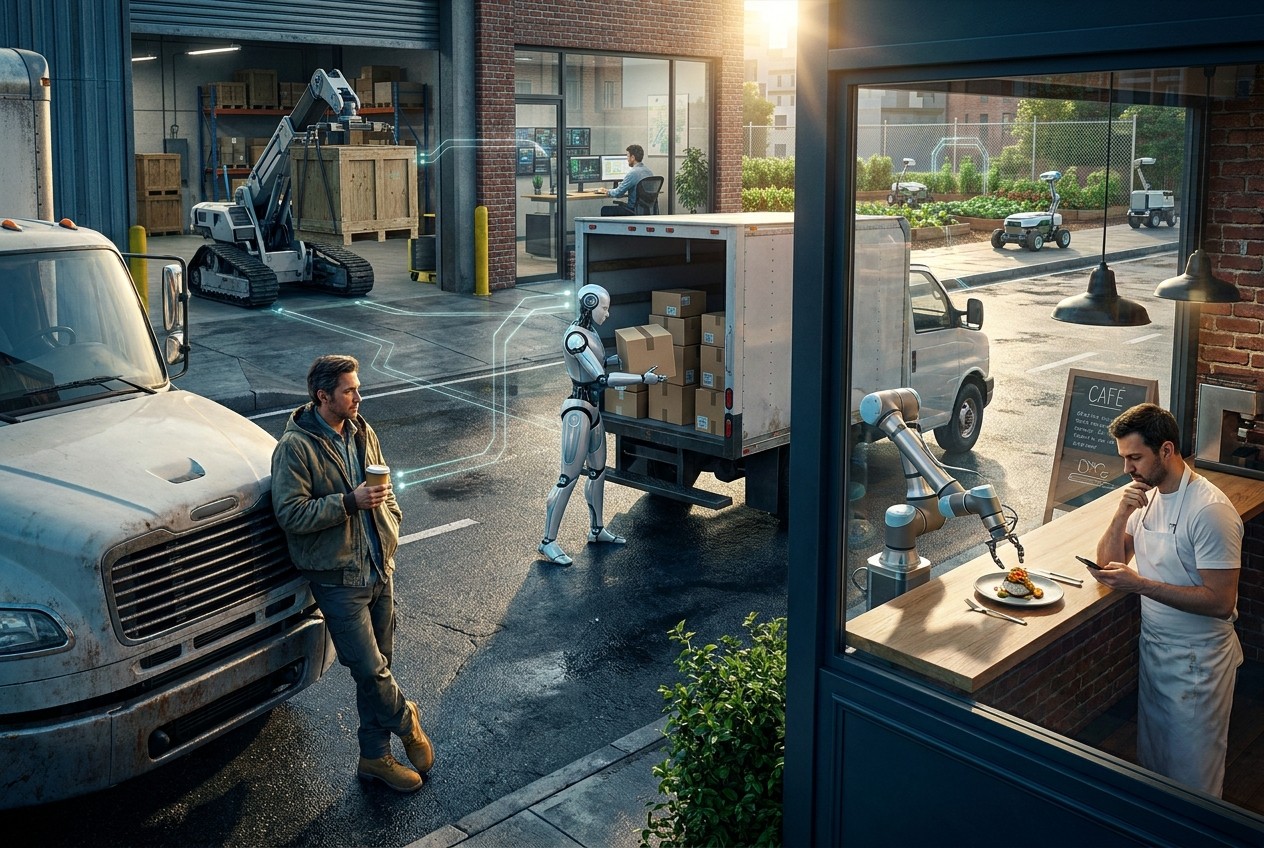
The final stage of the transition involves the transition of AI from the digital screen to the physical world. The integration of advanced, tactile-sensitive humanoid robotics—such as Amazon’s "Vulcan" and the dexterous G1 robot from Unitree—signals the end of human exclusivity in physical labor. By 2027, the presence of humanoid robots in domestic and industrial environments will become commonplace, rendering the denial of job displacement impossible.
Supporting Data: The Erosion of the Labor Moat
The belief that professional credentials—degrees, licenses, and years of specialized training—provide a "moat" against AI is the most dangerous cognitive error of the modern era. In many diagnostic and analytical fields, human involvement has actually been shown to decrease accuracy compared to pure machine outputs.
Recent data paints a stark picture of the corporate transition to "AI-first" models:
- Corporate Retrenchment: Amazon recently eliminated thousands of positions across operations and media, citing a strategic pivot toward AI-integrated workflows.
- Financial Sector Contractions: Major investment and retail firms have begun significant layoffs, with industry analysts noting that middle management and data-entry roles are being absorbed by AI agents that operate 24/7 without the need for human oversight.
- The Globalist Pivot: Economic forums have begun to openly discuss the "optimization" of the workforce in light of declining birth rates. The prevailing logic among the elite is that AI and robotics serve as a necessary replacement for human labor to maintain economic productivity in aging developed nations.
The scale of this shift is unprecedented. Current projections suggest that between 50% and 80% of white-collar and physical labor roles are candidates for automation within the next few years. This is not a distant, speculative forecast; it is a rapid compression of the global labor market.
The Anatomy of Denial
Why do professionals continue to dismiss the efficacy of AI? The Dunning-Kruger effect plays a critical role here. Those who lack the fundamental skills to evaluate the technical capabilities of modern machine cognition are the most likely to overestimate their own irreplaceability.
Furthermore, the "credentialed class" has a vested interest in the illusion of human necessity. Having spent decades accumulating professional status, the prospect that their work can be replicated by a machine is not merely a professional threat—it is an existential one. Consequently, many professionals double down on the belief that human traits like "creativity" or "empathy" remain uniquely shielded, ignoring the fact that these traits are increasingly being encoded into generative algorithms.
Official Responses and the Regulatory Paradox
The response from the architects of this technology has been conflicted. Figures like Bill Gates have publicly warned of "species-level emergencies" while simultaneously maintaining massive capital investments in AI development. This duality serves a strategic purpose: by calling for federal legislation and strict oversight, these figures essentially pull up the ladder behind them.
The advocacy for a Universal Basic Income (UBI) linked to Central Bank Digital Currencies (CBDC) is the logical conclusion of this agenda. If the ruling class successfully replaces the workforce with proprietary, centralized AI, the only way for the average citizen to participate in the economy will be through a system of state-monitored distribution. This transition threatens to turn the replacement economy into a control economy, where survival is contingent upon participation in a surveillance-heavy infrastructure.
Implications: The Path Toward Resilience
The direction of technology is not fixed; it is a product of ownership and intent. If the current trajectory remains unchecked, we face a future of total dependency. However, there is an alternative.
The Decentralization of Intelligence
The solution is not to surrender, but to build decentralized, open-source infrastructure. By running local AI models, individuals can maintain control over their own cognitive and productive tools. The same compute power used to automate roles can be repurposed for "liberty tech"—tools that assist in local food production, home diagnostics, and independent education.
Reframing Human Value
We must move away from the industrial-era mindset that equates human value solely with "labor." In a world where machines can perform routine cognitive and physical tasks, the focus must shift toward skills that require genuine human agency, moral judgment, and off-grid resilience.
The Call to Action
The time for debate has passed. The "lifeboat" must be built while the ship is still afloat. This involves:
- Technical Literacy: Learning to utilize and control local, uncensored AI models rather than relying on black-box, corporate-controlled services.
- Infrastructure Sovereignty: Utilizing and supporting independent, free-speech platforms that provide a refuge from the mainstream information filter.
- Skill Diversification: Moving toward tasks and trades that require complex, real-world physical dexterity and high-level decision-making—areas that remain the last frontiers of machine limitation.
The transition from a world run on human muscle and mind to one run on algorithms is no longer an abstract concept. It is the defining feature of our time. Denial will not save the worker, the professional, or the entrepreneur. Only those who adapt by mastering these tools—and securing their independence from the centralized surveillance state—will survive the coming compression of the labor market. The replacements are here; the question is whether you will be the master of your own tools or the subject of someone else’s.