











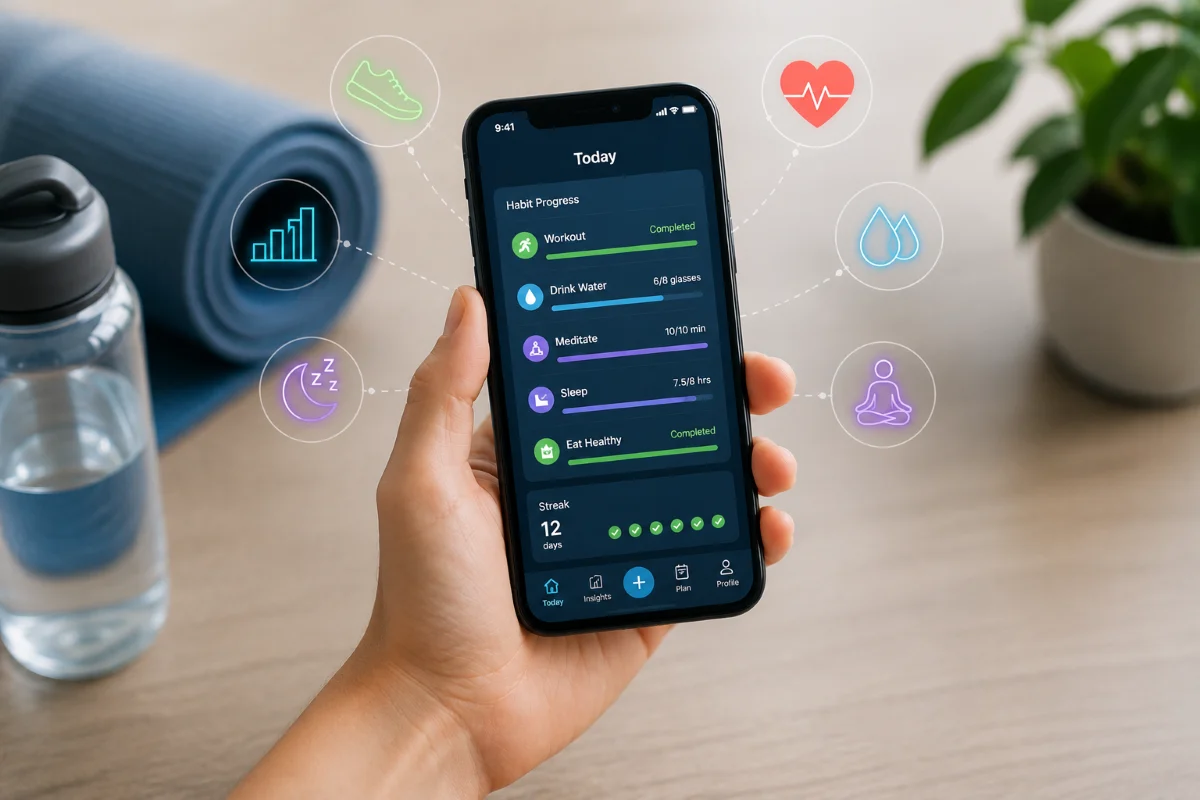
The landscape of personal wellness is undergoing a fundamental transformation. For decades, the digital health market was dominated by “outcome-focused” tools—apps designed to track the cold, hard metrics of body composition: the number on the scale, the daily step count, or the duration of a grueling gym session. However, a new generation of mobile applications is shifting the paradigm away from these static results toward the dynamic processes that create them.
Today’s health apps are evolving into sophisticated habit-formation engines. Rather than merely recording what has happened, these tools are being engineered to influence what will happen next, focusing on the micro-behaviors—hydration, sleep hygiene, mindfulness, and movement snacks—that ultimately dictate long-term health outcomes. For fitness professionals, this shift represents both a powerful opportunity and a complex challenge: how to integrate high-tech data into a human-centric coaching model.
The Shift: From Metrics to Mindset
The primary catalyst for this evolution is a growing consensus within behavioral psychology: information alone rarely changes human behavior. A person may know that a kale salad is healthier than a burger, but knowing does not equate to doing.
Modern habit-tracking apps are designed to bridge this "intention-behavior gap" by utilizing cues, reminders, and feedback loops. According to a 2024 review published in the Journal of Medical Internet Research, the most effective digital interventions rely on a suite of techniques: self-monitoring, strategic goal setting, and rewards. These are not merely bells and whistles; they are the digital equivalent of a behavioral therapist working in the background to automate consistency.
By focusing on the "small stuff"—the daily habits that form the bedrock of health—these apps aim to make consistency the path of least resistance. When a user tracks a daily glass of water or a ten-minute meditation, they are participating in a system that rewards the process, not just the performance.
Chronology of Digital Health Evolution
To understand how we arrived at this era of “behavior-first” tracking, one must look at the progression of the digital fitness sector over the last fifteen years:
- 2010–2015: The Quantification Era. This period was defined by the “Quantified Self” movement. Apps were primarily data repositories. Users manually entered calorie intake and manually logged workouts. The focus was on accumulation—how many miles, how many calories, how many steps.
- 2016–2020: The Wearable Integration. The rise of sensors allowed for passive tracking. Heart rate monitors and sleep trackers removed the friction of manual entry. Data became more granular, but often more overwhelming, leading to "data fatigue" among users who felt enslaved to their metrics.
- 2021–Present: The Habit-Formation Phase. Developers began to realize that raw data without actionable context led to high churn rates. The current wave of apps now integrates behavioral science, utilizing gamification, streak mechanics, and AI-driven nudges to encourage adherence rather than just recording output.
Supporting Data and Research
The efficacy of these tools is supported by a growing body of research. A 2023 meta-analysis in Health Psychology Review found that digital interventions incorporating self-monitoring and goal setting were significantly more likely to foster sustained physical activity than standard informational apps.
However, the data also highlights the necessity of the "human element." A 2024 study in Nature Medicine emphasized that while digital technologies are excellent for personalized intervention, they often fail when they operate in a vacuum. The most successful outcomes occur when digital tools act as a supplement to professional guidance.
The World Health Organization’s Global Strategy on Digital Health (2020–2025) notes that as we move toward more personalized, AI-driven interventions, the challenge shifts from data collection to data interpretation. The primary risk identified by researchers is the potential for digital tools to encourage "perfectionism" or "data-driven anxiety," where the user becomes more concerned with keeping a streak alive than with the actual health benefit of the behavior.
Implications for Fitness Professionals
For the fitness professional, the client’s smartphone is now an omnipresent assistant—or an omnipresent source of confusion. Clients often arrive at their first session with a dashboard full of data: sleep scores, HRV (Heart Rate Variability) readings, and "readiness" scores from their wearables.
The Coach as an Interpreter
The role of the coach has shifted from being the sole provider of data to being the interpreter of data. A client might be worried because their app told them their "recovery score" was low, leading them to cancel a workout. A skilled coach can look at that data, factor in the client’s current work stress and travel schedule, and help the client realize that a low score is a suggestion for a modified workout rather than a directive to do nothing.
The Gamification Trap
While gamification features like badges and streaks are excellent for building initial momentum, they carry inherent risks. Reporting from the nutrition-tracking sector has indicated that rigid calorie goals and "streak-shaming" can trigger disordered eating patterns in vulnerable users. Coaches are now tasked with “gamification management,” helping clients understand that missing a day of tracking is not a moral failure, but a normal part of the human experience.
Future Directions: The AI-Driven Frontier
The next phase of health apps is moving toward "context-aware" intelligence. Researchers are currently developing mobile health tools that do not just track what you did, but suggest what you should do based on your real-time environment.
Imagine an app that notes a high-stress day at work via calendar data and a lack of sleep via a wearable, and then suggests a 15-minute restorative yoga session rather than a high-intensity interval training (HIIT) workout. This level of personalization is the "Holy Grail" of digital health. However, as the npj Digital Medicine article (2023) points out, this requires significant advancements in privacy-conscious data collection. The more an app knows about you, the more it can help, but the higher the stakes for data security.
Best Practices for Integrating Apps into Coaching
To maximize the value of these tools, fitness professionals should adopt a structured approach:
- Prioritize Utility Over Complexity: Discourage clients from using apps that track 50 different metrics. Recommend apps that focus on one or two key behaviors that align with the client’s primary goal.
- Contextualize the Data: Teach clients that data is a tool, not a judge. When a client expresses concern about a "missed" metric, ask: "What does this number help us notice about your current routine?"
- Encourage Agency: The ultimate goal of a coach is to make themselves obsolete. Similarly, the goal of a habit app should be to eventually internalize the habit so that the user no longer needs the app to perform the behavior.
- Monitor for Stress: Be vigilant for signs of "tracking fatigue." If an app is causing a client to feel guilty or anxious, it has ceased to be a health tool and has become a source of physiological stress.
Conclusion: Technology as a Catalyst, Not a Replacement
As digital health apps continue to integrate into the daily lives of our clients, the fitness industry finds itself at a crossroads. We can either view these tools as competitors or embrace them as powerful supplements to our practice.
The most effective habit-tracking tools are those that facilitate a conversation between the coach and the client. They provide the "what" and the "when," but the human coach provides the "why" and the "how." By framing these tools as aids for awareness—rather than metrics for judgment—fitness professionals can leverage technology to build more resilient, consistent, and sustainable health routines for their clients.
In the final analysis, a streak on an app is only as meaningful as the life it serves. If a digital tool helps a client identify a barrier and overcome it, it is a success. If it forces a client to prioritize a digital badge over their own internal cues of fatigue and recovery, it is a liability. The future of fitness lies in the marriage of high-tech data and high-touch human wisdom, ensuring that the habits we build today are not just measurable, but truly sustainable.