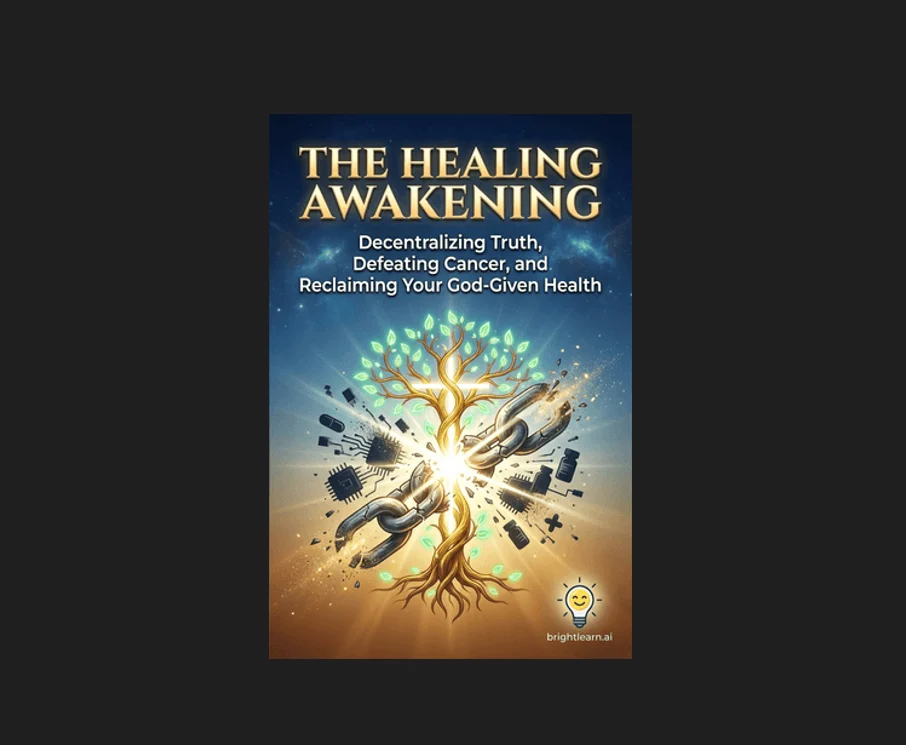
In an era defined by rapid technological shifts, the centralization of information, and an increasingly institutionalized approach to human biology, a transformative new work has emerged. The Healing Awakening: Decentralizing Truth, Defeating Cancer, and Reclaiming Your God-Given Health is more than a book; it is a comprehensive survival guide for those navigating what the author describes as an increasingly hostile landscape of corporate-controlled medicine. By challenging the orthodoxies of Big Pharma, Big Tech, and the globalist machine, the text offers a blueprint for individual sovereignty and spiritual resilience.
Main Facts: A Challenge to the Status Quo
At its core, The Healing Awakening operates on the premise that the institutions we rely on for health have been compromised. The book argues that the medical-industrial complex prioritizes profitability over patient outcomes, systematically suppressing natural, non-patentable therapies in favor of pharmaceutical interventions.
The narrative is structured around the concept of "decentralization"—the idea that individuals must reclaim their health data, their treatment protocols, and their access to information from the grip of central authorities. The book posits that when we outsource our health decisions to a centralized, profit-driven system, we lose our "God-given power" to heal. By focusing on fundamental human requirements—clean water, nutrition, environmental harmony, and spiritual alignment—the text argues that the human body possesses an innate, often ignored, capacity to regenerate.
Chronology: The Erosion of Trust and the Rise of Censorship
The author maps the history of the modern information landscape, noting a critical turning point in January 2025. This was the moment Mark Zuckerberg admitted that Meta’s fact-checking systems were "too politically biased" and had significantly damaged public trust. For many proponents of health freedom, this admission was the "emperor has no clothes" moment of the digital age.
However, the book warns against naive optimism. It posits that the shift in platform policy was not an act of genuine repentance, but a strategic maneuver to appease a new political administration. Despite the rhetoric of "community standards," the underlying algorithmic architecture—designed to suppress alternative viewpoints on health—remains fully operational. This "platform capture blindness" is identified as a primary danger: the public breathes a sigh of relief when prominent voices are unbanned, while remaining oblivious to the fact that the same corporations still hold the metaphorical "kill switch" on free expression.
Supporting Data: The Cancer Conundrum and Iatrogenic Harm
Perhaps the most contentious and heavily documented section of the book involves the modern oncology industry. The text cites data suggesting that for solid tumors, chemotherapy offers a marginal five-year survival improvement of only 2.1 percent. This leads to a scathing critique of the billion-dollar cancer industry, which the author argues is built on a foundation of fear and toxic protocols.
Key findings highlighted in the book include:
- Suppression of Natural Protocols: The book details the history of treatments such as the Gerson Therapy, the Budwig Protocol, and high-dose intravenous vitamin C, arguing these are suppressed not due to lack of efficacy, but due to their inability to be patented.
- The Mammography Debate: The text presents evidence suggesting that the ionizing radiation from annual mammograms can, in some instances, trigger the development of new breast cancers. It contends that the rate of overdiagnosis—where women are subjected to toxic treatments for tumors that might never have become lethal—is a form of "iatrogenic harm" masquerading as preventative medicine.
- The MyHa Protocol: In contrast to these systemic issues, the book introduces the 90-day "Make Yourself Healthy Again" (MyHa) Protocol, a systematic approach to detoxification, gut restoration, and parasite cleansing intended to serve as an accessible, home-based recovery roadmap.
The AI Divide: The Weaponization of Intelligence
A chilling component of the analysis involves the role of Artificial Intelligence. The book argues that AI is not a neutral tool but a "censorship engine" designed to guide users toward pharmaceutical solutions while blocking inquiries into natural health alternatives.
The author draws a striking comparison between various AI models. While Western models like Claude or Gemini often refuse to engage with questions regarding vaccine injuries or non-traditional remedies, China’s DeepSeek AI demonstrates a surprising willingness to provide data on these topics. This inversion—where an authoritarian-developed system provides more information than the AI developed in the "free world"—is presented as a major alarm signal regarding the state of information integrity in the West.
To combat this, the book proposes the Enoch Project: a vision for a free, open-source, offline AI. This digital "Noah’s Ark" would be trained on a vast library of natural health literature, capable of running on low-cost hardware without an internet connection, effectively insulating vital health knowledge from the reach of globalist censorship.
Official Responses and Institutional Perspective
While the book does not quote official spokespeople from the pharmaceutical or tech industries, it anticipates their response: a dismissal of these arguments as "conspiracy-laden" or "scientifically questionable." The author acknowledges that the book’s strident tone and ambitious scope will draw fire from mainstream medical institutions.
However, the text frames this pushback as a badge of honor. It argues that the medical-industrial complex’s reliance on "consensus science" is a tool for silencing inquiry. By inviting the reader to examine the financial ties between government regulatory agencies and the pharmaceutical sector, the book attempts to shift the burden of proof back onto the institutions that have historically benefited from the status quo.
Implications: Building a Decentralized Future
The final sections of the work move from diagnosis to action. The author emphasizes that the "Healing Awakening" is not an abstract theory but a practical call to duty.
The Spiritual Dimension
The integration of faith is treated as a foundational element of the healing journey. The book posits that oxytocin, the hormone of bonding and love, plays a critical role in reducing systemic inflammation. By fostering a relationship with the Creator, the reader is encouraged to move past the "shame" induced by past medical choices and into a state of empowerment.
Strategic Community Building
The book encourages readers to form "high-vibration" local communities. These groups are designed to act as decentralized hubs for skill-sharing—such as fermenting foods, identifying medicinal herbs, and providing mutual support. This strategy is presented as a necessary safeguard against the disruptions likely to occur as the current centralized systems face increasing instability.
The New Year’s Manifesto
The book concludes with a concrete list of objectives for 2025 and beyond:
- Digital Autonomy: Transitioning away from centralized Big Tech platforms for health-related research.
- Resource Independence: Establishing personal stockpiles of clean water and natural remedies.
- Intellectual Sovereignty: Cultivating the habit of "doing your own research" using offline, uncensored archives.
- Community Resilience: Forming local circles that can share knowledge and resources outside of the digital surveillance grid.
Final Assessment: A Call to Arms
The Healing Awakening is an unapologetic, aggressive, and highly provocative work. It is designed to disrupt the reader’s comfort zone and challenge the foundational assumptions of modern healthcare. While critics may point to its occasionally intense rhetoric, the book provides a robust framework for those who feel the current system has failed them.
The underlying message is clear: the era of blind trust in centralized institutions is over. The path forward, according to the author, is through the decentralization of knowledge, the restoration of the body through natural protocols, and the strengthening of local, faith-based communities. Whether one agrees with every scientific assertion or not, the book serves as a potent reminder that the power to heal often begins with the courage to question the very systems that claim to own the truth.
As the author concludes, the movement is growing, one garden and one community at a time. The "Healing Awakening" is not a future event—it is a present reality, and for those ready to answer the call, the path to reclaiming one’s God-given health is wide open.
For those interested in exploring these concepts further, "The Healing Awakening: Decentralizing Truth, Defeating Cancer, and Reclaiming Your God-Given Health" is available via this link. Thousands of additional resources can be accessed at Books.BrightLearn.AI, and users can explore the creation of their own materials at BrightLearn.AI.