









"I want to know I’m doing absolutely everything I can to preserve my health for as long as possible."
It is a sentiment echoed in modern gym locker rooms, viral podcast segments, and the curated feeds of social media influencers. As the science of longevity shifts from the fringes of academia to the center of popular culture, more people are obsessed with the idea of outliving their peers, hacking their biology, and extending their healthspan well into their 90s and beyond.

However, a glaring problem has emerged: the common "longevity protocol" has become synonymous with an extraordinary amount of effort, time, and financial burden. The question we must ask is whether this hyper-optimization is actually necessary, or if it is merely a high-cost distraction from the fundamentals that truly move the needle.
The Myths and Realities of "Optimizing" Health
The modern health landscape is dominated by high-profile "figureheads"—biohackers and experts who advocate for ice baths, continuous glucose monitoring, and expensive supplement stacks. While the desire for control over one’s biological destiny is understandable, the team at Precision Nutrition (PN), having coached hundreds of thousands of real-world clients, argues that "optimal" is rarely realistic, and more importantly, it isn’t necessary.

Myth: The "Basics" Are No Longer Enough
There is a pervasive belief that standard health practices—exercise, whole foods, sleep, and stress management—are insufficient for those seeking longevity. The reality is that the basics work exceptionally well. The reason most people fail to live as long or as well as they could is not a lack of access to "cutting-edge" biohacks; it is a failure to perform the simple, foundational habits with consistency.
Myth: More Effort Always Equals Better Results
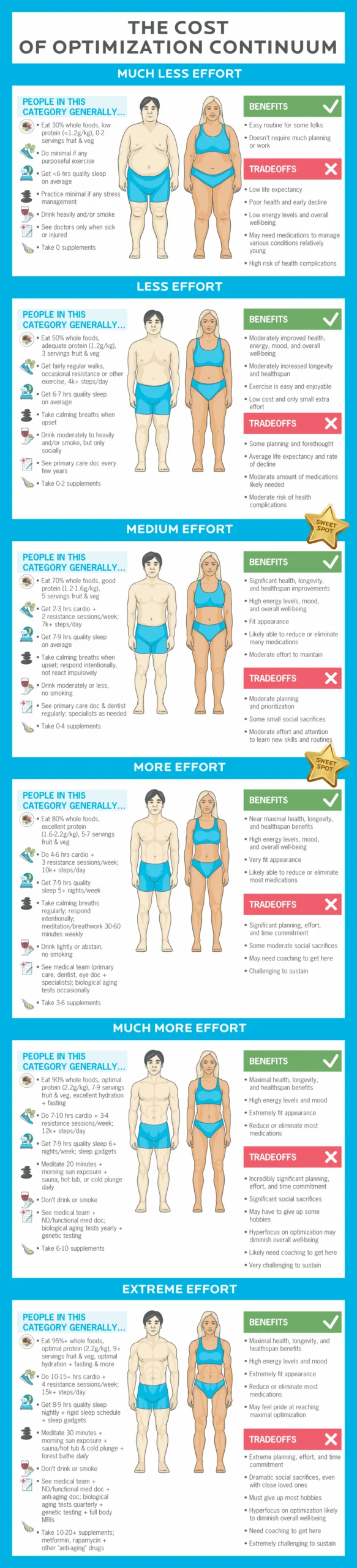
The pursuit of perfection often hits a wall of diminishing returns. Our data indicates that after a certain threshold of health effort, the benefits plateau. Adding layers of complexity to your life does not just risk burnout; it can actually introduce new stressors that counteract your health goals. If you are hitting 80 to 90 percent consistency on the basics, you are already approaching peak optimization.

Myth: Cutting-Edge Strategies Are Proven
Many "fringe" longevity methods currently popularized online are based on observational data, animal models, or small-scale, short-term human trials. Many of these unproven methods carry potential safety risks. Before investing in the latest fad, the evidence-based approach is to maximize the behaviors with proven track records.
Chronology: The Evolution of Longevity Culture
The shift toward extreme optimization didn’t happen overnight.

- Pre-2010s: Health discourse focused largely on basic disease prevention—don’t smoke, move more, and eat your vegetables.
- 2010s–2020: The rise of wearable technology (trackers, Oura rings, CGMs) allowed individuals to quantify their biology, shifting the focus from "feeling good" to "data optimization."
- 2020–Present: The "Longevity Industrial Complex" has exploded. High-profile figures like Bryan Johnson and various longevity-focused podcasters have turned health into a competitive sport, where the goal is to "beat" the aging process through aggressive intervention.
Supporting Data: The Case for the Fundamentals
The evidence for the "basics" is overwhelming. When we look at the data, the path to a long life is not found in a pill bottle, but in the mundane, daily choices we make.
1. The Power of Movement
A landmark study of Harvard alumni demonstrated that any amount of physical activity reduces all-cause mortality risk, regardless of genetics or starting body weight. Furthermore, data shows a "sweet spot" for exercise. While sedentary behavior is a major risk factor for chronic disease, extreme volumes of endurance training—the "Extreme Exercise Hypothesis"—may actually lead to heart health issues like myocardial fibrosis. The most benefit is found in achieving 150 to 300 minutes of moderate-intensity activity per week.

2. Nutritional Simplicity
The most robust nutritional data points to a simple fact: ultra-processed foods are the primary driver of poor health outcomes. A study of nearly 10 million participants linked the consumption of ultra-processed foods to 32 harmful health effects. Conversely, eating five servings of fruits and vegetables daily correlates to a 13 percent reduction in all-cause mortality. Beyond five servings, the benefits plateau.
3. Sleep: The Great Restorer
Sleep is the foundation of cognitive and physical longevity. A one-hour decrease in sleep duration is associated with an 11 percent increase in cardiovascular risk. For older adults, sleep is the primary mechanism for clearing beta-amyloid plaques from the brain, making it a critical defense against dementia.

4. Social Connection
Perhaps the most surprising finding in longevity research comes from the Harvard Study of Adult Development, which has been tracking participants for over 87 years. The study found that strong social relationships are the single biggest predictor of longevity, outweighing wealth, social class, and even IQ. Social isolation is as dangerous to your health as smoking 15 cigarettes a day.
Official Perspectives and Implications
Health organizations like the World Health Organization (WHO) and the CDC have long emphasized that while we cannot control every environmental factor (the social determinants of health, such as poverty or structural inequality), we do have agency over our behavioral patterns.

The Financial and Time Cost
If you compare a "medium-effort" healthy person to an "optimizer," the discrepancy is staggering. An optimizer spends three to four times the time and money on their health—investing in private blood panels, specialized supplements, cold plunges, and boutique fitness classes. For most people, this extra investment provides marginal returns compared to the "80 percent" gain provided by basic, consistent habits.
Implications for Mental Health
There is a dark side to optimization culture: orthorexia and exercise obsession. When health becomes an obsession, it often crowds out the "Deep Health" domains—social, existential, and emotional well-being. A life spent in a state of hyper-vigilance about one’s diet and vitals is, for many, a life that is less "lived."

Conclusion: Crafting Your Own Path
If you want to age well, you don’t need a complex protocol. You need a strategy that is sustainable.
- Clarify Your Goals: Do you want to live forever, or do you want to live well?
- Understand the Tradeoffs: If you choose to pursue an extreme optimization path, be aware of the costs—not just financial, but in terms of your time and peace of mind.
- Start with the Basics: Before adding supplements or fringe therapies, ask: Am I sleeping 7-9 hours? Am I eating whole foods? Am I moving daily? Do I have a supportive social circle?
- Tune Out the Noise: The "optimizers" on social media are not experts on your life. They are often selling a specific lifestyle or product.
True longevity is not found in the pursuit of perfection. It is found in the quiet, persistent, and boring practice of showing up for your body and your relationships, day after day. You are the architect of your own health; make sure you build a house that you actually enjoy living in.